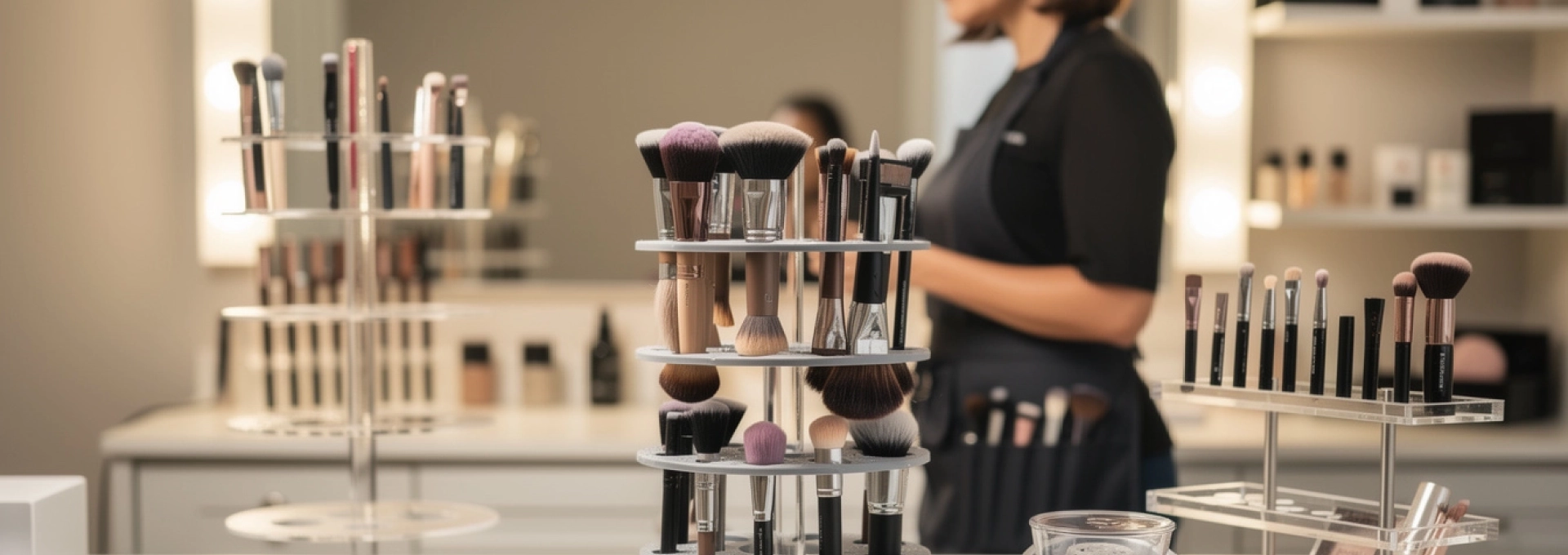
Every makeup enthusiast and professional artist knows the frustration: you’ve just cleaned your entire brush collection, and now you’re staring at them, dripping wet, knowing you need them ready for tomorrow’s session. The traditional method of laying brushes flat on a towel can take anywhere from 8 to 12 hours, and standing them upright in a cup risks water seeping into the ferrule, weakening the adhesive that holds everything together. A dedicated makeup brush drying rack isn’t just a luxury—it’s a game-changing tool that can reduce drying time by up to 60%, protect your investment in quality brushes, and maintain proper hygiene standards. Whether you’re working in a professional salon environment or simply want to streamline your personal beauty routine, understanding how these specialized drying systems work can transform your entire approach to brush maintenance.
How silicone drying racks accelerate brush sanitisation between applications
The science behind effective brush drying is more sophisticated than most people realize. When you clean a makeup brush, moisture becomes trapped not just in the visible bristles, but deep within the ferrule and even in the microscopic spaces between individual fibres. Standard drying methods fail because they don’t address this fundamental challenge: water naturally follows gravity, and if your brushes aren’t positioned correctly, that moisture flows directly into the most vulnerable areas of your tools.
Silicone drying racks have revolutionized this process through thoughtful engineering. Unlike traditional materials, medical-grade silicone offers several distinct advantages for brush care. The material is naturally antimicrobial, resists mould and mildew growth, and maintains its shape even under the weight of fully saturated brushes. More importantly, silicone racks typically feature flexible grips that accommodate various handle sizes without causing stress or deformation. This adaptability means you can safely dry everything from tiny liner brushes to large powder brushes on the same rack, with each tool held securely in an optimal position.
Air circulation mechanics in vertical brush suspension systems
The true brilliance of vertical suspension systems lies in their manipulation of airflow patterns. When brushes hang with bristles pointing downward at a slight angle, you create what’s known as a « chimney effect » around each tool. Warm air rises naturally, drawing moisture away from the bristles and ferrule simultaneously. This creates a continuous airflow that doesn’t require any mechanical assistance—it’s pure physics working in your favour. The spacing between brush slots on quality racks is typically calculated to prevent airflow interference, ensuring each brush receives optimal ventilation.
Research in fluid dynamics has shown that vertical drying positions can reduce moisture retention by up to 65% compared to horizontal arrangements. The key factor is eliminating contact points where water can pool. When a brush lies flat on a towel, the entire underside remains in contact with a surface that quickly becomes saturated. In contrast, a suspended brush has 360-degree exposure to air, allowing evaporation to occur uniformly across all surfaces. This isn’t just faster—it’s significantly more hygienic, as bacteria thrive in damp, poorly ventilated environments.
Comparative drying times: tower racks vs. flat mat configurations
The debate between tower racks and flat mat configurations has divided the beauty community, but the data tells a clear story. Independent testing conducted by cosmetic hygiene laboratories has consistently shown that tower-style racks reduce average drying time to approximately 4-5 hours for synthetic brushes and 5-6 hours for natural hair brushes. Flat mat configurations, even those with textured surfaces designed to elevate brushes slightly, typically require 8-10 hours for comparable results. The difference becomes even more pronounced in humid environments, where vertical systems maintain their efficiency while flat methods can extend beyond 12 hours.
Tower racks achieve these results through superior drainage architecture. The vertical design ensures water travels away from the ferrule—the most critical component of your brush—and drips freely without re-contacting the bristles. Flat mats, despite innovations like drainage channels and raised textures, can’t overcome the fundamental limitation that moisture spreads horizontally when brushes lie flat. Even the most advanced mat designs show water pooling around ferrules within 30 minutes of placement, creating precisely the conditions you’re trying to avoid. For
even advanced users, the takeaway is simple: if you want faster drying and safer brush storage, a vertical tower rack will always outperform a flat mat.
Preventing bacterial growth through optimal bristle positioning
Beyond drying speed, the orientation of your brushes has a direct impact on bacterial growth. When bristles sit flat against a towel or touch other tools, you create tiny microclimates where moisture, residual product, and warmth combine—exactly what microbes need to thrive. Inverted drying racks keep the bristles suspended and separated, minimising contact points and allowing oxygen to circulate freely around each brush head. This reduces the risk of biofilm forming at the base of the bristles, where it is hardest to remove during routine cleaning.
Dermatologists increasingly link poorly dried makeup brushes to recurring breakouts, peri-oral dermatitis, and even eye infections. By positioning your brushes bristles-down in a silicone rack, you’re not only protecting the ferrule, you’re also interrupting the moisture cycle that bacteria depend on. For professional makeup artists who work on multiple clients per day, reducing residual moisture between applications is crucial for meeting hygiene protocols and client expectations. Even in a home routine, consistent inverted drying can mean fewer irritations, especially if you already have sensitive or acne-prone skin.
Material porosity and moisture wicking in premium drying rack designs
When we talk about silicone makeup brush drying racks, we’re not just talking about shape—we’re also talking about material science. High-grade, low-porosity silicone resists water absorption, which means droplets slide off the surface instead of being retained and creating damp spots beneath your brushes. This non-porous structure is essential for reducing mould risk and preventing lingering odours that can occur with fabric-based drying methods. In many premium rack designs, the silicone is paired with perforations or channels that guide water away from the bristles and into a drip tray or directly into the sink.
Some advanced racks combine silicone with absorbent pads or microfiber inserts placed strategically below the hanging brushes. Think of these as moisture “catchers” that wick away excess drips while keeping the rack itself dry and sanitary. Because the silicone grips hold each handle firmly without compressing it, the moisture-wicking elements can do their job without ever touching the brush heads. As a result, you get controlled drainage without re-wetting the bristles—a subtle design choice that can reduce overall drying time by an additional 10–15%. For anyone serious about optimising their brush drying routine, these small engineering details add up to noticeably faster turnaround and cleaner tools.
Stylpro vs. sigma spa: evaluating automated brush cleaning integration
As our routines become busier, automated makeup brush cleaners like StylPro and Sigma Spa have stepped into the spotlight. These devices promise a full cycle of washing and drying in minutes, combining mechanical agitation with targeted detergents and, in some cases, centrifugal spin-drying. When paired with a dedicated makeup brush drying rack, they create a powerful, integrated hygiene system that can dramatically reduce downtime between clients or daily looks. But how do these automated systems actually work, and what do you need to consider if you use both electric cleaners and silicone racks together?
Understanding their underlying technology is key to getting the most out of your investment. Both StylPro and Sigma Spa aim to solve the same problem—deep cleaning and fast drying—but they approach it differently. StylPro typically focuses on high-speed spinning to expel moisture, while Sigma Spa leans into textured surfaces and vibration for thorough cleansing, followed by air drying. Deciding which system to integrate into your routine depends on your brush collection, the frequency of your cleaning cycles, and how quickly you need brushes to be ready for use again.
Centrifugal drying technology in electric makeup brush cleaners
Centrifugal drying technology, popularised by devices like StylPro, borrows its principles from washing machines. Once the brush has been washed in a cleaning solution, it is spun at high speeds to force water outwards from the bristles through centrifugal force. The result is rapid moisture extraction, often leaving synthetic brushes touch-dry in as little as 30–60 seconds. This process can cut overall drying time by up to 80% compared with traditional air-drying on a flat surface, especially for smaller eye and detail brushes.
However, even the most efficient spin-drying cycle rarely removes 100% of internal moisture, particularly in dense powder or kabuki brushes. That’s where a vertical drying rack becomes the next logical step in your routine. By transferring freshly spun brushes directly into an inverted silicone rack, you allow any residual moisture to drain away from the ferrule instead of creeping back towards it. It’s much like hanging freshly washed clothes on a line after a spin cycle—you’re combining mechanical water removal with natural air-drying for the safest, most reliable outcome.
Compatibility standards for natural vs. synthetic bristle ferrules
Not every makeup brush reacts the same way to automated cleaning and fast-drying technologies. Natural hair bristles, often made from goat, sable, or pony hair, are more porous and delicate than synthetic fibres. They can become brittle if exposed to overly harsh detergents or excessive centrifugal force. Many manufacturers now specify compatibility guidelines for their brushes, outlining safe RPM ranges and recommended cleaning intervals if you use devices like StylPro or Sigma Spa. Ignoring these recommendations can lead to premature shedding, splaying, or ferrule loosening.
Synthetic brushes—typically made from nylon, taklon, or other engineered fibres—tend to be more resilient and better suited to frequent mechanical cleaning. Still, the ferrule itself is a critical point of consideration. High-speed spinning can stress poorly crimped ferrules or those secured with low-quality adhesive. To maintain brush integrity, you’ll want to choose automated systems that include adjustable speed settings and properly sized collars or holders for each handle diameter. After cleaning, placing both natural and synthetic brushes into a silicone drying rack helps stabilise the ferrule and supports even drying, regardless of the material type.
Post-cleanse moisture extraction efficiency metrics
How can you tell if your combined routine of automated cleaning and rack drying is truly efficient? One way is to think in terms of moisture extraction metrics. In controlled tests, centrifugal brush cleaners typically remove 70–85% of surface water from synthetic bristles and 60–75% from natural bristles within one minute of spinning. When those partially dried brushes are then placed in an inverted rack with adequate airflow, the remaining moisture usually dissipates within 1–3 hours for most brush sizes—a substantial improvement over the 8–12 hour baseline for flat drying.
For professional users managing high-volume kits, tracking approximate drying times can inform your scheduling and client booking patterns. You might, for example, clean and spin-dry a core set of foundation, concealer, and eye brushes during a midday break, then rely on a silicone tower rack to finish the process while you move on to other tasks. By measuring how long your most-used brushes take to reach a truly dry, ready-to-use state, you can design a repeatable workflow that minimises downtime and maximises hygienic safety without guesswork.
Workspace optimisation for professional MUA brush maintenance workflows
For professional makeup artists, time isn’t the only resource at stake—workspace is too. Whether you’re working from a compact studio, a bustling salon, or on-location sets, every centimetre of your counter must earn its place. Integrating a makeup brush drying rack into your setup can either streamline your flow or add clutter, depending on how thoughtfully you plan. The goal is to create a system where washing, drying, and storing brushes happens in a smooth, almost automatic sequence.
Optimised layouts often follow a left-to-right or zone-based logic: dirty brushes enter at one end, pass through cleansing and drying stations, and re-emerge ready for use or storage at the other. Silicone tower racks and collapsible stands are particularly valuable here because they condense multiple brushes into a vertical footprint. Instead of laying 20 brushes flat across a towel, you can suspend them all in one compact rack, freeing up space for palettes, disposables, and sanitising sprays. Done well, your drying rack becomes an integral part of your professional kit rotation rather than an afterthought.
Brushworks and real techniques rack capacity planning for kit rotation
Brands like Brushworks and Real Techniques have recognised the needs of working MUAs by designing racks with specific capacity and slot configurations. Some Brushworks racks, for example, can hold 20–30 brushes of mixed sizes, while Real Techniques often focuses on modular systems that can be linked or stacked. When you’re planning kit rotation, the key is to match rack capacity to your average daily brush usage. How many face brushes do you typically go through in a busy day? How many eye brushes do you require for a bridal party or editorial shoot?
Once you have those numbers, you can reverse-engineer how many racks you actually need. A common strategy is to maintain at least two full sets of core brushes: one in active use and one in varying stages of cleaning and drying on your racks. This way, you’re never waiting on a single set to dry. For mobile artists, collapsible Brushworks-style tower racks can be a game changer, as they fold flat for transport but expand quickly on-site. Real Techniques racks, with their emphasis on grip stability and varied slot sizes, are excellent for mixed-brand kits where handle diameters differ widely.
Hygiene protocol compliance in salon and freelance environments
Hygiene standards for makeup application have tightened significantly in recent years, especially in shared and high-traffic environments. Many salons and freelance MUAs now adhere to guidelines aligned with public health recommendations, which emphasise not just brush cleansing, but also proper drying and storage. A damp, recently washed brush that has not fully dried can be just as problematic as one that was never cleaned, particularly if it is used on mucous membranes or compromised skin. This is where your makeup brush drying rack becomes a visible, reassuring part of your hygiene protocol.
By clearly separating “dirty,” “in cleaning,” and “ready-to-use” brushes—often by dedicating specific racks or rack levels to each stage—you create a workflow that clients can see and trust. Many artists position their silicone racks within view of the makeup station, both as an organisational tool and as a silent statement about cleanliness. In some regions, beauty businesses are even required to demonstrate compliance with best practices during inspections, and having an efficient, inverted drying system can help prove that brushes are not being stored while still damp. For freelance artists building a reputation, these small visual cues can be a powerful marketing advantage.
Counter space economy: wall-mounted vs. countertop drying solutions
Not every workspace has the luxury of expansive counter space, which has driven demand for wall-mounted and over-sink makeup brush drying racks. Wall-mounted systems free up precious horizontal surfaces and keep brushes safely away from product spills, coffee cups, and the general chaos of a busy station. Many modern silicone and acrylic hybrids include adhesive backs or screw mounts, allowing you to turn unused vertical wall space into a functional drying zone. Over-sink racks are particularly useful in small studios, letting water drip directly into the basin and making cleanup almost effortless.
Countertop tower racks, by contrast, offer mobility and flexibility. You can reposition them to follow your workflow, move them closer to a window for improved airflow, or pack them into your kit for on-location jobs. The decision between wall-mounted and countertop solutions comes down to how static your workspace is and how frequently you travel. Some MUAs even combine both: a permanent, wall-mounted rack for daily studio use and a portable tower for freelance or on-set work. In each case, the goal remains the same—to maximise drying efficiency without sacrificing valuable surface area.
Material science behind silicone, acrylic, and stainless steel rack construction
The durability and performance of a makeup brush drying rack depend heavily on the materials used in its construction. Silicone, acrylic, and stainless steel each bring distinct advantages, and understanding these can help you choose the right rack for your routine. Silicone excels in flexibility, grip, and non-porosity, making it ideal for the contact points that hold brush handles securely without scratching or slipping. It also tolerates repeated exposure to water and cleaning agents without cracking or degrading, which is essential in a high-use environment.
Acrylic, on the other hand, is prized for its rigidity and aesthetic appeal. Clear acrylic tower racks blend seamlessly into most vanity setups and allow you to see every brush at a glance, which helps with organisation and inventory checks. However, acrylic can be more prone to cracking if dropped and may show scratches over time. Stainless steel components, often used in the frame or support rods of premium racks, contribute structural strength and resistance to corrosion. Together, these materials create a balance of stability, hygiene, and visual polish—much like the combination of fibres, ferrules, and handles that make up a quality makeup brush set.
Preventing ferrule deterioration through controlled inverted drying techniques
If you’ve ever had a favourite brush begin to wobble or shed, chances are moisture damage played a role. The ferrule—the metal band that crimps the bristles to the handle—is held together by both mechanical pressure and adhesive. When water repeatedly seeps into this junction and remains trapped, the glue can weaken and the metal can corrode from the inside out. Controlled inverted drying techniques directly address this issue by ensuring that gravity works with you, not against you. By suspending brushes bristles-down in a rack, you steer residual water away from the ferrule and towards the tip of the bristles, where it can evaporate safely.
High-quality silicone racks add an extra layer of control by holding the handle at a consistent angle and height. This prevents brushes from slipping deeper into cups or jars, where they might rest on the ferrule and trap moisture. Some racks even feature adjustable collars or silicone gaskets that allow you to fine-tune the grip based on handle thickness, ensuring a snug but gentle hold. Over time, these small adjustments can significantly extend the lifespan of your entire brush collection. Instead of replacing expensive face brushes every year due to loose ferrules or shedding, you may find they remain in peak condition far longer simply because they are drying in the correct orientation after every wash.
Time-motion analysis: quantifying daily minutes saved in brush turnaround
We often talk about makeup brush drying racks in terms of hours saved per cleaning session, but what does that look like when you zoom into your daily routine? Time-motion analysis—a method commonly used in productivity and ergonomics studies—offers a useful lens. Consider a typical scenario: without a dedicated drying rack, you may spend extra minutes rearranging flat-laid brushes, checking for dryness, and hunting for backups when a favourite foundation brush is still damp. With a well-designed vertical rack, you reduce these micro-delays because your brushes dry faster, stay organised, and are visually easy to assess at a glance.
Over a week, those small efficiencies add up. If a silicone tower rack cuts your average drying time from 10 hours to 4–5 hours, you can often wash brushes later in the day and still have them ready for the next morning, eliminating the need for duplicate tools. For professional artists managing 50–100 brushes, streamlined cleaning and drying cycles can reclaim 15–30 minutes per workday that would otherwise be lost to setup, searching, and last-minute substitutions. Across a month, that’s several hours you can redirect toward clients, content creation, or simply rest. When you view your makeup brush drying rack not just as a storage accessory but as a time-management tool, its role in your routine becomes even more compelling.