# Layering fragrances: how to create a unique olfactory identity
The quest for a distinctive scent signature has become increasingly important in a world where personal branding extends beyond visual presentation. Fragrance layering—the artful practice of combining multiple perfumes, oils, and scented products—offers you an opportunity to transcend the limitations of single-bottle perfumery and craft an olfactory identity as unique as your fingerprint. This sophisticated technique, rooted in ancient Middle Eastern traditions and now embraced by contemporary perfume houses worldwide, transforms you from passive consumer to active creator in the realm of scent. The complexity achievable through strategic layering rivals that of bespoke commissioned fragrances, yet remains accessible to anyone willing to understand the fundamental principles of perfume architecture and composition.
Understanding olfactory families and fragrance classification systems
Before embarking on your layering journey, grasping the fundamental taxonomy of fragrance becomes essential. The perfume industry relies on classification systems that organize thousands of scents into comprehensible categories, enabling you to predict how different compositions might interact when combined on your skin. These frameworks, developed over decades by industry experts, provide the conceptual foundation for successful experimentation.
The fragrance wheel: michael edwards’ taxonomic framework
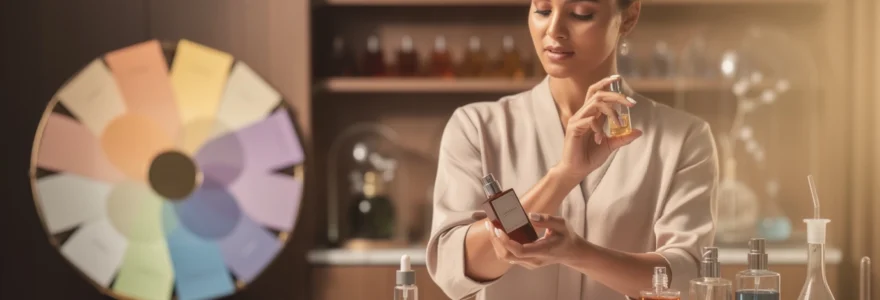
Michael Edwards’ Fragrance Wheel represents the most widely adopted classification system in modern perfumery, organizing scents into four primary families: Floral, Oriental (now often termed Amber), Woody, and Fresh. Each quadrant subdivides further into nuanced categories—for instance, Fresh encompasses Citrus, Water, and Green subcategories, while Floral branches into Soft Floral, Floral, and Floral Oriental. This wheel’s genius lies in its circular structure, which visually demonstrates that adjacent families share common characteristics and typically layer harmoniously, while opposite families create dramatic contrasts. When you select fragrances positioned near each other on the wheel, you’re likely to achieve seamless blends; conversely, pairing opposites demands more careful calibration but can yield strikingly original results. The wheel evolves continuously as perfumers introduce novel accords—gourmand notes emerged as a distinct category only in recent decades—reflecting the dynamic nature of contemporary perfumery.
Distinguishing top, heart, and base notes in perfume architecture
Every fragrance unfolds in three distinct phases, often described as a pyramid structure. Top notes constitute the initial impression, typically comprising volatile molecules that evaporate within 5-15 minutes—citrus oils, light herbs, and aldehydes dominate this category. Heart notes emerge as top notes fade, forming the perfume’s character for 20 minutes to several hours; florals, fruits, and spices frequently occupy this middle register. Base notes provide the foundation, consisting of heavy molecules that can persist for 4-24 hours or longer—woods, resins, musks, and amber define this category. Understanding this temporal architecture proves crucial for layering because you’re essentially creating a more complex pyramid by stacking multiple fragrance structures. When you apply a woody base perfume followed by a citrus-dominant scent, the citrus top notes provide immediate sparkle while the woody base ensures longevity, creating a composition that evolves more dramatically throughout the day than either fragrance would individually.
Natural extracts versus synthetic aroma molecules in modern perfumery
Contemporary fragrances blend natural botanical extracts with synthetic aroma chemicals, each contributing distinct properties to layering outcomes. Natural ingredients—essential oils, absolutes, and CO2 extracts—offer unparalleled complexity and depth; a single rose absolute contains hundreds of aromatic compounds that create subtle variations no synthetic can fully replicate. However, natural materials vary between harvests, may contain allergens, and sometimes lack sufficient tenacity. Synthetic molecules, developed through organic chemistry, provide consistency, potency, and access to scents impossible to extract naturally—clean musks, aquatic notes, and many fruity accords exist only as synthetics. For layering purposes, fragrances rich in natural materials often blend more organically due to their inherent complexity, while synthetic-heavy compositions can project more powerfully but may occasionally clash when combined carelessly. Modern niche perfumery frequently emphasizes
modern aroma molecules as “scaffolding”—clean musks, ambroxan, and Iso E Super, for example, can act like translucent fabrics that add texture without crowding the composition. When you layer fragrances that blend naturals and synthetics, pay attention to how these transparent, long-lasting molecules behave: they often linger after brighter notes fade, subtly tying different perfumes together. If you find that two rich, natural-heavy scents feel too dense when combined, introducing a minimalist, synthetic-forward fragrance as a bridging layer can create breathing room and enhance balance.
Concentration levels: parfum, eau de parfum, and eau de toilette distinctions
Fragrance concentration plays a pivotal role in how layering fragrances will perform on your skin. Parfum (or extrait) typically contains 20–40% aromatic compounds, offering dense, long-lasting sillage that can project for 8–24 hours. Eau de Parfum (EdP), usually 15–20% concentration, balances richness with wearability and is often the most versatile format for building a layering wardrobe. Eau de Toilette (EdT) tends to sit around 8–12% concentration, emphasizing top and heart notes with a lighter, more fleeting presence that can be ideal for adding lift or freshness to deeper scents.
When creating a unique olfactory identity through layering, it’s often wiser to anchor your composition with the higher-concentration format and then adjust mood and brightness with lighter strengths. For example, you might apply a small amount of parfum with strong woody or amber facets as a base, then mist an airy citrus EdT over the top to create a more accessible daytime version of an otherwise evening-leaning scent. Be mindful that higher concentrations are not simply “stronger” versions of the same perfume; they can shift the balance of notes, with parfums often emphasizing base accords and EdTs highlighting the opening. Testing different concentrations together on your skin will quickly reveal which combinations feel seamless and which compete for attention.
Strategic layering techniques for multi-dimensional scent profiles
Once you understand how fragrance families, note structures, and concentrations interact, you can begin to approach layering fragrances with more deliberate strategy. Rather than randomly combining favorite perfumes, think in terms of constructing a multi-dimensional scent profile—one that has vertical depth (top, heart, and base) and horizontal nuance (contrasting or complementary accords). In practice, this means choosing one central idea—woody warmth, smoky sweetness, airy florals—and then using other scents to echo, amplify, or counterbalance that theme. The goal is a composition that feels intentional and coherent, not a chaotic collage of disconnected notes.
Complementary pairing: matching woody and amber accords
Woody and amber (oriental) accords are natural allies when layering fragrances, as they share a common role as structural bases in perfume architecture. Woods like sandalwood, cedar, vetiver, and guaiac provide dryness, creaminess, or smokiness, while amber accords—typically built around labdanum, benzoin, vanilla, and resins—offer warmth and a subtle sweetness. When you pair a dry woody fragrance with a soft amber, you essentially sculpt the silhouette of your scent: the wood defines the backbone, while the amber rounds the edges and adds a glowing halo. This kind of complementary pairing is especially effective if you want to transform a sharp or austere woody perfume into something more sensual without losing its character.
To experiment, try treating your favorite woody scent as the “frame” and an amber-centric perfume as the “light source” that softens and illuminates it. Apply the woody fragrance closer to the body (chest, inner elbows), then mist the amber over more exposed pulse points like the neck and wrists so that it diffuses around the wood. You might also reverse the roles if you own a gourmand-leaning amber that feels too sweet on its own—adding a smoky vetiver or dry cedar on top can cut through the sugar and create a more refined, resinous impression. Ask yourself: do you want your olfactory identity to lean more comforting or more architectural? Adjust the ratio of woody to amber accordingly.
Contrasting method: combining floral and leather compositions
Where complementary pairings focus on harmony, contrasting methods embrace tension to create memorable, characterful blends. One of the most compelling contrasts in modern perfumery arises from combining floral and leather compositions. Florals—rose, jasmine, iris, orange blossom—suggest softness, brightness, and often a traditionally “feminine” aura, while leather accords (built from birch tar, isobutyl quinoline, saffron, or smoky woods) evoke toughness, refinement, and a more “masculine” edge. When layered with intention, these opposites can yield an olfactory identity that feels both polished and subversive, like silk worn under a biker jacket.
For a wearable starting point, choose a relatively transparent floral—perhaps a sheer rose or airy white blossom—and pair it with a smooth leather rather than a heavily smoky, tar-like one. Apply the leather fragrance first in small amounts to provide structural depth, then veil it with the floral so that petals sit on top of suede. This creates a nuanced duality: at first sniff, people might perceive the bouquet, but as the perfume warms on your skin, subtle hints of leather emerge, adding intrigue. If you want to lean further into contrast, experiment with a bright, dewy floral over a dark, animalic leather—but do so sparingly, as the clash can quickly become abrasive. Think of this as color-blocking in fashion; two strong hues can look striking together, but only if the proportions are carefully judged.
Chronological application: sequencing from heaviest to lightest formulations
Temporal strategy—when you apply each fragrance—matters as much as what you apply. Chronological layering follows a simple principle: start with your heaviest, most tenacious scent and progressively move toward lighter, more volatile formulations. Heavier fragrances, rich in woods, resins, and musks, anchor themselves to the skin and serve as the long-term “memory” of your olfactory identity, while lighter citruses, herbs, and some florals dance around them in the opening hours. By respecting the natural evaporation curve of perfume materials, you avoid situations where a delicate top-note-centric scent is immediately bulldozed by a powerful base-heavy composition.
A practical approach is to treat your layering routine like dressing in layers of clothing. First, apply a concentrated oil, extrait, or dense Eau de Parfum to the torso and inner pulse points, giving it 5–10 minutes to settle. Next, add a mid-weight fragrance—perhaps a floral, leather, or spicy composition—to more exposed areas. Finally, finish with the lightest cologne or Eau de Toilette, misted broadly over the upper body or even onto hair and clothing. As the day progresses, the outermost layer fades, revealing the heart and eventually the base you chose as your core. This sequential structure ensures your fragrance narrative unfolds in a controlled way rather than collapsing into an indistinct blur.
Body chemistry considerations: ph levels and skin type impact on sillage
Even the most carefully constructed layering strategy must account for the variable you can’t see: your own body chemistry. Factors such as skin pH, oiliness or dryness, and even diet and medications can subtly alter how perfume materials develop and project. Drier skin tends to “drink” volatile molecules more quickly, reducing perceived longevity and sillage, while oilier skin can extend wear but may amplify certain heavy or sweet notes. Slightly more acidic skin sometimes brightens citrus and green notes but can also skew delicate florals or musks in unexpected directions. This is why a signature layered combination that smells luminous on one person may feel flat or unbalanced on another.
To work with your chemistry rather than against it, start by observing how a few key reference fragrances behave on your bare skin versus over a neutral moisturizer or unscented oil. If you notice that scents vanish quickly, especially top notes, consider applying a light layer of fragrance-free lotion or jojoba oil first to create a more even, hydrated “canvas.” Conversely, if perfumes tend to become overly sweet or heavy on you, you might favor airier, hesperidic (citrus) or aromatic (herbal) layers on outer pulse points, keeping denser compositions closer to the body and using fewer sprays. Remember that sillage—the scented trail you leave behind—is a function not only of concentration and materials, but also of how well those materials interact with your skin. Regularly revisiting your favorite combinations in different seasons and climates will help you refine a layering routine that consistently supports the olfactory identity you want to project.
Building blocks: essential fragrance categories for your layering wardrobe
Just as a well-curated clothing wardrobe relies on versatile staples, an effective layering wardrobe benefits from a few key fragrance categories that can be mixed and matched. Think of these as functional “modules” you can plug into different combinations to express various moods without starting from scratch each time. While your exact selection will reflect your personal taste, most layering strategies benefit from at least one bright citrus or aromatic cologne, one transparent floral, one reliable woody base, one warm amber or gourmand, and one clean or skin-like musk. With these pillars in place, you can build everything from subtle office-appropriate blends to dramatic evening signatures.
For example, a zesty citrus cologne can instantly lift a dense amber or oud-based perfume, making it more wearable in warm weather while preserving its depth. A soft, neutral musk acts like a photographic soft-focus filter, smoothing rough edges when paired with aggressive leathers or spices and adding a “your skin but better” effect. Transparent florals, especially rose, jasmine, and orange blossom in lighter interpretations, are invaluable for adding radiance and femininity (or androgynous softness) to woody and resinous scents. Meanwhile, a dry sandalwood or vetiver can ground overly sweet gourmands and orientals, turning a dessert-like perfume into something more sophisticated. When you evaluate potential additions to your collection, ask: does this fragrance fill a new functional role in my layering wardrobe, or simply duplicate something I already own?
Signature combinations from renowned perfume houses and independent artisans
Many contemporary perfume houses actively design their collections with layering in mind, and fragrance communities frequently share “house recipes” that have achieved cult status. Studying these combinations can be an efficient way to learn how professionals think about balancing accords and constructing multi-layered olfactory identities. At the same time, independent artisans and niche brands often encourage more experimental pairings, inviting you to treat each bottle as a modular building block rather than a finished, untouchable composition. By exploring both worlds, you gain a richer vocabulary for expressing yourself through scent.
Le labo’s santal 33 layered with diptyque tam dao
Le Labo’s Santal 33 has become emblematic of modern niche perfumery—a smoky, spicy, slightly leathery sandalwood accord that feels both familiar and strangely abstract. Diptyque’s Tam Dao, by contrast, presents a more meditative, milky sandalwood intertwined with cedar and cypress, evoking temple wood rather than urban loft. When you layer these two, you essentially create a “sandalwood overdose” that explores different facets of the same material, amplifying its presence while smoothing some of Santal 33’s rougher edges. For those seeking a unique olfactory identity rooted in woods but tired of smelling Santal 33 “everywhere,” this pairing offers a way to reclaim and personalize a ubiquitous cult favorite.
A practical method is to apply Tam Dao first as a calm, woody base across the torso and inner arms, then add Santal 33 more sparingly on pulse points for its distinctive smoky cardamom and leather accents. The result is a layered fragrance that feels richer and more dimensional than either alone, with Tam Dao’s creamy sandalwood rounding out Santal 33’s sharper angles. In cooler weather, you can increase the ratio of Santal 33 for a bolder, more projection-heavy aura; in summer, invert the proportions to let Tam Dao’s tranquil woods dominate while Santal provides just a whisper of spice. This is a textbook example of how layering fragrances within the same family—here, woody—can still yield a new, signature profile.
Tom ford’s tobacco vanille combined with byredo’s gypsy water
Tom Ford’s Tobacco Vanille is an opulent, almost baroque composition: dense tobacco leaf and pipe smoke wrapped in vanilla, dried fruits, and spices. It is rich, enveloping, and unmistakably evening-leaning. Byredo’s Gypsy Water, on the other hand, is airy and luminous, blending bergamot, juniper berries, incense, and a pale woody base that feels like cool forest air. Layering these two might seem counterintuitive at first—one is heavy and gourmand, the other transparent and woody-fresh—but together they exemplify how contrast can bring surprising balance. Gypsy Water acts like ventilation in a dimly lit room, letting air and light into Tobacco Vanille’s dense interior.
To layer them effectively, start with a conservative application of Tobacco Vanille on the chest and lower pulse points, where its warmth can unfold without overwhelming your surroundings. After a brief pause, mist Gypsy Water over upper pulse points and perhaps a touch on clothing, allowing its sparkling top notes and sheer incense to diffuse more widely. The combined effect is a tobacco-vanilla accord that feels more wearable in daytime or transitional seasons, with Gypsy Water’s brightness lifting the composition and adding a sense of movement. This duo also illustrates how layering can stretch the versatility of expensive niche fragrances; instead of reserving Tobacco Vanille solely for winter nights, you can adapt it into a more flexible olfactory identity that suits a broader range of occasions.
Jo malone’s layering philosophy: lime basil and mandarin with wood sage and sea salt
Jo Malone London has built an entire brand philosophy around scent combining, deliberately formulating its colognes to play well together. One of the house’s most celebrated pairings is Lime Basil & Mandarin with Wood Sage & Sea Salt, a duo that captures both the crispness of citrus and the mineral calm of a coastal landscape. Lime Basil & Mandarin offers a zesty, aromatic opening, while Wood Sage & Sea Salt contributes an almost textural salinity and airy, musky woods. When layered, they create a modern, gender-neutral identity that feels effortless, clean, and quietly sophisticated—ideal for those who want a personal signature that never overwhelms yet remains distinctive.
Following Jo Malone’s own guidance, you can customize this combination by deciding which scent should take the lead. If you want a brighter, more invigorating profile, apply Lime Basil & Mandarin more generously and use Wood Sage & Sea Salt as a soft, grounding veil. For a subtler, more skin-like effect, reverse the order: lay down Wood Sage & Sea Salt as the main accord, then add a few targeted sprays of Lime Basil & Mandarin to introduce citrus lift. This approach echoes the brand’s broader layering philosophy: start with a fragrance that matches your core mood or “signature,” then add a second cologne as a modifier—warmer, fresher, more floral or woodier—depending on the season or occasion. Over time, this method allows you to build a compact Jo Malone wardrobe capable of generating dozens of nuanced combinations.
Advanced techniques: incorporating oils, balms, and unscented fixatives
Beyond combining alcohol-based perfumes, advanced layering fragrances techniques involve playing with different product formats—oils, balms, and fixative bases—to fine-tune diffusion, longevity, and intimacy. Fragrance oils, whether concentrated attars or modern rollerballs, tend to sit closer to the skin and develop more slowly, making them ideal as foundational layers. Balms and solid perfumes, often based on waxes and butters, can create localized scent zones with a softer, more personal aura. Unscented fixatives—such as neutral body oils, shea butter, or specialized fragrance primers—serve as invisible anchors that enhance performance without imposing their own aroma.
One effective strategy is to treat fragrance oil as your “ink” and alcohol-based sprays as your “watercolor wash.” For example, you might apply a drop of vanilla or amber oil to pulse points, then mist a woody or citrus perfume over a wider area. The oil slows evaporation, lending depth and staying power to the sprayed fragrance, while also adding a subtle gourmand undertone. Balms can be used in a similar way: smoothing an unscented or lightly scented balm over the wrists and neck before spraying creates a slightly occlusive layer that traps volatile molecules, extending wear. This is especially helpful if your skin is naturally dry or if you live in a climate that tends to strip moisture from the skin.
Unscented fixatives are also a powerful tool for taming challenging perfumes. If you love the drydown of a particular oud, leather, or incense fragrance but find the opening too aggressive, you can buffer it by first applying a thin layer of fragrance-free oil or cream. This not only protects your skin but can soften the sharpest edges, making the scent more approachable. Some enthusiasts even experiment with minimalist musky or ambroxan-based perfumes as quasi-fixatives: their clean, persistent base provides a transparent framework onto which more complex scents can be layered. As always, test small amounts first—especially with potent oils and attars—because concentrated materials can quickly overwhelm a blend if over-applied.
Avoiding olfactory clashing: incompatible accord combinations and reformulation issues
Not every combination is destined to become a signature. Just as certain colors clash when worn together, some fragrance accords create discordant or muddy results when layered. Extremely sweet gourmands paired with sharp aquatics can smell synthetic and jarring, while heavy animalic leathers on top of dense white florals may veer into overwhelming territory. Overly complex perfumes—those already packed with multiple contrasting accords—can be especially risky to combine because each brings its own full “orchestra” of notes. When you layer two such compositions, you may end up with too many instruments playing at once, drowning out any sense of structure.
To avoid olfactory clashing, apply a simple rule of thumb: at least one element in your pairing should be relatively linear or minimalist. This could be a straightforward citrus, a single-note musk, a dry vetiver, or a gentle amber. If both fragrances are intricate and assertive, try applying them to different zones of the body (for example, one on the wrists and another on the neck) so that they mingle in the air rather than directly on the skin. You can also test potential combinations on blotters before committing—spray each scent on a separate strip, wait a few minutes, then hold them together and move them in front of your nose to simulate sillage. If the result feels chaotic or fatiguing even on paper, it’s unlikely to improve on skin.
Another subtle challenge arises from reformulations, which occur when brands adjust formulas due to regulatory changes, material shortages, or cost considerations. A pairing you loved several years ago may smell different today if one or both components have been reformulated, even if the bottle and name remain unchanged. If you notice that a familiar combination suddenly feels thinner, sweeter, or less balanced, consider the possibility that the formula has shifted. In such cases, you might restore harmony by introducing a new bridging element—perhaps a woody base to replace lost depth, or a citrus top layer to cut newfound sweetness. Ultimately, layering fragrances is an evolving practice rather than a fixed recipe; staying attentive to how your perfumes behave over time will help you adjust and refine your olfactory identity as both you and your collection change.