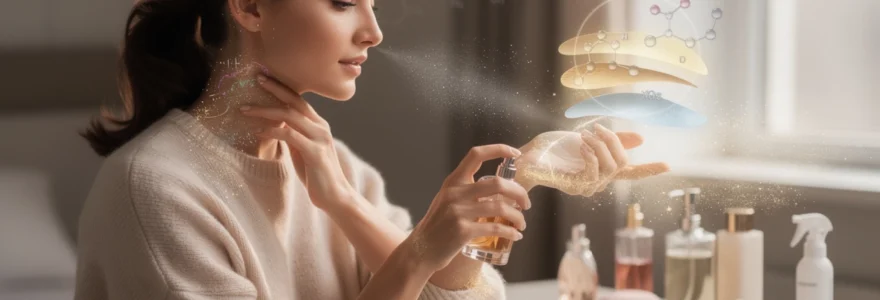
The fleeting nature of fragrance can be one of life’s most exquisite disappointments. You invest in a beautiful scent, apply it carefully in the morning, only to discover it has vanished by midday. This common frustration stems from a complex interplay of molecular chemistry, skin biology, and application technique. Understanding these factors transforms perfume application from guesswork into a precise art form that can extend your fragrance’s presence from a few hours to an entire day.
The longevity of perfume on skin depends on multiple scientific variables, from the volatility of aromatic compounds to the pH balance of your skin. Modern perfumery combines centuries-old traditions with cutting-edge chemistry to create fragrances designed for optimal performance. However, even the most expertly crafted perfume requires proper application and skin preparation to achieve its full potential.
Professional perfumers and fragrance chemists have developed sophisticated techniques that go far beyond simply spraying and hoping for the best. These methods involve understanding molecular behaviour, optimising skin chemistry, and employing strategic application protocols that work with your body’s natural processes rather than against them.
Understanding fragrance molecular structure and longevity factors
Volatile organic compounds and evaporation rates in perfume compositions
The foundation of fragrance longevity lies in the molecular weight and volatility of aromatic compounds. Volatile organic compounds (VOCs) in perfume exist on a spectrum from highly volatile top notes to heavy, persistent base notes. Lighter molecules such as citrus terpenes and aldehydes evaporate quickly due to their low molecular weight, typically disappearing within 15-30 minutes of application.
Medium-weight molecules like floral esters and spicy phenols form the heart of most fragrances, lasting 2-6 hours on average. The heaviest molecules—woods, resins, musks, and amber compounds—can persist for 8-12 hours or even longer. Understanding this molecular hierarchy helps you select fragrances with inherently longer-lasting characteristics and predict how your chosen scent will evolve throughout the day.
Top, middle, and base note concentration impact on sillage duration
The classic fragrance pyramid structure directly influences longevity performance. Top notes, representing 15-20% of most compositions, provide immediate impact but offer minimal lasting power. These opening accords are designed to attract attention and create first impressions, not to endure. Their rapid evaporation is actually intentional, clearing the way for more complex heart notes to emerge.
Heart notes typically comprise 30-50% of a fragrance and determine its main character. These middle accords bridge the gap between fleeting top notes and persistent base notes, usually lasting 3-5 hours. The concentration and quality of heart notes significantly impact overall longevity perception, as they represent the fragrance’s true personality during peak wear time.
Base notes, though often representing only 20-30% of the total composition, provide the foundation for lasting power. High concentrations of base note materials like sandalwood, patchouli, vanilla, and synthetic musks create fragrances with superior tenacity. Premium fragrances often feature higher base note concentrations specifically to enhance longevity.
Alcohol percentage effects on fragrance projection and tenacity
The alcohol-to-perfume oil ratio fundamentally determines both projection strength and longevity duration. Eau de Toilette formulations typically contain 8-15% perfume oil in alcohol, creating lighter, more volatile compositions that project well initially but fade quickly. Eau de Parfum concentrations of 15-25% perfume oil provide better longevity while maintaining good projection.
Parfum or Extrait de Parfum concentrations of 25-40% perfume oil offer maximum longevity but with different projection characteristics. Higher oil concentrations create closer-to-skin fragrances that last longer but project less dramatically. The alcohol serves as a carrier that helps initial diffusion, but as it evaporates, the remaining oil concentration determines lasting power.
Some luxury houses now offer oil-based fragrances with minimal or no alcohol content. These formulations
Some luxury houses now offer oil-based fragrances with minimal or no alcohol content. These formulations typically sit closer to the skin, offering exceptional longevity with a more intimate scent bubble and reduced evaporation. Because oil slows down the release of volatile compounds, you often experience a smoother, more gradual evolution of notes throughout the day. If you find that traditional alcohol-based perfumes disappear quickly on you, exploring perfume oils can be a strategic way to make your perfume last longer on the skin without over-spraying.
Synthetic versus natural aromatic molecules in longevity performance
The debate between natural and synthetic ingredients is often framed in terms of purity or safety, but when it comes to fragrance longevity, the key difference lies in molecular stability. Natural essences such as citrus, delicate florals, and some herbs are composed of highly volatile molecules that oxidise and evaporate quickly. This can create a beautiful, nuanced opening but often results in shorter wear time, especially on dry or warm skin types.
Synthetic aromatic molecules, by contrast, are engineered for consistency, stability, and tenacity. Modern perfumery relies on sophisticated aroma chemicals—such as synthetic musks, amber molecules, and woody accords—that are specifically designed to linger on the skin for 8–12 hours or more. These lab-created structures resist oxidation better than many naturals, maintaining their character over time and underpinning the overall fragrance with a strong, long-lasting base.
In practice, most contemporary fragrances use a blend of natural and synthetic components to balance beauty with performance. You might enjoy the brightness of natural bergamot in the opening, supported by long-lasting synthetic woods and musks in the dry-down. When your goal is all-day wear, looking for compositions rich in modern woody, musky, or amber accords—often synthetic or semi-synthetic—is one of the most reliable ways to extend your perfume’s presence on the skin.
Skin chemistry optimisation for enhanced fragrance retention
Ph balance manipulation through skincare layering techniques
Your skin’s pH level subtly but significantly affects how a perfume smells and how long it lasts. Healthy skin generally sits in a slightly acidic range (around pH 4.7–5.5), which helps support the barrier function and maintain balanced oil production. When pH is disrupted—by harsh cleansers, over-exfoliation, or certain treatments—fragrances can behave unpredictably, sometimes becoming sour, flat, or fleeting within an hour or two.
You cannot change your natural skin pH entirely, but you can create a more stable surface for fragrance using strategic skincare layering. Gentle, pH-balanced cleansers prevent extreme shifts, while hydrating toners and essences help restore comfort after washing. Following with a lightweight, fragrance-free moisturiser before applying perfume creates a smoother, more uniform canvas that helps aromatic molecules adhere and evolve predictably.
Think of your skincare routine like priming a canvas before painting: when the surface is even and balanced, the colours—your perfume’s notes—appear more vivid and stay in place longer. If you use active treatments such as exfoliating acids or retinoids, applying your perfume to areas that receive fewer strong actives (like the forearms, torso, or behind the knees) can also help maintain a more neutral pH environment, supporting better fragrance longevity.
Sebum production control using niacinamide and zinc-based treatments
Sebum, your skin’s natural oil, acts as a built-in fixative that can make perfume cling to the skin for longer. Oily skin types often notice that fragrances last significantly longer on them, while those with very dry skin struggle to maintain scent for more than a few hours. However, excessively oily skin can sometimes distort delicate compositions or cause them to project more aggressively than intended.
Niacinamide and zinc-based treatments offer a way to moderate sebum production without stripping the skin. Niacinamide (vitamin B3) helps regulate oil output, strengthen the skin barrier, and reduce irritation, creating a more consistent surface for perfume application. Zinc, often found in targeted serums or light moisturisers, can mattify and balance shine, especially in the T-zone, without fully eliminating the natural oils that help your fragrance last longer on the skin.
If you have combination or oily skin, the goal is not to remove all oil but to refine and stabilise it. Using a niacinamide serum in the morning, followed by a non-comedogenic moisturiser, can create an ideal base: enough sebum to hold scent molecules, but not so much that they break down or bloom too intensely. For drier zones, you may skip oil-control products and lean more on hydration and occlusive ingredients to prevent rapid evaporation.
Hydration barrier enhancement with hyaluronic acid and ceramides
Well-hydrated skin holds onto fragrance better, much like a damp sponge retains water longer than a dry one. When the skin’s barrier is compromised and dehydration sets in, perfume tends to soak in quickly and vanish, especially lighter eau de toilette formulas. This is why many fragrance professionals recommend moisturising before application to make perfume last longer throughout the day.
Hyaluronic acid and ceramides are two powerful allies for improving your skin’s hydration barrier. Hyaluronic acid acts like a magnet for water, drawing moisture into the upper layers of the skin and plumping its surface. Ceramides, on the other hand, help reinforce the lipid barrier that keeps that moisture from escaping, leading to smoother, more resilient skin that releases scent molecules more slowly.
In practical terms, you can apply a hydrating serum with hyaluronic acid to slightly damp skin after showering, then lock it in with a ceramide-rich, fragrance-free lotion on areas where you plan to apply perfume. This layered hydration routine creates a supple, slightly “cushioned” surface that not only feels comfortable but also helps your chosen fragrance unfold gradually over hours rather than minutes.
Body temperature regulation impact on fragrance diffusion patterns
Perfume is highly responsive to heat, which is why you often catch stronger whiffs of your scent when you are exercising, stressed, or in a warm environment. Higher body temperature increases the kinetic energy of fragrance molecules, causing them to evaporate and diffuse more rapidly. This can boost projection but also shorten the time your perfume remains noticeable on the skin.
Conversely, cooler skin slows evaporation, leading to a more subdued but longer-lasting scent. If you know you will be in a hot climate or crowded event space, it can be helpful to apply part of your fragrance to slightly cooler, less exposed areas—such as the torso, lower back, or behind the knees—rather than only focusing on the warmest pulse points. This helps balance immediate impact with extended wear.
You can think of body temperature regulation like adjusting the flame under a pot: turn the heat too high and the water (your fragrance) boils away quickly; keep it at a gentle simmer and it lasts much longer. Simple habits such as avoiding very hot showers right before application, or waiting until your skin has cooled after a workout, can subtly improve how long your perfume lasts on your skin without changing the fragrance itself.
Strategic application techniques for maximum longevity
Pulse point targeting: wrists, neck, and behind-ear application methods
Pulse points are classic fragrance application zones because they generate gentle heat, helping to diffuse scent molecules into the air. The wrists, sides of the neck, and the area just behind the ears are especially effective for creating an aura of fragrance around you. When used strategically, these spots can significantly enhance how your perfume projects and how long it remains perceptible to others.
To make perfume last longer on the skin, apply 1–2 sprays to clean, moisturised pulse points and allow them to dry naturally. Avoid the common habit of rubbing your wrists together, as this friction can disrupt the delicate top notes and push volatile molecules to evaporate too quickly. Instead, think of placing your perfume like a mist of fine silk over the skin—light, even, and undisturbed.
You can also vary your pulse point application depending on the context. For daytime or office environments, focusing on the lower neck and behind the ears keeps the scent more intimate. For evenings or special events, adding a light spritz to the inner wrists and the crook of the elbows can enhance projection as your body moves, creating a subtle trail without overwhelming those around you.
Clothing fibre absorption properties for extended scent projection
Clothing can act as an excellent secondary carrier for fragrance, often holding onto scent far longer than bare skin. Natural fibres such as cotton, wool, and linen have porous structures that trap aromatic molecules, slowly releasing them over many hours. Synthetic materials like polyester are less absorbent but can still carry fragrance on their surface, especially when sprayed from a slight distance.
If you want to extend scent projection, lightly misting your clothing from 20–30 centimetres away can add impressive staying power. Target areas where fabric moves and catches the air—scarves, coat linings, or the back of a blazer—rather than saturating one spot. Always test a small, inconspicuous area first to ensure the fabric does not stain or react, and avoid delicate materials such as silk or untreated leather, which can be damaged by perfume oils and alcohol.
This technique works particularly well when paired with skin application: your body heat activates the scent on your pulse points, while your clothing acts like a slow-release diffuser. Together, they create a more three-dimensional fragrance experience, helping your perfume last longer on your skin and in your immediate environment without constant reapplication.
Hair fragrance application using alcohol-free misting techniques
Hair is another highly effective carrier for scent because its porous structure can absorb and hold fragrance molecules for extended periods. Each time your hair moves, it gently disperses a subtle trail of aroma, often lasting longer than the same perfume on your skin. However, traditional alcohol-heavy perfumes can be drying or damaging if sprayed directly and frequently onto hair.
To protect hair health while enjoying long-lasting fragrance, opt for dedicated hair mists or alcohol-free formulations when possible. These products are typically enriched with conditioning ingredients and contain a lower concentration of alcohol, reducing the risk of dryness or colour fade. If you use your regular perfume, spray it into the air and pass your hair through the mist once or twice rather than applying it directly to the strands.
You can also lightly spritz hair accessories, such as scrunchies, headbands, or hat linings, which will carry the scent without exposing your hair to repeated alcohol contact. This method acts like a portable diffuser: each time you adjust your hair or remove your hat, you release a hint of fragrance, enhancing both perceived longevity and sillage in a gentle, controlled way.
Layered application protocol with matching body products
Layering is one of the most powerful ways to make your perfume last longer on the skin without resorting to heavy over-spraying. By using products from the same fragrance family—such as a matching shower gel, body lotion, and eau de parfum—you create multiple scent “anchors” at different levels of the skin and hair. This multi-step approach reinforces the fragrance profile and slows down its dissipation over time.
A simple layered application protocol might start with a scented or complementary body wash, followed by an unscented or lightly fragranced moisturiser to lock in hydration. Next, you apply a matching body lotion or oil, concentrating on areas where you plan to spray your perfume. Finally, you add 1–3 spritzes of the main fragrance on top of this prepared base, focusing on pulse points and lightly misting clothing if desired.
Think of this approach as building a fragrance wardrobe on your skin: the shower product sets the tone, the lotion deepens it, and the perfume crowns it. When done thoughtfully, layering can turn a fragrance that usually lasts 3–4 hours into one that remains noticeable well into the evening, all while maintaining a coherent, sophisticated scent story rather than a confusing mix of competing aromas.
Professional fragrance layering and fixative enhancement methods
Professional perfumers use fixatives—ingredients that slow down evaporation and help anchor volatile notes—to extend fragrance life. While you do not have access to a full lab at home, you can adapt some of these principles to make your own perfume last longer on the skin. The key is to combine products and techniques that create a stable base, reinforce key accords, and lock in the scent without overwhelming your senses.
One effective method is to start with a neutral, long-wearing base such as a light layer of unscented body oil (jojoba oil closely mimics natural sebum) on key application areas. Oil creates a semi-occlusive film that slows evaporation, acting much like a fixative. Over this, you can apply a complementary fragrance oil or rollerball version of your scent—if available—before finishing with a mist of the eau de parfum on top. This oil-then-spray combination often yields impressive improvements in tenacity.
Advanced fragrance layering can also involve pairing different perfumes from similar families to build complexity and depth. For example, you might apply a vanilla-forward fragrance oil at the base, then layer a woody or amber eau de parfum over it to create a customised, long-lasting signature. The deeper, resinous materials act like structural beams in a building, supporting lighter floral or citrus notes and keeping them present for longer. When experimenting, always start with small amounts to ensure harmony and avoid creating an overpowering blend.
Environmental storage and preservation techniques for fragrance integrity
Even the most carefully chosen and applied perfume will struggle to last if it has degraded in the bottle. Heat, light, and oxygen are the main enemies of fragrance integrity, causing oxidation that can flatten top notes, darken the liquid, and reduce overall longevity on the skin. Storing your perfumes in a hot bathroom, on a sunny windowsill, or in a frequently opened, brightly lit cabinet can significantly shorten their effective lifespan.
To preserve performance, keep your fragrances in a cool, dry, and stable environment away from direct sunlight. A closed drawer, wardrobe shelf, or dedicated storage box works well, helping to shield the bottles from temperature swings and UV exposure. Always replace the cap firmly after use, as this minimises oxygen exposure and slows the breakdown of volatile aromatic compounds that are essential for both projection and long wear.
If you live in a particularly warm climate, you may consider storing your most precious fragrances in a wine fridge or temperature-controlled cabinet set around 12–15°C. This is similar to how fine wines are preserved to protect delicate flavour molecules. While refrigeration is not strictly necessary for everyday scents, controlled storage for special perfumes can maintain their original character and ensure they continue to perform with the same intensity and longevity as when first purchased.
Advanced fragrance longevity hacks using complementary products
Once you have mastered the fundamentals of skin preparation, strategic application, and proper storage, you can turn to a few advanced hacks to make your perfume last longer on the skin in real-world situations. These techniques make use of complementary products you may already have in your routine, helping you fine-tune both projection and wear time without needing to invest in completely new fragrances.
One popular method is to apply a thin layer of petroleum jelly or a rich, fragrance-free balm to key pulse points before spraying. This creates a semi-occlusive barrier that holds perfume molecules at the surface of the skin rather than allowing them to sink in and disappear. Because the balm itself has minimal scent, it acts like a neutral “glue” for your perfume, enhancing longevity without competing with the composition.
Textiles and accessories can also play a powerful supporting role. Lightly spritzing items such as scarves, coat linings, or even the inner band of a hat turns them into mobile scent diffusers that reinforce the perfume on your skin. You can also coordinate with home fragrance—candles, diffusers, or room sprays in a similar scent family—to create an environment that echoes your personal fragrance. This surrounding aroma subtly boosts your perception of your perfume’s presence, helping it feel more continuous and immersive throughout the day.
Finally, consider keeping a small travel atomiser or solid perfume version of your favourite scent on hand for strategic touch-ups. Rather than reapplying heavily all over, a single targeted spritz to the neck or inner wrist every few hours can refresh the top notes while the original base and heart notes continue to hum in the background. Used together with the skincare, layering, and storage strategies outlined above, these complementary-product hacks help ensure that your chosen fragrance feels like an all-day companion rather than a fleeting morning memory.