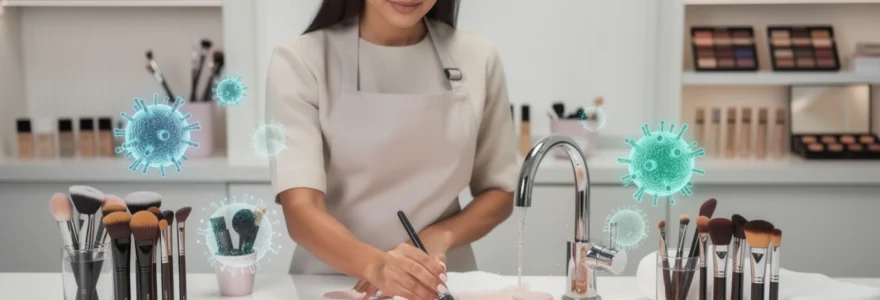
Professional makeup application demands pristine tools that perform at their peak potential. Yet countless beauty enthusiasts and professional artists overlook one critical aspect that can dramatically impact both skin health and makeup quality: proper brush hygiene. The accumulation of bacteria, product residue, and environmental contaminants in makeup brushes creates a cascade of problems that extend far beyond aesthetic concerns.
Modern makeup brush cleaning mats represent a revolutionary approach to maintaining tool hygiene, combining innovative materials with scientifically-designed textures to deliver superior cleaning results. These specialised accessories transform the tedious chore of brush maintenance into an efficient, thorough process that preserves brush integrity whilst eliminating harmful microorganisms. The investment in professional-grade cleaning equipment pays dividends through enhanced makeup performance, extended brush lifespan, and most importantly, protected skin health.
Understanding the microscopic world that thrives within dirty makeup brushes reveals why traditional cleaning methods often fall short. The complex interaction between natural oils, synthetic polymers, and bacterial colonies requires targeted intervention through specialised cleaning technologies that address each component systematically.
Bacterial contamination risks in unwashed makeup brushes
The seemingly innocent act of applying makeup with unwashed brushes introduces a dangerous cocktail of microorganisms directly onto facial skin. Research indicates that makeup brushes can harbour over 1,000 bacterial colonies per square centimetre after just one week of regular use. These microscopic invaders establish complex biofilms within brush bristles, creating resilient communities that resist casual cleaning attempts and multiply exponentially under favourable conditions.
Temperature and humidity fluctuations common in bathroom environments create ideal breeding grounds for pathogenic bacteria. The organic matter from dead skin cells, sebaceous secretions, and cosmetic ingredients provides abundant nutrition for bacterial growth. Within 48 hours of initial contamination, bacterial populations can increase by factors exceeding 10,000, transforming your favourite brushes into vectors for skin infections and inflammatory conditions.
Staphylococcus epidermidis and propionibacterium acnes accumulation
Staphylococcus epidermidis, whilst typically considered part of normal skin flora, becomes problematic when concentrated in dense colonies within brush bristles. These gram-positive cocci produce biofilm matrices that protect bacterial communities from antimicrobial agents and create persistent infection risks. When transferred back to facial skin through contaminated brushes, elevated concentrations of S. epidermidis can trigger inflammatory responses, particularly around the delicate eye area where skin barrier function is naturally compromised.
Propionibacterium acnes presents an even greater concern for individuals prone to acne vulgaris. This anaerobic bacterium thrives in the lipid-rich environment created by foundation and concealer residues embedded within brush fibres. P. acnes produces inflammatory mediators including lipases and proteases that break down sebaceous triglycerides into free fatty acids, creating the acidic conditions that perpetuate acne lesion formation. Regular use of contaminated brushes essentially inoculates facial skin with concentrated bacterial loads that overwhelm natural defence mechanisms.
Cross-contamination between eye and face makeup applications
The practice of using the same brushes for both eye and face makeup creates dangerous cross-contamination pathways that can lead to serious infections. The conjunctival sac of the eye maintains a delicate microbial balance that becomes disrupted when foreign bacteria from facial applications are introduced through contaminated eye brushes. This disruption can precipitate bacterial conjunctivitis, chalazion formation, and in severe cases, orbital cellulitis requiring immediate medical intervention.
Fungal spores present on face makeup brushes pose particular risks when transferred to the periocular region. The warm, moist environment around the eyes provides optimal conditions for fungal proliferation, potentially leading to chronic blepharitis or keratitis. Professional makeup artists understand these risks and maintain strict separation between eye and face tools, implementing rigorous cleaning protocols to prevent cross-contamination events.
Fungal spore development in natural bristle brushes
Natural animal hair brushes, prized for their superior blending capabilities, create unique environments conducive to fungal colonisation. The keratin structure of animal hair contains microscopic cuticles and cortical layers that trap
moisture and organic debris along the shaft. When brushes are stored in humid bathrooms or used with liquid and cream products, these microcavities can retain water for prolonged periods, creating ideal conditions for fungal spore germination. Species such as Malassezia and Candida may proliferate within these structures, remaining invisible at the surface while progressively weakening the hair fibre itself.
Once established, fungal colonies in natural bristle brushes can contribute to persistent skin issues, particularly in individuals with compromised barrier function or seborrhoeic tendencies. Users may notice increased itching, flaking, or localised redness in areas where contaminated brushes are repeatedly applied. Regular, mechanical agitation against a textured makeup brush cleaning mat, combined with appropriate antibacterial or antifungal cleansers, disrupts these colonies and removes the organic residues that fuel continued growth.
Dermatitis and allergic reaction triggers from product residue buildup
Beyond microbial threats, neglected makeup brushes become saturated with layers of oxidised oils, fragrances, preservatives, and pigment particles. This complex residue mixture can act as a potent irritant, particularly when repeatedly pressed into sensitive areas such as the eyelids, nasolabial folds, and neck. Over time, even individuals with previously resilient skin may develop contact dermatitis, characterised by dryness, erythema, and pruritus that appears to “mysteriously” worsen despite careful product selection.
Allergic contact reactions are especially common with certain dyes, nickel traces from ferrules, and specific preservative systems present in long-wear or waterproof formulations. When these compounds accumulate within brush heads, they are delivered to the skin at higher, more concentrated doses than originally intended. Systematic cleansing on a makeup brush cleaning mat ensures that residual actives and sensitising agents are effectively removed between uses, reducing cumulative exposure and helping you pinpoint true product allergies rather than reacting to weeks of layered buildup.
Makeup brush cleaning mat technologies and materials
Not all makeup brush cleaning tools are created equal. Contemporary brush cleaning mats leverage material science, ergonomics, and microbiology to create surfaces that dislodge stubborn residue without compromising delicate bristles. At the heart of these innovations lies the recognition that brushes designed for high-performance makeup application require an equally sophisticated approach to maintenance. The choice of base material, surface geometry, and additional functional coatings collectively determines how efficiently a mat can restore brushes to a hygienic, like-new state.
For both professional makeup artists and everyday users, the right cleaning mat dramatically reduces the time and effort required to deep clean an entire brush set. Instead of relying solely on the friction of your palm or a smooth dish, purpose-built texture zones generate controlled turbulence in the bristles, allowing cleansers to penetrate and lift out embedded product. This targeted design not only enhances hygiene but also standardises the cleaning process, so every brush in your kit receives the same level of care.
Silicone texture patterns for synthetic bristle deep cleansing
Medical-grade or food-grade silicone has become the material of choice for most makeup brush cleaning mats due to its durability, flexibility, and resistance to both cosmetic solvents and repeated disinfection. Crucially, silicone can be moulded into highly specific micro-textures—ridges, nodules, crosshatch patterns, and concentric rings—that are engineered to interact optimally with different brush shapes and fibre types. For densely packed synthetic brushes used with liquid foundation or cream contour, these patterns act almost like miniature combs, separating each filament so cleanser can reach the inner core.
When you swirl a brush over these raised zones, the bristles flex and splay repeatedly, dislodging product that simple rinsing would leave behind. Unlike abrasive surfaces that can scratch or cut fibres, high-quality silicone offers controlled friction with a slightly “grippy” feel, maximising residue removal while preserving tip softness. Many mats feature labelled areas for “face”, “eye”, or “precision” brushes, guiding users to the appropriate texture density for deep cleansing without over-stressing finer bristles.
Suction cup stabilisation systems for wet cleaning procedures
A frequently overlooked aspect of efficient brush cleaning is stability. Traditional methods often require one hand to hold a dish or smooth pad in place, leaving only the other hand to control both the brush and water flow. Modern makeup brush cleaning mats solve this by incorporating integrated suction cup systems on the underside of the silicone, allowing the mat to adhere firmly to sinks, basins, or even tiled surfaces. This simple mechanical feature significantly enhances safety and speed during wet cleaning procedures.
With the mat anchored, both hands are free: one to manipulate the brush through different texture zones, and the other to regulate water temperature and cleanser distribution. This stable platform also minimises accidental drops, splashes, and repeated twisting motions that can loosen ferrules over time. For professional artists working on tight schedules—such as between bridal parties or backstage at fashion shows—suction-based stabilisation transforms brush hygiene from a precarious balancing act into a streamlined, repeatable workflow.
Antimicrobial coating applications in premium cleaning mats
Some premium makeup brush cleaning mats incorporate antimicrobial additives into the silicone matrix or surface coating. These may include silver ion technologies, quaternary ammonium compounds, or other biocidal agents that inhibit the growth of bacteria and fungi on the mat itself between uses. While these coatings do not replace proper brush disinfection, they reduce the risk that the mat becomes another reservoir for microbial contamination—particularly when stored in humid bathrooms or shared professional environments.
From a practical standpoint, antimicrobial-enhanced mats dry more hygienically and are less likely to develop odours or visible biofilm over time. For users who clean brushes multiple times per week, this added level of protection provides peace of mind that the cleaning surface is not reintroducing the very organisms they are trying to remove. It is still essential, however, to periodically wash and air-dry the mat, as active coatings work best when not obscured by soap scum or hardened cosmetic residue.
Dual-sided texture configurations for different brush densities
As brush collections become more diverse—ranging from ultra-fluffy powder brushes to razor-thin liner tools—single-texture solutions quickly show their limitations. Dual-sided makeup brush cleaning mats address this challenge by offering distinct texture profiles on each surface. One side may feature larger, widely spaced ridges tailored to voluminous face brushes, while the opposite side presents finer, more intricate patterns optimised for small eye and lip brushes that require precision cleansing.
This configuration allows you to match brush density and size to the most effective cleaning terrain without switching tools or applying excessive pressure. It also supports more nuanced routines, such as using the coarser side for an initial degreasing pass on heavily soiled brushes, then finishing on the finer side to refine bristle alignment and remove any remaining pigment. Over time, this customisable approach not only enhances hygiene but also helps preserve each brush’s original shape and performance characteristics.
Professional makeup artist cleaning protocols using textured mats
In professional settings, where multiple clients are seen in rapid succession, a robust brush hygiene protocol is non-negotiable. Makeup artists must balance strict infection control standards with the practical realities of limited time and water access. Textured makeup brush cleaning mats have become central to this process, providing a controlled environment in which both rapid “on-the-spot” cleansing and thorough end-of-day deep cleaning can be carried out systematically. The mat functions as the hub of a wider hygiene strategy that encompasses products, tools, and storage.
A typical professional workflow integrates two complementary stages. Between clients, artists often use a high-grade alcohol-based brush cleaner to dissolve surface pigments and sanitise fibres, working the bristles across a dry section of the mat to accelerate evaporation and mechanically remove residue. At the end of the working day, the same brushes undergo a full wet-cleaning cycle with gentle antibacterial soap or specialised brush shampoo on the textured mat, ensuring that oils, biofilm, and embedded product are completely removed from the inner bristle core.
To standardise this routine, many artists establish a written or mental checklist. Brushes are grouped by function—face, eye, lip—and cleaned in batches over designated texture zones, reducing the risk of cross-contamination. Colour-coded bands or ferrules may be used to differentiate “clean”, “in use”, and “to be cleaned” brushes on set. This disciplined approach, anchored by the use of a dedicated cleaning mat, reassures clients that hygiene is treated with the same seriousness as artistry, reinforcing professional credibility and safeguarding reputations.
Brush bristle preservation through proper mat-based cleaning techniques
One of the most compelling arguments for adopting a makeup brush cleaning mat is its role in preserving the structural integrity of brush bristles over time. Excessive scrubbing in the palm, soaking brushes vertically in water, or using harsh detergents can all accelerate shedding, fraying, and splaying of fibres. A well-designed mat provides a controlled environment in which bristles are flexed just enough to release debris, but not so aggressively that the internal glue bond or cuticle structure is compromised.
Correct technique is key. Brushes should be gently dampened with lukewarm water, cleanser applied directly to the bristles or mat, and then moved in small circular or back-and-forth motions across the appropriate texture zone. Rather than grinding the brush head down, you allow the raised patterns to do the majority of the work, much like a washboard in traditional laundry. This analogy is useful: the tool amplifies your effort so you can achieve a deeper clean with less pressure, reducing mechanical stress on individual filaments.
For natural hair brushes, minimising swelling and drying cycles is critical, as repeated over-saturation can cause the hair shaft to weaken and split. Mat-based cleaning makes it easier to keep water focused on the bristles rather than the ferrule and handle, helping protect both the adhesive and any wooden components. After cleansing, gentle reshaping and horizontal drying ensure that gravity does not pull moisture into the ferrule, further extending the life of the brush. Over months and years, this careful, mat-assisted routine translates to softer, more resilient tools that retain their original performance characteristics far longer than brushes subjected to improvised cleaning methods.
Colour payoff enhancement through systematic brush maintenance
While hygiene is a primary driver for regular brush cleaning, makeup performance is the benefit you notice immediately in the mirror. Product residue, oxidised oils, and old pigments accumulating on your tools act like a dull film over your makeup products, muting shades and disrupting texture. Systematic maintenance using a makeup brush cleaning mat removes this invisible barrier, allowing formulations to behave as the brand intended. The result is richer colour payoff, smoother blending, and a more predictable response from every product in your kit.
Think of clean brushes as freshly primed painting tools: just as an artist would never attempt fine detail with a dirty, clogged brush, you should not expect true-to-pan colour or seamless gradients from brushes carrying yesterday’s smokey eye or last week’s cream contour. By building mat-based cleaning into your routine—weekly for personal use, and even more frequently for professionals—you create consistent conditions that let your skill, not leftover residue, determine the outcome of each application.
Pigment saturation improvements in eyeshadow application
Eyeshadow performance is particularly sensitive to brush cleanliness. When bristles are coated with residual oils and old pigment, they struggle to grip new product evenly. Instead of picking up a uniform layer of powder, the brush collects patchy clumps that deposit inconsistently on the lid, leading to streaks, muddy transitions, and disappointing colour intensity. A deep clean on a textured makeup brush cleaning mat strips away this film, restoring the fibre’s natural ability to hold and release pigment in a controlled manner.
This effect is especially noticeable with matte and bright or pastel shades, which already require a certain level of precision to appear smooth and saturated. Have you ever wondered why a palette looks vibrant in the pan but underwhelming on the eye? Often, the culprit is not the formula but the brush. After thorough mat cleaning, you’ll find that even older palettes can deliver renewed vibrancy, as there is no longer a veil of beige transition shade or dark smokey residue dulling every subsequent look.
Foundation blending consistency through residue elimination
Complexion products such as foundation, concealer, and cream contour place intense demands on makeup brushes, particularly dense synthetic kabuki or buffing styles. These tools quickly accumulate a mixture of pigments, silicones, and skin oils that settle deep within the fibre bundle. If not properly removed, this buildup hardens near the brush core, creating uneven stiffness that translates directly to streaky, patchy application on the skin. Regular use of a makeup brush cleaning mat ensures that cleanser reaches this inner zone, breaking down residue before it can solidify.
The payoff is immediately visible in your base makeup. Clean foundation brushes glide over the skin, distributing product smoothly and allowing you to build coverage where needed without dragging or lifting previously applied layers. Consistency from one application to the next also improves, as you are no longer working against an unpredictable mix of yesterday’s formula and today’s. For high-definition work—such as bridal photography or video—this level of control can make the difference between a flawless, airbrushed finish and a complexion that looks textured and uneven under scrutiny.
Lip product colour accuracy maintenance protocols
Lip brushes and dual-ended tools used for liners and glosses are among the most easily overlooked when it comes to cleaning, yet they play a crucial role in colour accuracy. Residual tints from red, berry, or deep nude shades can stain bristles, subtly influencing the outcome of softer or cooler-toned looks applied later. By implementing a simple protocol—wiping off excess product after each use, followed by regular deep cleaning on the fine-texture zones of a makeup brush cleaning mat—you preserve the integrity of every lip colour in your collection.
This is particularly important for professional artists who may move from a classic red bridal lip to a barely-there pink on the next client. Any residual pigment can skew the result, undermining the client’s expectations and the artist’s design. Clean, neutral bristles act like a blank canvas, allowing the exact undertone, depth, and finish of each lipstick or gloss to shine through. In hygiene terms, frequent lip brush cleaning also reduces the risk of transferring oral bacteria or viral particles between products and applications, an essential consideration in any shared kit.
Cost-effectiveness analysis of cleaning mat investment versus brush replacement
From a financial perspective, a high-quality makeup brush cleaning mat represents a modest, one-time investment that can dramatically reduce long-term expenditure on brushes. Professional-grade brush sets—particularly those featuring natural hair or advanced synthetic fibres—can cost hundreds of pounds or dollars. Without proper maintenance, these tools degrade quickly, shedding, fraying, or losing shape to the point where they must be replaced far sooner than their design life. By contrast, a durable silicone mat typically sits at the lower end of the price spectrum yet directly contributes to extending each brush’s usable lifespan.
When considering cost-effectiveness, it helps to adopt a lifecycle view. Suppose a foundation brush lasts two years under basic, palm-only cleaning before becoming too misshapen for precise work. With consistent, mat-based cleaning that reduces mechanical stress and thoroughly removes residue, that same brush may perform optimally for four years or more. Multiply this gain across an entire collection of 15–30 brushes, and the cumulative savings quickly exceed the initial cost of the mat. In essence, the mat functions as preventative maintenance—much like regular servicing for a car—protecting a more substantial underlying investment.
There is also an opportunity cost associated with poor hygiene: breakouts, irritation, or infections often lead users to discard both brushes and products prematurely, mistakenly blaming formulas rather than contaminated tools. By maintaining hygienic, high-performing brushes with the help of a cleaning mat, you minimise wasted product, avoid unnecessary repurchases driven by skin flare-ups, and reduce downtime caused by compromised skin health. Over time, this holistic efficiency—better skin, longer-lasting tools, and more reliable makeup performance—makes the case for a makeup brush cleaning mat not as a luxury accessory, but as an essential, cost-effective component of any serious beauty routine.