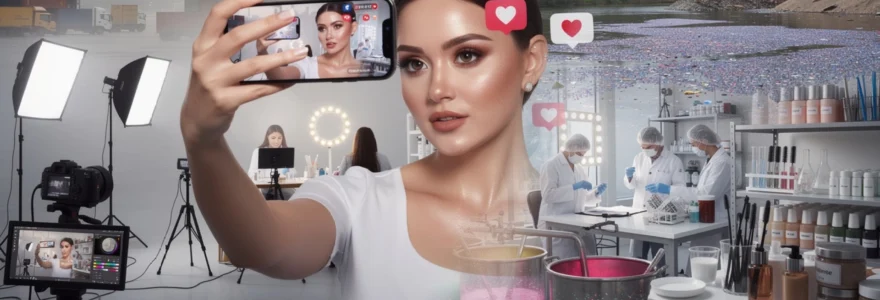
Behind the perfectly curated feeds and flawless campaigns lies a beauty industry operating with practices that consumers rarely witness. Social media platforms showcase polished results whilst concealing the complex machinery of digital manipulation, questionable formulations, and environmental consequences that power the global cosmetics market. The disconnect between what brands present online and their actual operations has created an information gap that affects millions of beauty consumers worldwide.
The beauty industry’s social media presence generates billions in revenue annually, yet the mechanisms behind this success remain largely invisible to the average consumer. From sophisticated photo editing techniques to undisclosed chemical formulations, the industry operates behind multiple layers of marketing sophistication that obscure genuine product information and manufacturing processes.
Manufacturing reality behind instagram’s perfect skin campaigns
The immaculate skin showcased in beauty campaigns represents hours of professional work that extends far beyond traditional makeup application. Modern beauty advertising relies on a sophisticated blend of digital artistry and cutting-edge technology to create images that often bear little resemblance to the original photographs. This manufactured perfection sets unrealistic expectations for consumers who purchase products expecting to achieve similar results.
Professional beauty photography involves multiple stages of enhancement, beginning with controlled studio environments and extending through extensive post-production processes. The final images consumers see on Instagram and other platforms represent the culmination of techniques that would be impossible to replicate in everyday circumstances, yet brands rarely acknowledge this distinction when marketing their products.
Photoshop manipulation techniques in L’Oréal and estée lauder advertisements
Major beauty conglomerates employ teams of digital artists who specialise in skin retouching techniques that go far beyond basic colour correction. These professionals utilise frequency separation methods to isolate skin texture from colour information, allowing for precise manipulation of both elements independently. The process involves creating multiple layers that address different aspects of skin appearance, from pore visibility to overall luminosity.
L’Oréal’s advertising campaigns frequently employ advanced masking techniques that selectively enhance specific facial features whilst maintaining a natural appearance. The company’s digital artists use custom brushes designed to mimic skin texture patterns, ensuring that retouched areas blend seamlessly with unedited portions of the image. This attention to detail creates convincing results that consumers interpret as achievable through product use alone.
Estée Lauder’s marketing materials demonstrate sophisticated colour grading techniques that alter the fundamental appearance of skin tone and texture. Their post-production teams employ luminosity masks to target specific brightness ranges within images, allowing for precise control over how light interacts with different areas of the subject’s face. These techniques create the illusion of perfect skin whilst maintaining the subtle variations that prevent images from appearing obviously artificial.
CGI integration methods used by fenty beauty and rare beauty
Contemporary beauty brands increasingly incorporate computer-generated imagery elements into their campaigns, blending digital creations with traditional photography to achieve impossible perfection. Fenty Beauty’s recent campaigns utilise 3D modelling software to create idealised versions of facial features that are then seamlessly integrated with photographs of real models. This approach allows for precise control over every aspect of the final image whilst maintaining photorealistic quality.
Rare Beauty employs motion capture technology combined with facial reconstruction software to create digital doubles of their brand ambassadors. These digital avatars undergo extensive refinement processes that eliminate perceived imperfections whilst maintaining recognisable characteristics of the original subjects. The resulting imagery presents an enhanced version of reality that consumers associate with the brand’s products rather than digital manipulation.
The integration of CGI elements extends beyond facial features to include digitally enhanced makeup applications that demonstrate product capabilities beyond physical limitations. Brands create virtual makeup looks that showcase ideal colour payoff, blend seamlessly, and maintain perfect appearance throughout extended wear periods. These digital demonstrations establish performance expectations that actual products struggle to match in real-world conditions.
Professional lighting equipment standards for MAC cosmetics shoots
MAC Cosmetics employs lighting setups that utilise multiple high-powered strobes positioned strategically to eliminate shadows and create even illumination across the subject’s face. Their standard configuration includes key lights, fill lights, and rim lights working in coordination to produce the flat, even lighting that minimises texture and creates the appearance of perfect skin. This professional lighting setup costs thousands of pounds and requires extensive technical expertise to operate effectively.
The brand’s photographers work with colour-corrected lighting systems that maintain
colour accuracy across skin tones, ensuring that foundations, highlighters and colour cosmetics appear more vibrant and even than they would under everyday lighting conditions. Diffusion panels and softboxes are used to scatter light and blur fine lines, pores and uneven texture before any retouching takes place. For most consumers taking selfies in bathrooms, offices or dim bedrooms, recreating this clinical control over light is impossible. Yet when these professionally lit images are pushed across Instagram, TikTok and brand websites, they are rarely labelled as the result of complex technical setups rather than the inherent performance of a product.
These lighting standards also influence how makeup shades are developed and approved. Products are often shade-matched and tested under these optimised conditions, which means colours may shift or look less flattering when worn under fluorescent office lighting or warm indoor bulbs. This discrepancy can leave consumers feeling as though they chose the wrong product or have applied it incorrectly, when in reality they are comparing home results to imagery created in conditions closer to a film set than a bedroom mirror.
Skin texture removal algorithms in beauty filter applications
Alongside professional photography, beauty filter applications have introduced a new layer of digital manipulation that blurs the line between skin care results and software effects. Modern filters use facial recognition systems and deep-learning algorithms trained on thousands of faces to identify key landmarks such as eyes, nose, lips and jawlines. Once mapped, the software applies virtual “meshes” and skin-smoothing algorithms that reduce contrast in areas associated with texture, such as pores, fine lines and blemishes.
These skin texture removal tools do more than add a soft blur. Many apps apply dynamic sharpening to features like eyes and lips while simultaneously smoothing surrounding skin, creating a hyper-real, doll-like effect reminiscent of high-end retouching. TikTok’s Bold Glamour filter, for example, uses advanced face-tracking that barely glitches, even when users move quickly or cover parts of their face. The result is an ultra-consistent appearance that can make bare skin seem inadequate by comparison, even though no real-world beauty product can replicate this algorithmic transformation.
Psychological research suggests that repeated exposure to these heavily filtered versions of ourselves can reduce satisfaction with our natural appearance. When you are used to seeing your face with artificially removed texture and enhanced symmetry, the return to reality in a bathroom mirror can feel jarring. This effect is especially pronounced for younger users who are still forming their sense of identity and self-image. Yet most platforms present these filters as playful tools rather than as powerful image-editing technologies that rival professional retouching suites.
Undisclosed chemical formulations and regulatory loopholes
Behind the glossy packaging and aspirational branding, many beauty products contain complex chemical formulations that consumers seldom fully understand. Ingredient lists are often written in technical INCI (International Nomenclature of Cosmetic Ingredients) terminology, making it difficult for non-experts to assess potential risks or sensitivities. While global regulations exist to protect consumers, they are full of grey areas, exemptions and enforcement gaps that allow controversial substances to remain in circulation.
In many regions, cosmetics are subject to less stringent pre-market testing than pharmaceuticals or medical devices. Companies can self-certify safety based on internal data or existing literature, and regulators may only intervene once adverse events are reported at scale. Marketing language such as “clean”, “non-toxic” or “dermatologist approved” can further confuse shoppers, as these terms are often unregulated and defined by brands rather than independent authorities. This combination of complex chemistry, limited oversight and vague claims creates a perfect environment for misinformation to spread on social media.
PFAS compounds in waterproof mascara formulations by maybelline
One of the most concerning classes of chemicals found in some cosmetics are PFAS (per- and polyfluoroalkyl substances), sometimes referred to as “forever chemicals” because they do not readily break down in the environment. Investigations published in recent years have detected PFAS in several waterproof mascaras, eyeliners and long-wear products marketed for their smudge-proof or ultra-resistant properties. These compounds can enhance film formation and water resistance, making mascaras cling to lashes even under humid or wet conditions.
PFAS are associated with potential health risks, including hormonal disruption and immune system effects, although the degree of exposure from cosmetics is still being studied. The challenge for consumers is that PFAS do not always appear clearly on ingredient lists. They may be included under broader chemical names or present as impurities in treated pigments and polymers. Some products can carry “long-wear” or “24-hour hold” claims that sound like simple performance benefits when, in reality, they may be enabled by persistent fluorinated compounds.
Brands like Maybelline, owned by larger conglomerates, operate within legal thresholds but may still rely on chemical strategies that many consumers would find troubling if fully explained. As public awareness grows, some companies have begun to pledge PFAS-free formulations, but enforcement remains limited and patchy. For now, shoppers seeking to avoid these chemicals must rely on independent databases and advocacy groups, since social media campaigns rarely highlight the less glamorous side of waterproof performance.
Parabens and phthalates in charlotte tilbury foundation lines
Parabens and phthalates are two other ingredient families that have attracted sustained controversy in the beauty industry. Parabens are widely used as preservatives to prevent microbial growth in water-based formulas such as foundations, concealers and creams. Phthalates, meanwhile, can appear as plasticisers in packaging or as components of fragrance blends to help scents last longer on the skin. Although many large brands claim to have reduced or removed these substances, they still appear in various product lines across the market.
In foundation ranges positioned as luxurious or skin-enhancing, such as those from Charlotte Tilbury, long shelf life and stable texture are critical selling points. Preservatives ensure that products remain safe over months of daily use, but the specific chemicals chosen are not always obvious to consumers. Some parabens continue to be permitted at low concentrations in both EU and US markets, despite research linking certain types to potential endocrine-disrupting effects in animal studies. The regulatory stance is that current exposure levels from cosmetics are within acceptable margins, yet many consumers prefer to minimise their cumulative contact.
Phthalates can be even more opaque, as they are often classified within the catch-all term “fragrance” on ingredient labels. This makes it challenging for shoppers to know whether their favourite foundation or primer contains these compounds indirectly. When influencers describe a product as “clean” or “safe” based solely on marketing language, they can unwittingly reinforce the idea that premium branding automatically equates to chemical transparency. In reality, ingredient safety is nuanced, and consumers benefit from scrutinising labels rather than relying entirely on social media endorsements.
Fragrance allergen masking in chanel and dior skincare products
Fragrance is one of the most common causes of cosmetic-related skin irritation, yet it remains a powerful marketing tool across luxury skincare lines. Brands like Chanel and Dior build entire brand identities around signature scents, weaving them into creams, serums and cleansers to create a sensory experience. While EU regulations require the disclosure of 26 specific fragrance allergens when used above certain thresholds, many products still list “parfum” or “fragrance” as a single umbrella term that obscures the full blend.
This masking effect makes it difficult for individuals with sensitive skin or known fragrance allergies to avoid problematic compounds. A consumer might experience redness, itching or dermatitis from a high-end moisturiser and assume the issue lies with an “active ingredient”, when the real culprit could be a fragrant aldehyde or essential oil component. On social media, skincare routines often praise the luxurious feel and scent of these products, rarely acknowledging that the same aromatic profile can be a liability for reactive skin.
Compounding the issue, some brands reformulate quietly to comply with evolving regulations or cost considerations without clearly informing consumers. The label may change only slightly, while the actual allergen profile shifts in more significant ways. In this environment, independent patch testing, dermatologist guidance and fragrance-free alternatives become essential tools for navigating luxury skincare marketing. Yet those realities seldom feature in the polished flat-lays and bathroom-shelf aesthetics dominating Instagram and TikTok.
FDA loopholes exploited by kylie cosmetics and morphe
In the United States, the Food and Drug Administration (FDA) regulates cosmetics under a framework that many experts consider outdated for today’s globalised, influencer-driven market. Unlike drugs, most cosmetics do not require pre-market approval, and companies are largely responsible for ensuring product safety. This regulatory model creates loopholes that agile brands can exploit, particularly when launching rapid-fire collections and limited-edition collaborations designed to generate hype on social media.
Brands such as Kylie Cosmetics and Morphe have built empires on influencer marketing and fast product cycles. While they must comply with basic labelling and safety requirements, they can introduce new palettes, lip kits and complexion products far more quickly than regulators can independently verify each formula. Colour additives are regulated more strictly, but other ingredients can slip through as long as they are not explicitly banned. Additionally, the distinction between a “cosmetic” and an “over-the-counter drug” (such as SPF products or acne treatments) can be blurred by marketing language, allowing some items to avoid the more rigorous rules applied to drugs.
Another loophole lies in the relative lack of mandatory reporting for adverse events. Unless issues become high-profile enough to attract media attention or class actions, many consumer complaints remain scattered across reviews and comment sections rather than in official safety databases. This can create a false sense of security online, where a product appears widely loved despite pockets of users experiencing irritation, staining or other problems. Without stronger oversight and clearer reporting pathways, the gap between Instagram hype and regulatory reality will continue to widen.
Influencer compensation structures and brand partnership manipulation
Influencer marketing has become one of the most powerful tools in the beauty industry, yet the financial arrangements behind glossy sponsorships are often hidden from view. On the surface, it appears that content creators are simply sharing their favourite serums or mascaras. In reality, many posts are carefully negotiated pieces of advertising with specific talking points, performance metrics and legal contracts attached. When compensation is not clearly disclosed, it undermines the authenticity that first attracted audiences to influencers in the early days of beauty blogging.
Common compensation models include flat fees per post, affiliate commission structures and long-term ambassador contracts that bundle social content with event appearances and product development input. Larger influencers can command five or six-figure sums for a single campaign, especially if exclusivity clauses prevent them from promoting competitor brands. These deals often come with non-disparagement agreements that discourage creators from sharing negative experiences or formula concerns, even months after a campaign ends. As a result, followers may only ever see the positive side of a product, regardless of its actual performance.
Micro-influencers and emerging creators may receive payment in the form of free products or low commissions tied to trackable links. While this might seem more transparent, it can still create subtle pressure to post favourable reviews to maintain relationships with public relations teams and secure future campaigns. How many times have you seen a creator declare a product “life-changing” just weeks after launch, only for it to vanish from their routine shortly after? This pattern can be a sign that content is calibrated for short-term engagement and sales, rather than for long-term trust.
Recent regulatory crackdowns in the EU, UK and US have sought to improve transparency by requiring clear “ad”, “sponsored” or “paid partnership” labels on promotional content. However, enforcement is uneven, and many creators still bury disclosures in hashtags or small text that viewers may overlook. For consumers, a useful rule of thumb is to look for creators who show both successes and failures, disclose when products were gifted, and continue to use items long after a campaign has ended. As with traditional advertising, understanding who pays whom – and for what – is key to interpreting beauty recommendations online.
Environmental impact concealment by major beauty conglomerates
Beyond individual products and campaigns, the beauty industry has a substantial environmental footprint that is rarely visible on social media. While brands increasingly highlight recyclable packaging, “green” formulas and carbon-neutral pledges, the full lifecycle impacts of sourcing, manufacturing, transport and disposal are seldom communicated in detail. Sustainability messaging often focuses on visually appealing initiatives, such as limited-edition eco-packaging, rather than on the less photogenic reality of industrial waste, emissions and resource extraction.
Large conglomerates have the resources to invest in sustainability reporting, yet much of the data remains buried in corporate PDFs rather than displayed in influencer content or product pages. This disconnect allows companies to benefit from “conscious consumer” trends without exposing the trade-offs and complexities behind their operations. For consumers scrolling through curated feeds, it can feel as if a few recyclable lids and refillable lipsticks have solved the industry’s environmental challenges, when in fact these are only small pieces of a much larger puzzle.
Microplastic pollution from unilever and P&G exfoliating products
Microplastics – tiny plastic particles less than 5mm in size – have long been used in cosmetic products as exfoliating agents, film formers and glitter components. While many regions have banned or restricted plastic microbeads in rinse-off products, other forms of microplastics, such as water-insoluble polymers, still appear in a range of skincare and haircare items. Companies like Unilever and Procter & Gamble (P&G), which own numerous mass-market beauty brands, have faced scrutiny over the contribution of their exfoliating scrubs and cleansers to microplastic pollution in rivers and oceans.
Even when individual products contain only small amounts of microplastics, the cumulative effect across millions of users and daily routines can be significant. Once washed down the drain, these particles are difficult to capture in wastewater treatment plants and can persist in aquatic environments for decades. Studies have detected microplastics in marine organisms and even in human blood, raising concerns about long-term ecological and health implications. Yet product campaigns on social media tend to focus on smooth skin and “glowing” results, with little mention of what happens to those particles after they swirl down the sink.
In response to public pressure, some brands have reformulated to use natural exfoliants like ground seeds, sugar or silica, and now highlight “microplastic-free” claims. However, many consumers are unaware that polymers listed under complex names such as polyethylene, polyacrylate or polyquaternium can also break down into microplastic fragments over time. Learning to read ingredient labels – or consulting independent databases that flag potential microplastic content – can help shoppers align their beauty routines with their environmental values beyond the limited narratives pushed on social channels.
Palm oil sourcing practices hidden by sephora private label brands
Palm oil and its derivatives are ubiquitous in cosmetics, used for their emollient properties and ability to stabilise formulas. However, unsustainable palm oil cultivation has been linked to deforestation, habitat loss for endangered species and human rights concerns in producing countries. While many large companies have made commitments to source certified sustainable palm oil, the complexity of global supply chains means that traceability remains a serious challenge. Retailers with private label brands, such as Sephora, face particular scrutiny because they act as both vendor and brand owner.
On social media, Sephora’s in-house lines are often positioned as trendy, accessible options with a wide range of shades and textures. Posts celebrate new launches and limited-edition collaborations, but rarely explain whether the palm-derived ingredients in these formulas come from traceable, deforestation-free sources. Even when companies participate in certification schemes like RSPO (Roundtable on Sustainable Palm Oil), the level of certification (from basic membership to fully segregated supply) is seldom communicated clearly to consumers.
This opacity makes it difficult for shoppers to distinguish between meaningful sustainability action and surface-level “green” marketing. If a brand does not publish updated, third-party-verified sourcing information, it is reasonable to assume that palm derivatives may be mixed from multiple origins, some of which could contribute to environmental degradation. For consumers who care about ethical beauty, asking brands direct questions, supporting those that publish detailed sourcing maps and favouring palm-free alternatives when possible are practical ways to go beyond the curated imagery of eco-consciousness.
Carbon footprint calculations omitted by coty and revlon supply chains
Measuring the true carbon footprint of a beauty product is complex. It involves accounting for emissions at every stage: raw material extraction, manufacturing, packaging production, global transport, retail operations and end-of-life disposal. Large groups such as Coty and Revlon operate sprawling supply networks that span continents, yet most consumers only see the final lipstick or fragrance bottle on a store shelf or Instagram flat-lay. Detailed emissions data, when calculated, is often disclosed only at a high corporate level rather than broken down by brand or product line.
Without granular carbon reporting, it is almost impossible for consumers to compare the climate impact of different beauty purchases. A product marketed as “sustainable” because it uses recycled plastic may still carry a heavy carbon load due to energy-intensive production or air freight. Conversely, a less aggressively marketed item from a smaller brand might have a lower footprint but receive little attention because it lacks influencer backing. This asymmetry of information allows carbon-intensive products to maintain a green sheen online.
As climate concerns intensify, some forward-thinking companies are experimenting with on-pack carbon labels or third-party certifications to give shoppers clearer benchmarks. However, these initiatives are still the exception rather than the rule, and major conglomerates have been slow to embrace such transparency at scale. For now, consumers can look for brands that publish life-cycle assessments, prioritise local manufacturing and invest in renewable energy across their operations – even if those choices are less visually exciting than yet another limited-edition launch.
Packaging waste generation statistics suppressed by ulta beauty
Packaging is one of the most visible environmental issues in the beauty sector, yet robust data on waste volumes is surprisingly scarce in mainstream marketing. Retailers like Ulta Beauty stock thousands of SKUs across makeup, skincare, haircare and fragrance, much of it housed in multi-layered packaging designed more for shelf appeal than for recyclability. While Ulta has public sustainability statements and recycling partnerships, detailed figures on how much packaging enters and exits its ecosystem each year are harder to find in consumer-facing materials.
On social platforms, the unboxing experience has become a content genre in its own right. PR mailers, advent calendars and influencer hauls showcase oversized boxes, decorative inserts and plastic trays that are discarded moments after filming. This spectacle rarely addresses where those materials end up or how easily they can be processed by local recycling systems. In many regions, mixed materials, pumps and small cosmetic containers either cannot be recycled or are not captured efficiently, ultimately contributing to landfill or incineration.
Some retailers and brands now promote take-back schemes and “empties” recycling programmes as a solution. While these initiatives are a step in the right direction, their actual capture rates are often low compared to the total volume of goods sold. Without transparent statistics on participation and outcomes, it is difficult to assess whether these programmes meaningfully offset the industry’s packaging footprint or serve primarily as marketing tools. For consumers, reducing impulse purchases, choosing refillable or minimal-packaging options and supporting brands that design with end-of-life in mind remain some of the most effective ways to cut through the noise.
Labour exploitation in global beauty supply networks
Behind every lipstick bullet and facial oil lies a complex web of labour, often stretching from small farms and mines to contract factories and fulfilment centres. While social media spotlights celebrity founders and creative directors, it rarely shows the workers harvesting botanical ingredients, assembling palettes or packing orders in warehouses. This invisibility can mask exploitative conditions, particularly in regions where labour laws are weakly enforced or where informality is common.
Key raw materials such as mica (used for shimmer), shea butter, cocoa butter and various plant oils are frequently sourced from countries in the Global South. Investigations have documented instances of child labour and unsafe working conditions in some mica mines and agricultural supply chains linked to the beauty sector. Even when brands subscribe to ethical sourcing charters, tracing every tier of their supply network can be as difficult as following the threads of a tangled web. Certifications help, but they are not foolproof, and audits can be announced in advance or limited in scope.
At the manufacturing and distribution stages, pressures to reduce costs and speed up delivery can translate into long hours, low wages and precarious contracts for factory and warehouse workers. The rise of fast beauty – rapid product churn fuelled by viral trends – amplifies this pressure, as suppliers scramble to meet sudden spikes in demand triggered by an influencer’s post. Yet the posts themselves showcase only the end product and the influencer’s lifestyle, not the human effort underpinning each limited-edition drop.
For consumers, asking brands about their social audits, living wage commitments and supplier codes of conduct is one way to push labour issues into the conversation. Supporting companies that publish detailed, independently verified reports on working conditions – and that respond constructively when problems are exposed – can gradually shift industry norms. Transparency around labour is rarely glamorous content, but it is a crucial part of understanding what beauty really costs beyond the price tag.
Psychological manipulation tactics through algorithmic content curation
The final hidden layer of the modern beauty industry is not in the lab or the factory, but in the algorithms that curate what we see online. Platforms like Instagram, TikTok and YouTube use engagement-based ranking systems that prioritise content most likely to keep us scrolling. In the beauty niche, this often means a steady stream of transformation videos, “glow-up” journeys and hyper-polished routines that present appearance as a central pillar of identity and success. Over time, such feeds can subtly reshape our beliefs about what is normal or desirable.
Algorithmic curation functions like a hall of mirrors: the more you interact with certain types of beauty content, the more the system reflects those preferences back at you, often in exaggerated form. Watch a few videos about covering acne, and you may soon be inundated with content suggesting that visible texture is a problem to be solved at any cost. For younger users in particular, this can foster appearance anxiety and a sense that self-worth is tied to constant improvement. Unlike traditional advertising, which is clearly labelled and time-limited, algorithmically selected content blurs into everyday social interaction, making it harder to recognise where marketing ends and social pressure begins.
These systems also amplify extremes. Highly edited before-and-after clips, sensationalised product claims and dramatic “skin transformations” are more likely to attract comments and shares than nuanced discussions about realistic expectations or slow, evidence-based skincare. As a result, creators who adopt more balanced, sceptical tones may be sidelined by the algorithm, even if their advice is more trustworthy. It is a bit like walking into a library where the loudest, most dramatic books are always placed front and centre, while careful, measured titles are hidden on the back shelves.
Understanding these dynamics is the first step towards reclaiming some control. You can consciously diversify your feed by following dermatologists, cosmetic chemists and critical reviewers who explain the limits of products as well as their benefits. Taking regular breaks from beauty content, muting triggering keywords and remembering that much of what you see is designed to sell – not to inform – can help maintain a healthier relationship with your reflection. Social media has made beauty more accessible and creative than ever before, but recognising the invisible machinery behind the feed is essential if we want to enjoy it without being consumed by it.