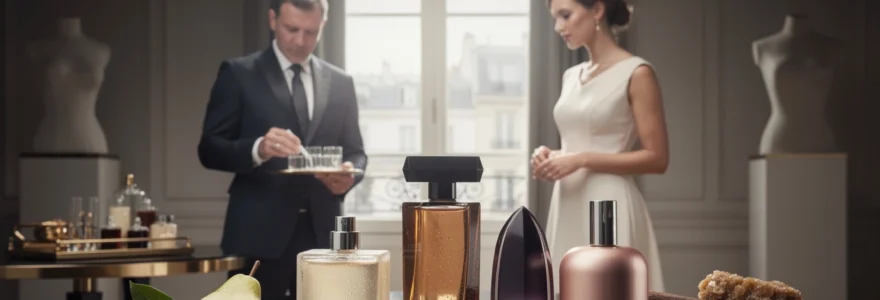
In the rarefied atmosphere of luxury perfumery, where tradition meets innovation and artistry converges with commercial success, Givenchy occupies a distinctive position that transcends conventional fragrance boundaries. Since Hubert de Givenchy first ventured into olfactory creation in 1957 with L’Interdit, the maison has consistently challenged perfumery conventions whilst maintaining an unwavering commitment to sophisticated elegance. The house’s approach to fragrance development mirrors its couture heritage, treating each scent as a carefully constructed composition that dresses the skin with the same precision and artistry as haute couture garments dress the body. This philosophy has resulted in a collection of fragrances that don’t merely follow trends but establish new olfactory territories, blending unexpected elements with classic structures to create scents that are both timelessly elegant and provocatively modern.
Givenchy’s olfactory DNA: hubert de givenchy’s couture philosophy translated into fragrance architecture
The architectural precision that defined Hubert de Givenchy’s couture collections finds its olfactory expression in the structured yet fluid nature of Givenchy fragrances. Much like the clean lines and unexpected details that characterised his fashion designs, Givenchy perfumes exhibit a distinctive framework that balances classical elegance with avant-garde surprises. This approach manifests in the careful layering of fragrance notes, where traditional floral bouquets are enhanced with unexpected spice accents, and masculine woody compositions receive delicate floral touches that blur conventional gender boundaries.
The couture influence extends beyond mere aesthetic considerations to encompass the very methodology of fragrance creation. Just as Givenchy garments were constructed with meticulous attention to proportion and silhouette, the house’s perfumes demonstrate similar architectural thinking. Each fragrance possesses what perfumers term “good bones” – a solid structural foundation that supports more delicate ornamental notes. This creates compositions that maintain their integrity throughout their evolution on the skin, much like how a well-tailored garment maintains its shape and elegance regardless of movement or time.
The philosophy of sophisticated rebellion that characterised the founder’s approach to fashion translates directly into the brand’s olfactory creations. Givenchy fragrances consistently challenge expectations by introducing unexpected elements into familiar frameworks. This might manifest as the addition of star anise to a traditional rose composition in Very Irrésistible, or the incorporation of iris into the masculine Gentleman fragrance. These additions serve not merely as novelty but as sophisticated architectural elements that enhance and elevate the overall composition.
Signature molecular compositions: analysing givenchy’s distinctive accord structures
The molecular architecture of Givenchy fragrances reveals a sophisticated understanding of how individual aromatic compounds interact to create harmonious yet complex compositions. Rather than relying on simple linear progressions from top to base notes, Givenchy perfumers construct multi-dimensional olfactory experiences that reveal different facets depending on skin chemistry, temperature, and time. This approach requires an intimate knowledge of how various molecules behave both individually and in combination, creating what industry professionals term “intelligent fragrances” – compositions that adapt and evolve uniquely for each wearer.
L’interdit’s forbidden white flower complex: tuberose and orange blossom synergy
L’Interdit’s signature lies in its masterful orchestration of white flowers, where tuberose and orange blossom create a synergistic accord that transcends the sum of its parts. The tuberose provides creamy, narcotic intensity whilst the orange blossom contributes crystalline freshness, creating a tension that maintains the fragrance’s vitality throughout its development. This pairing is enhanced by jasmine sambac, which adds green, slightly animalic facets that prevent the composition from becoming overly sweet or predictable.
The technical brilliance of this accord lies in the careful balancing of volatile and substantive molecules. Orange blossom’s lighter terpenes provide immediate impact and freshness, whilst tuberose’s heavier lactones ensure longevity and depth. The addition of blackcurrant buds introduces a subtle green tartness that acts as a natural preservative for the white flower complex, preventing it from becoming cloying
by counterbalancing its more opulent facets. At a molecular level, this is an illustration of Givenchy’s broader olfactory DNA: a constant play between radiance and shadow, weightlessness and density, that keeps the “forbidden white flower” bouquet both addictive and impeccably polished on the skin.
Gentlemen only’s masculine woody-aromatic framework: pink pepper and patchouli integration
If L’Interdit represents Givenchy’s mastery of white florals, Gentlemen Only showcases the house’s talent for reimagining woody-aromatic masculinity. The fragrance architecture is built around a pink pepper and patchouli integration that feels both familiar and intriguingly modern. Pink pepper introduces a sparkling, almost effervescent spiciness, rich in rosy, terpenic molecules that create immediate lift and contrast against the darker, earthier tones of patchouli. This bright, peppery top accord sets the stage for a nuanced evolution rather than a simple linear dry-down.
Patchouli, with its complex profile of woody, camphoraceous and subtly chocolate-like nuances, provides the backbone of Gentlemen Only’s masculine framework. Rather than letting patchouli dominate in a heavy, vintage manner, Givenchy’s perfumers refine it using fractionated qualities and carefully dosed supporting woods. Cedar, vetiver and modern amber molecules interlock with patchouli, smoothing out its rougher edges while amplifying its depth. The result is a woody signature that feels “tailored” – structured, clean and textural, like a perfectly cut suit with discreet, unexpected lining details.
From a technical standpoint, the interplay of pink pepper’s light, volatile components with the more substantive patchouli fractions exemplifies Givenchy’s “intelligent fragrance” philosophy. As the top notes dissipate, the peppery sparkle does not simply vanish; traces of its rosy-spicy character remain woven into the heart through shared molecular facets with woods and aromatic herbs. This creates a continuous aromatic thread that you can perceive from first spray to late dry-down, making Gentlemen Only a sophisticated choice if you are seeking a long-lasting woody fragrance with a modern, understated twist.
Ange ou démon’s duality concept: light versus dark olfactory contrasts
Ange ou Démon takes Givenchy’s fascination with contrast and codifies it into a full-fledged duality concept. Rather than a simple “sweet versus heavy” structure, the composition explores light and dark olfactory contrasts at multiple levels: brightness versus shadow, translucency versus density, innocence versus seduction. The luminous facet is built around airy florals and citrus, often featuring mandarin and a transparent jasmine quality that lend a crystalline, almost halo-like glow. These notes leverage highly diffusive molecules that project lightness without becoming sharp.
Opposing this radiance is a darker undercurrent of woods, resins and gourmand nuances. Thick, balsamic notes, enriched with amber and exotic woods, create a velvety base that wraps the wearer like a midnight cloak. Molecules such as vanillic benzoin and warm tonka give the composition a sensual, almost addictive pull, referencing the “démon” side of the fragrance’s name. By engineering these two poles to overlap rather than simply stack, Givenchy achieves an effect similar to chiaroscuro in painting: the light seems brighter because of the surrounding darkness, and the depth feels richer because of the sparkling highlights.
This duality is not only conceptual but also functional when you consider real-life wear. On some skins, the luminous floral-citrus characters are accentuated, making Ange ou Démon feel like an ethereal, sophisticated day scent. On others, the resinous gourmand base rises more quickly, creating a sultrier, evening-appropriate aura. This adaptive personality is part of what distinguishes Givenchy scents in the world of sophisticated perfumery: the same formula offers multiple interpretations, allowing you to inhabit both your “angelic” and “demonic” sides depending on context, temperature and even your own mood.
Irresistible’s modern gourmand innovation: pear and ambergris molecular pairing
Within the contemporary landscape of gourmand perfumery, Irresistible stands out through its refined pairing of juicy pear facets with an ambergris-inspired base. Rather than leaning on overtly sugary accords, Givenchy opts for a ripe yet crisp pear note, rich in esters that evoke freshness, transparency and a mouth-watering fruitiness. This pear signature functions almost like a spotlight in the composition, instantly recognisable and emotionally uplifting, tapping into the trend for “feel-good” fragrances that still retain an air of luxury.
What makes Irresistible particularly sophisticated is the decision to anchor this playful fruitiness in an ambergris molecular framework. Using modern amberwood and ambroxan-type materials, the perfumers recreate the mineral, salty, skin-like warmth historically associated with natural ambergris. This pairing creates a fascinating tension: bright, almost sparkling fruity molecules dance on top of a diffusive, musky-woody base that feels both airy and long-lasting. You get the comfort and sensuality of a gourmand fragrance without the heaviness of traditional vanilla-bomb compositions.
On a technical level, the pear and ambergris accord showcases Givenchy’s precise control over diffusion and sillage. Pear’s volatile components are calibrated to blend gradually into floral and woody heart notes, while the ambergris-style molecules provide a powerful but transparent radiance that can be perceived at arm’s length without becoming overwhelming. For anyone searching for a modern gourmand fragrance that feels clean, luminous and “second-skin” rather than syrupy, Irresistible’s molecular architecture is a clear illustration of how Givenchy pushes this category in a more sophisticated, couture direction.
Master perfumer collaborations: creative partnerships defining givenchy’s olfactory excellence
Behind every iconic Givenchy scent lies a close collaboration with master perfumers, many of whom are responsible for the most acclaimed compositions in modern perfumery. Rather than imposing a rigid house style, Givenchy cultivates ongoing creative partnerships that allow perfumers to explore the brand’s codes of elegance, duality and subtle rebellion in depth. This long-term dialogue is crucial in a market where over 2,000 new fragrances launch annually worldwide; it ensures that Givenchy fragrances feel coherent and recognisable even as they innovate.
These collaborations also align with the brand’s couture heritage. Just as a fashion house might work repeatedly with a particular pattern-maker or atelier head, Givenchy returns to perfumers whose sensibilities resonate with its own aesthetic. You can see this in the way certain noses revisit themes like white florals, patchouli or airy musks across different launches, refining them each time. The result is an olfactory “handwriting” that’s subtle but unmistakable: if you wear L’Interdit, Gentleman or Irresistible, you experience variations on a shared vocabulary of elegance and tension.
Dominique ropion’s artistic vision: crafting L’Interdit and gentleman fragrances
Dominique Ropion is widely regarded as one of the great technicians and artists of contemporary perfumery, and his work with Givenchy exemplifies his ability to balance precision with emotion. In the modern reinterpretations of L’Interdit, Ropion (often in co-creation) revisits the original white-flower icon with new molecular tools, enhancing its intensity while preserving its chic restraint. The way he sculpts tuberose, jasmine and orange blossom – amplifying their radiance yet keeping them beautifully controlled – mirrors the discipline of haute couture pattern cutting, where every seam has a purpose.
Ropion’s contribution to the Gentleman line further illustrates his nuanced understanding of masculine identity in fragrance. Instead of relying on blunt strength, he plays with contrasts: robust woods softened by iris, spices sharpened by clean musks, sweetness carefully countered by herbaceous or mineral facets. This allows Gentleman fragrances to feel powerful yet sensitive, classic yet open-minded – a profile that speaks clearly to modern men who want refinement rather than cliché. When you spray a Gentleman scent, you are essentially wearing Ropion’s vision of what a “new gentleman” should smell like: self-assured, but never loud.
From an industry perspective, having a perfumer of Ropion’s calibre attached to key pillars helps anchor Givenchy’s standing in sophisticated perfumery. His formulas are known for their structural integrity and high-quality raw material usage, factors that contribute to the strong performance and longevity you may notice on skin or fabric. In a market where many launches feel ephemeral, Ropion’s work with Givenchy has the density and balance required to produce true future classics.
Fifi grangé’s feminine touch: creating ange ou démon’s complex character
With Ange ou Démon, perfumer Fifi Grangé brought a distinctly feminine, almost narrative-driven sensibility to Givenchy’s portfolio. The fragrance’s dual angel/demon concept could have been treated as a simple marketing story, yet Grangé translates it into a layered, nuanced composition where every contrast feels intentional. Light, airy top notes and transparent florals are given equal importance to the denser, more carnal base, reflecting an understanding that modern femininity is rarely one-dimensional.
Grangé’s feminine touch lies in the way she smooths transitions between these opposing facets. Rather than abrupt shifts from innocence to seduction, Ange ou Démon glides gradually through stages, much like the changing light in a day. Soft spices, creamy woods and delicately vanillic tones act as bridges between luminous and shadowy elements, creating a sensuous continuity. This is crucial if you’re looking for a signature scent that feels complex but wearable: you can enjoy the thrill of contrast without experiencing olfactory “whiplash.”
Her work also underscores Givenchy’s long-standing commitment to character-driven women’s fragrances. Ange ou Démon does not attempt to please everyone; instead, it speaks powerfully to those who recognise themselves in its duality. In the broader context of sophisticated perfumery, this kind of focused, story-rich composition helps Givenchy differentiate itself from more generic offerings, inviting you to choose a scent that reflects an inner narrative rather than a passing trend.
Anne flipo and dominique ropion’s irresistible partnership: contemporary french perfumery
The Irresistible line benefits from the combined expertise of Anne Flipo and Dominique Ropion, a partnership that brings together two distinct yet complementary visions of contemporary French perfumery. Flipo is renowned for her luminous, joyful compositions, often characterised by airy florals and crisp fruits, while Ropion contributes structural rigor and depth. In Irresistible, their shared authorship is evident in the way the fragrance feels both spontaneous and meticulously engineered.
Flipo’s influence can be sensed most clearly in the radiant pear and rose facets that define Irresistible’s opening and heart. These notes are vibrant and modern, using advanced captive molecules to achieve a natural, dewy effect that persists far longer than classical materials would allow. Ropion’s role becomes more apparent as the scent settles, with sophisticated woods, musks and ambers creating a subtle but persistent trail. This interplay is a perfect illustration of how Givenchy fragrances are designed to evolve beautifully from first impression to final whisper.
For you as a wearer, the Flipo–Ropion collaboration translates into a fragrance wardrobe within a single bottle: uplifting enough for daytime, sensual enough for evening, polished enough for professional environments and intimate enough for close encounters. In a global market where consumers increasingly seek “signature scents” that can transition seamlessly across settings, this kind of flexible yet characterful design is a key differentiator for Givenchy.
Premium raw material sourcing: givenchy’s quality-driven ingredient selection process
While the artistry of composition is central to Givenchy’s identity, the house is equally rigorous about the raw materials it uses to construct its sophisticated fragrances. In an era where sustainability, traceability and quality are under intense scrutiny, Givenchy works closely with leading fragrance suppliers to secure high-grade naturals and innovative synthetics. This encompasses everything from responsibly sourced patchouli and vetiver to cutting-edge musks and amber molecules that enhance performance without compromising on refinement.
One hallmark of Givenchy’s ingredient strategy is the use of fractionated and “polished” naturals. Instead of relying on crude extractions that can smell heavy or inconsistent, the brand often opts for specific fractions of ingredients like patchouli, iris or cedarwood, isolating desirable facets while minimising rougher elements. It’s comparable to a couturier choosing a particular weave or finish of fabric: the material is recognisably the same, but the texture, weight and drape are optimised for the desired effect on skin. This attention to detail is a key reason why many Givenchy scents feel both rich and remarkably clean.
Givenchy also places emphasis on long-term supplier relationships, particularly for emblematic notes such as jasmine, tuberose and orange blossom in L’Interdit, or the patchouli and vetiver that characterise Gentleman and Gentleman Only. Strategic sourcing from regions like India, Madagascar or Grasse ensures not only olfactory excellence but also greater control over batch-to-batch consistency. As consumers become more aware of the story behind their perfumes, this traceable approach reinforces Givenchy’s positioning in the luxury fragrance segment.
From a performance standpoint, the brand’s use of high-quality, often proprietary molecules helps deliver the projection and longevity that many fragrance enthusiasts now expect. Modern ambergris-style materials, ultra-fine musks and state-of-the-art diffusive woods enable scents like Irresistible or Gentleman Society to radiate with a soft yet persistent aura. If you’ve ever wondered why certain Givenchy fragrances cling beautifully to clothing or seem to reappear in subtle waves throughout the day, the answer lies as much in ingredient choice as in compositional skill.
Bottle design philosophy: architectural aesthetics reflecting haute couture heritage
Givenchy’s bottle designs are far more than mere containers; they are three-dimensional extensions of the maison’s couture language. The brand consistently favours architectural lines, balanced proportions and refined detailing that echo Hubert de Givenchy’s love for structure and simplicity. You can see this in the clean, slightly rounded rectangular silhouette of L’Interdit’s bottle, which recalls vintage apothecary flacons but is streamlined with modern transparency and a couture-like “collar” at the neck. It feels at once timeless and contemporary, much like a perfectly cut little black dress.
The Gentleman bottles, by contrast, evoke the gravitas and tailoring of a masculine wardrobe. Strong shoulders, clear horizontal bands and weighty glass communicate solidity and reliability, while subtle curves keep the design from feeling rigid. The interplay of glossy and matte finishes on certain editions mirrors the contrast between a crisp shirt and a textured tie, or between polished leather and soft wool. This visual tension quietly reinforces the olfactory narrative of strength tempered by sensitivity that runs through the Gentleman line.
In more playful or daring ranges such as Irresistible or Ange ou Démon, Givenchy explores additional sculptural and chromatic codes without abandoning its underlying architectural discipline. Soft pinks, faceted surfaces and delicate gradations of colour in Irresistible’s flacon suggest light, movement and a certain joyful femininity, while still maintaining geometric coherence. Ange ou Démon’s more dramatic bottle, with its angular, almost crystalline silhouette, nods directly to the light-and-shadow duality of the juice inside. As with haute couture, these bottles do more than please the eye; they communicate character at a glance.
For the consumer, this design philosophy enhances the overall luxury fragrance experience. A Givenchy bottle is meant to feel comfortable in the hand, stable on a vanity and visually harmonious alongside other beauty objects, almost like a small piece of architecture for the dressing table. Spraying becomes a daily ritual comparable to slipping on a favourite tailored jacket or dress: an act that is as much about how you feel as how you look or smell. In a crowded market, this harmony of form and function helps cement Givenchy’s status as a house where aesthetics are never an afterthought.
Market positioning strategy: givenchy’s luxury fragrance segment differentiation against competitors
In the competitive arena of designer and luxury perfumery, Givenchy positions itself at the intersection of heritage and modernity, carving out a unique niche between ultra-classic houses and more disruptive niche brands. Rather than chasing every passing trend, the maison focuses on building strong fragrance “pillars” – lines like L’Interdit, Gentleman, Irresistible and Ange ou Démon – that can be developed over time through flankers and limited editions. This strategy allows Givenchy to offer variety without diluting its core identity, an important distinction if you want your signature scent to remain recognisable even as new versions appear.
Price-wise, Givenchy typically sits in the premium designer segment: accessible enough to attract a broad audience, yet elevated through quality of materials, bottle design and storytelling. This mid-to-high positioning helps the brand compete credibly with other LVMH and prestige players while still offering clear value against many niche houses. For consumers, that means you can enjoy sophisticated perfumery – refined white florals, nuanced patchoulis, complex amber accords – at a price point that remains realistic for everyday wear, not just special occasions.
Differentiation also comes from Givenchy’s gender-fluid approach to scent design and marketing. While fragrances are still broadly segmented into men’s and women’s lines at retail, the underlying compositions often incorporate elements traditionally associated with the opposite gender – iris in Gentleman, woody tones in women’s launches, gourmand signatures softened by mineral musks in unisex collections. This reflects wider cultural shifts in how we talk about and wear fragrance. If you’re drawn to crossing those boundaries, Givenchy offers a particularly comfortable space to do so within the mainstream market.
Finally, the brand’s communication strategy emphasises personality and attitude over purely aspirational fantasy. Campaigns fronted by actors and artists such as Rooney Mara, Aaron Taylor-Johnson or Benjamin Clementine highlight character, charisma and individuality rather than unattainable perfection. In an environment where consumers increasingly seek authenticity and emotional connection from their luxury fragrance choices, this focus on “who you are” rather than “what you should be” gives Givenchy a clear and enduring point of difference in the world of sophisticated perfumery.