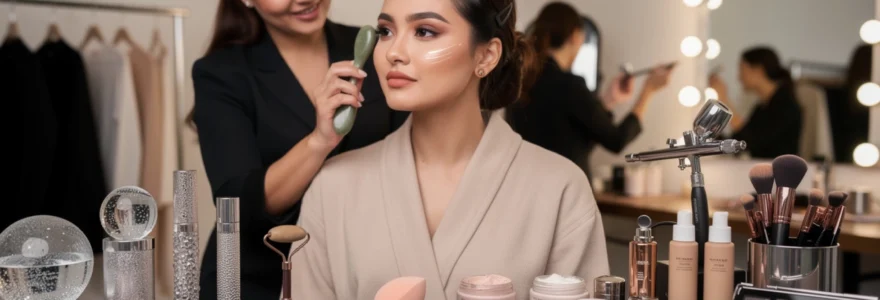
Behind the glamour of fashion week runways and high-profile photoshoots lies a world of meticulously honed techniques that transform skin into camera-ready perfection. Professional makeup artists working in high-pressure backstage environments have developed sophisticated methods that deliver flawless complexions in remarkably short timeframes. These industry experts understand that exceptional makeup application begins long before the first brush touches skin—it starts with comprehensive preparation protocols that optimise texture, hydration, and luminosity.
The distinction between everyday makeup and professional backstage artistry isn’t merely about product quality or application skill. It’s about understanding the science behind complexion perfection: how light interacts with skin, which formulations provide genuine longevity under harsh stage lighting, and which preparation techniques yield results that translate beautifully both in person and on camera. Whether you’re preparing for a special occasion or simply seeking to elevate your daily routine, these professional strategies offer transformative potential for anyone committed to achieving exceptional skin presentation.
Professional skin preparation protocols used by celebrity makeup artists
The foundation of any exceptional makeup application begins with thorough skin preparation. Celebrity makeup artists understand that proper skin prep accounts for approximately 60% of the final result, making it the most critical phase of the entire process. Unlike rushed morning routines, professional preparation follows systematic protocols designed to optimise skin texture, hydration levels, and overall receptivity to cosmetic products.
Backstage at major fashion shows, time constraints demand efficiency without compromising results. Artists typically allocate 8-12 minutes for comprehensive skin preparation, focusing on three primary objectives: eliminating surface debris and dead skin cells, balancing hydration levels across different facial zones, and creating an ideal canvas texture that allows products to adhere seamlessly. This methodical approach ensures makeup wears beautifully throughout extended photoshoots or performances lasting several hours.
Cryotherapy facial tools: ice globes and cryo sticks for depuffing
Cryotherapy applications have become indispensable in professional makeup environments, particularly when working with models and performers who operate on minimal sleep. Ice globes—smooth, weighted spheres typically crafted from tempered glass or stainless steel—deliver concentrated cold therapy that constricts blood vessels, reduces inflammation, and provides immediate depuffing effects. When chilled to approximately 0-5°C and rolled across the face using specific lymphatic drainage patterns, these tools can reduce under-eye puffiness by up to 40% within just three minutes.
Cryo sticks offer similar benefits with enhanced precision for targeted areas. Their elongated design allows makeup artists to address specific concerns: the orbital bone area beneath eyes, the nasolabial folds prone to product settling, and the jawline where fluid retention creates undefined contours. Professional application involves maintaining consistent pressure whilst moving the tool in upward, outward motions that follow natural lymphatic pathways. This technique not only reduces visible swelling but also temporarily tightens pores, creating an exceptionally smooth surface for subsequent product application.
Lymphatic drainage massage techniques with gua sha and jade rollers
Lymphatic drainage massage represents a cornerstone technique in backstage beauty protocols. Unlike traditional facial massage that focuses on muscle manipulation, lymphatic techniques specifically target the body’s waste removal system. When performed correctly, these methods facilitate the movement of accumulated fluid and toxins towards lymph nodes, resulting in reduced facial puffiness, improved circulation, and enhanced product absorption. Professional makeup artists estimate that proper lymphatic drainage can improve foundation application quality by approximately 35% by creating more even skin texture.
Gua sha tools, traditionally crafted from jade, rose quartz, or bian stone, feature strategically designed edges and curves that correspond to facial contours. The technique involves applying moderate pressure whilst scraping the tool across skin in specific directional patterns: always moving towards lymph node clusters located near the ears, jawline, and collarbone. Jade rollers provide a gentler alternative, featuring dual-sized cylindrical stones mounted on handles. The smaller roller addresses delicate areas around eyes and nose, whilst the larger roller efficiently covers broader zones like cheeks and forehead. Both methods should be performed on cleansed skin with a facial oil or serum to ensure smooth gliding without pulling or dra
gging.
For backstage results at home, focus your lymphatic drainage massage on three key areas: under the eyes, along the jawline, and beside the nose where congestion often builds. Use light to medium pressure—imagine sliding a credit card over gel, not scraping a wooden table—and always work in upward and outward motions. Two to three minutes of consistent jade rolling or gua sha can significantly reduce morning puffiness, soften fine lines temporarily, and create the kind of smooth, lifted surface that makes foundation glide on rather than cling to texture. When done regularly, many artists report they need 20–30% less base product to achieve the same level of coverage.
Microcurrent devices: NuFace and foreo bear for instant lifting
Microcurrent devices like NuFace and Foreo Bear have moved from facialist treatment rooms straight into backstage kits because of their ability to deliver a visible “mini facelift” in under 10 minutes. These tools emit low-level electrical currents that mimic the body’s natural bioelectricity, stimulating facial muscles and boosting ATP (adenosine triphosphate) production. In practical terms, that means subtly lifted cheekbones, a more defined jawline, and firmer-looking skin—all critical for a flawless complexion under unforgiving HD cameras.
Celebrity makeup artists typically use microcurrent after cleansing but before any heavy serums or creams. A conductive gel is applied to allow the current to pass efficiently, then the device is glided along muscle lines: from jaw to ear, corner of mouth to temple, and under the cheekbone for lift. Think of it as a “gym session” for your face—short, targeted, and focused on creating tone. Studies indicate that regular microcurrent use can increase collagen and elastin production over time, but even a single backstage session can make foundation sit more smoothly and reduce the need for aggressive contouring.
If you want to integrate this backstage trick into your own routine, aim for three to five minutes of focused work on areas that tend to droop or lose definition, such as nasolabial folds and the lower face. Keep the current at a comfortable setting—there should be no pain, only a mild tingling or tightening sensation. Because microcurrent temporarily improves circulation and lymph flow, you’ll often notice a fresher tone to the skin, which allows you to opt for more natural, skin-like foundation finishes without sacrificing definition or structure.
Pre-makeup hydration masks: charlotte tilbury magic cream method
Hydration masks are one of the most effective ways to achieve a plump, luminous base in very little time, which is why they’re a staple in celebrity red carpet prep. The Charlotte Tilbury Magic Cream method has become almost legendary backstage: a rich, occlusive moisturizer is massaged into the skin using fast, upward strokes that combine hydration, massage, and mild exfoliation. This “facial in a jar” approach floods the epidermis with moisture while boosting microcirculation, creating an instant glow that reads as youthful and healthy on camera.
Professionals often layer a thin hydrating sheet mask or gel mask first, leaving it on for five to ten minutes while hair is being prepped, then remove excess serum and follow with Magic Cream or a similarly rich moisturizer. The key is in the massage technique—using fingertips to tap, press, and lightly pinch along the cheekbones, jawline, and forehead. This not only encourages deeper penetration of humectants like hyaluronic acid but also temporarily relaxes tension lines, softening the appearance of wrinkles before a single drop of foundation is applied.
At home, you can recreate this backstage hydration ritual even if you do not own the exact products. Choose a sheet mask focused on hydration rather than anti-aging actives, then follow with a cream that offers both emollients and occlusives. Spend a full two minutes massaging it in; think of it as an investment that will allow you to wear less makeup while still achieving a flawless complexion. You will notice that foundation grips better, looks less cakey, and remains radiant for longer because the skin underneath is genuinely moisturised, not just superficially coated.
Primer technology and silicone-based complexion perfecting formulations
Once the skin is prepped, backstage artists turn to primer technology to engineer an ultra-smooth, long-wearing surface. Modern primers are less about simply “making makeup last” and more about customising the skin’s behaviour under foundation—controlling oil, diffusing pores, soothing sensitivity, or adding light-reflecting radiance. Silicone-based formulations, in particular, have become indispensable because of their ability to blur imperfections and create a breathable yet highly stable film on the skin.
Understanding how these primer technologies work allows you to select formulas strategically rather than applying them as a one-size-fits-all step. A red carpet makeup artist might layer a mattifying primer only through the T-zone, a hydrating primer on the cheeks, and a colour-correcting base around the nose and chin. By approaching primer as a targeted treatment instead of a single blanket application, you mirror the precision used backstage and dramatically improve the longevity and realism of your complexion makeup.
Dimethicone and cyclopentasiloxane: pore-blurring chemistry explained
Silicone-based primers rely heavily on ingredients like dimethicone and cyclopentasiloxane to achieve that instantly smoothed, airbrushed effect. Dimethicone is a heavier silicone that forms a flexible, non-comedogenic barrier over the skin, filling in fine lines and visible pores. Cyclopentasiloxane, on the other hand, is lighter and more volatile, evaporating after application while helping spread the product evenly. Together, they create a silky texture that allows foundation to glide on without catching on dryness or texture.
From a visual perspective, these silicones scatter and refract light, reducing the contrast between raised and indented areas of the skin. This is why pore-blurring primers can make even rough or acne-prone skin appear smoother in photos and under bright studio lighting. Think of them as a soft-focus filter built into your base routine—rather than covering imperfections with more pigment, you are optically minimising them so you can actually use less foundation. For oil-prone skin, this is crucial because it prevents the “heavy base” effect that can break apart as sebum rises throughout the day.
For everyday use, apply silicone-based primers sparingly and only where needed—typically along the sides of the nose, centre of the forehead, chin, and over enlarged pores on the cheeks. Use clean fingertips to press the formula into the skin instead of rubbing; pressing encourages the product to settle more evenly into tiny irregularities. If you are concerned about sensitivity, look for non-fragranced primers and always patch test, but rest assured that dimethicone is widely considered non-irritating and is often used in dermatological formulations for compromised skin.
Colour-correcting primers: peach, green, and lavender undertone neutralisation
Backstage, colour-correcting primers are a subtle yet powerful tool for achieving a flawless complexion with minimal coverage. Rather than layering on heavy concealer to hide redness, sallowness, or dark shadows, artists employ sheer tints to neutralise discolouration before foundation. Peach and salmon tones counteract blue and purple under-eye circles on light to medium skin, while deeper apricot shades work beautifully on richer skin tones. Green primers neutralise redness from rosacea, blemishes, or irritation, and lavender tones help brighten sallow, yellow undertones.
The trick is to think in terms of sheer washes of corrective colour rather than opaque blocks. You are not trying to create orange or green patches; you are gently shifting the underlying tone so your usual foundation can do less heavy lifting. A pea-sized amount of peach primer under the eyes, for example, can reduce the need for high-coverage concealer that might look dry or creased in a few hours. Similarly, a whisper of green around the nostrils and across the centre cheeks can cancel persistent redness, allowing for a more natural, skin-like base.
If you want to borrow this colour-correcting strategy from backstage routines, apply your corrections only to areas that truly need them and blend the edges well with a damp sponge or fingertips. Then, step back from the mirror and check in natural light—if you still see strong green or lavender, you have applied too much. Once your foundation is layered on top, the skin should look neutral and even, not tinted. This approach is particularly effective for bridal and event makeup where flash photography can exaggerate any mismatched or over-applied corrective tones.
Mattifying primers with oil-absorbing microspheres for shine control
Shine control is a constant battle under stage lights and camera flashes, which is why mattifying primers with oil-absorbing microspheres are non-negotiable backstage. These formulations often contain silica, rice powder, or polymer-based microspheres that act like microscopic sponges, soaking up excess sebum as it appears. Unlike traditional heavy powders that can leave the skin looking flat or chalky, these primers keep the complexion matte yet still dimensional and skin-like.
Professional artists rarely apply mattifying formulas all over the face; instead, they map them onto specific “hot zones” where shine tends to peak first. This targeted approach retains a natural glow on the high points of the face while preventing unwanted greasiness across the T-zone. In hot or humid environments, a thin layer of mattifying primer can extend foundation wear by several hours, reducing the frequency of touch-ups and blotting. For oily or combination skin, this backstage trick can be nothing short of transformative.
At home, treat mattifying primers as a preventative step rather than a fix. Apply after your regular moisturizer has fully absorbed, focusing on the centre forehead, around the nose, and on the chin. If you struggle with mid-day shine even with good skincare, consider layering a tiny amount of primer over your first layer of foundation and then setting lightly with powder. This “sandwiching” approach creates multiple barriers against oil breakthrough without building up obvious texture on the surface.
Hydrating primer bases: hyaluronic acid and glycerin infusions
On the other end of the spectrum, hydrating primers enriched with hyaluronic acid and glycerin are vital for keeping drier or mature skin looking plump and luminous under makeup. Hyaluronic acid can hold up to 1,000 times its weight in water, drawing moisture into the upper layers of the epidermis, while glycerin acts as a humectant and slip agent, improving both hydration and the way foundation glides. When skin is properly hydrated, fine lines appear softer and foundation is far less likely to cling to rough patches or settle into creases.
Backstage, these hydrating primers are often used directly after skincare and before any silicone-based blurring products. This layering order mimics a well-constructed skincare routine: water-based hydration first, followed by occlusive and texturising steps. The result is a complexion that looks naturally dewy, not greasy—a crucial distinction on HD cameras that can easily translate excess shine into a “sweaty” appearance. For models and actors who have been travelling, a hydrating primer can replace an additional layer of moisturizer, streamlining the routine while still delivering comfort and glow.
If you are aiming for a flawless yet fresh-looking complexion, especially during colder months or in air-conditioned environments, choose a primer that lists hyaluronic acid, glycerin, or panthenol near the top of the ingredient list. Apply a thin, even layer over the entire face, then wait 60–90 seconds before following with foundation to allow the humectants to settle. You will find that sheer or medium-coverage bases suddenly become enough; when the skin beneath is plump and supple, you no longer need to rely on heavy coverage to create the illusion of health.
Foundation application methods for photoshoot-ready skin
With skin prep and primers in place, the focus backstage shifts to foundation application methods that deliver the elusive combination of coverage, longevity, and believability. It is not just the formula that determines a flawless complexion but also the tools, pressure, and layering techniques used. Under intense lighting, any streaks, uneven patches, or mismatched tones are magnified, so professional artists employ precise systems to ensure foundation appears seamless from every angle and distance.
Whether they are working with full-coverage long-wear formulas or lighter, skin-tint textures, the goal is the same: to create a base that looks like perfected skin rather than makeup sitting on top of it. By understanding the strengths of airbrush systems, stippling brushes, damp sponges, and layered liquid-powder combinations, you can choose the method that best suits your skin type, lifestyle, and desired finish—without having to own a full backstage kit.
Airbrush foundation systems: temptu and luminess air techniques
Airbrush foundation systems like Temptu and Luminess Air are backstage favourites for editorial shoots and high-definition filming because they produce an ultra-fine mist of pigment. This micro-droplet application creates a thin, even veil of product that fuses with the skin’s surface rather than sitting in visible layers. The result? A second-skin effect that photographs beautifully and requires minimal retouching, even under 4K cameras. Because the spray is so fine, it can also be built up selectively over areas that need more coverage without looking cakey.
Artists typically begin by applying a sheer, all-over pass of foundation, holding the airbrush wand about 15–20 cm from the face and moving in small, circular motions. They then step closer and spot-build coverage on areas of redness or pigmentation, much like digital “airbrushing” in post-production—but done in real life. One underrated advantage is hygiene: since the device never directly touches the skin, there is reduced risk of contamination or streaking. For long days on set, airbrush foundation also tends to resist sweat and sebum better than many traditional liquid formulas.
At home, a full airbrush kit might feel like an investment, but if you frequently attend events or work on camera, it can be worthwhile. Start with low pressure and practice on the back of your hand to get comfortable with distance and movement; the key is to keep the wand moving so you do not overload any area. If you prefer not to commit to a system, you can still mimic the effect by mixing a few drops of a full-coverage foundation with a liquid highlighter or moisturizer and applying with a dense brush in very thin layers, aiming for that same “barely there” veil of colour.
Stippling and buffing brushwork: sigma F80 and real techniques methods
For most backstage scenarios, however, high-quality foundation brushes remain the workhorses of complexion perfection. The Sigma F80 and comparable buffing brushes from Real Techniques are beloved for their densely packed, synthetic bristles that distribute product evenly across the skin. Stippling—pressing the brush straight down in small, bouncing motions—creates a soft-focus effect and preserves coverage, while buffing—using small circular motions—blends edges and melts the product into the skin for an undetectable finish.
Professional artists often combine these techniques: they stipple foundation into the centre of the face, where more coverage is usually needed, then buff outwards toward the hairline and jaw. This prevents tell-tale lines of demarcation while keeping redness, broken capillaries, or discolouration under control. Think of it as painting a gradient: the most saturation in the middle, gently fading to natural skin at the edges. This approach ensures that the complexion looks believable up close yet still polished from a distance, which is exactly what high-pressure backstage environments demand.
If you are upgrading your own routine, focus less on the number of brushes you own and more on mastering pressure and movement with one or two good tools. Use light pressure to avoid lifting product back off the skin, and clean your brushes regularly to prevent streaks or patchiness caused by product build-up. A stippling or buffing brush can also be used to refine the edges of cream bronzer and blush, helping every complexion product blend together seamlessly for a truly flawless base.
Beauty sponge dampening: beautyblender bounce application
Damp beauty sponges, such as the classic Beautyblender, are another backstage essential for achieving what many artists call the “real skin finish.” When properly dampened—expanded with water, then squeezed until just slightly moist—the sponge absorbs excess product and presses the remaining foundation into the skin in tiny, diffused layers. This prevents heaviness while still delivering the coverage required for a flawless complexion on stage or in photographs.
Backstage, artists often use a dual-tool approach: foundation is first applied with a brush for speed and coverage, then perfected with a damp sponge to erase any brush strokes and push the product into textured areas like around the nose or over fine lines. The sponge acts almost like a mini airbrush, diffusing pigment and merging it with primers and skincare underneath. It also excels at blending concealer into foundation, ensuring that under-eye brightness transitions gradually into the rest of the face without visible edges.
To get the most from this method at home, avoid using your sponge dry—it will absorb more product, create patchiness, and fail to deliver that signature blurred effect. Instead, run it under water until fully expanded, then squeeze it in a towel until only a faint dampness remains. Use bouncing, pressing motions rather than dragging, and pay particular attention to the nostrils, corners of the mouth, and along the jawline. You will notice that even full-coverage foundations suddenly look more natural, as if the pigment is part of your skin rather than a layer on top.
Layering liquid and powder formulations: the sandwich technique
One of the most reliable backstage tricks for a truly long-lasting, flawless complexion is the “sandwich technique,” which involves layering liquid and powder formulations strategically. The basic structure is simple: start with a thin layer of liquid foundation, set targeted areas with a fine powder, and then apply additional cream or liquid products (like blush or bronzer) before a final, light dusting of powder where necessary. This multiple-layer system creates interlocking textures that are far more resistant to sweat, heat, and movement than a single, heavy application.
Think of it like building a stable structure out of alternating materials: each thin layer reinforces the others without adding obvious bulk. Backstage, this technique is especially useful for combination skin where some areas need serious longevity while others benefit from a fresher, less-powdered look. For instance, an artist might set only the T-zone after the first foundation layer, leave the cheeks bare for cream blush and highlight, then lightly veil the entire face with a translucent powder to unify textures.
When trying the sandwich method yourself, the key is restraint. Each layer should be whisper-thin; you should never see visible powder sitting on the skin or feel the base becoming heavy. After applying your initial liquid foundation, press a small amount of powder onto the areas that break down fastest—usually the sides of the nose, centre forehead, and chin—using a puff or small brush. Then apply creams (blush, bronzer, contour) and finish with a minimal dusting of powder only where shine needs to be controlled. This deliberate layering can easily double the wear time of your makeup without compromising on radiance.
Backstage concealing strategies for hyperpigmentation and blemishes
Even the best-prepped skin and most expertly applied foundation often require targeted concealing, especially when dealing with hyperpigmentation, dark circles, and active breakouts. Backstage, the objective is to neutralise and disguise these concerns in a way that remains invisible both to the naked eye and under harsh lighting. Heavy-handed concealer can quickly sabotage an otherwise flawless complexion, so professional artists rely on colour theory, formula selection, and precision placement to achieve coverage that looks like skin.
Instead of automatically applying thick concealer everywhere you see discolouration, consider how backstage artists approach the problem: they analyse the undertone of the concern, choose a correcting shade if needed, then layer a minimal amount of skin-matching concealer only where absolutely necessary. This surgical approach produces a far more sophisticated result than simply masking everything with one opaque product.
Colour theory in corrective concealment: salmon and peach undertones
Corrective concealment is built on the same colour-wheel logic as colour-correcting primers but applied more locally and with higher pigment. Salmon and peach undertones are especially useful backstage for counteracting blue and purple shadows under the eyes, as well as post-inflammatory hyperpigmentation left by healed blemishes. On fair skin, a light peach or bisque shade is ideal; on medium to deep skin, richer apricot or terracotta correctors neutralise darkness without turning ashy.
By neutralising the underlying tone first, you dramatically reduce the amount of skin-tone concealer needed on top. This is important because thick layers under the eyes are prone to creasing and emphasising texture, particularly after several hours of wear. Think of the corrector as a “background edit”: once you have shifted the canvas closer to your natural tone, the final touches of concealer can be feather-light yet still appear fully opaque. Backstage artists often use a small, synthetic brush or even their fingertips to tap corrector precisely onto the darkest areas only, avoiding unnecessary buildup on nearby skin.
If you are unsure which shade you need, look at the discolouration you are trying to correct in natural light. Do you see more blue, purple, or brown? Blue and purple are best addressed with peachy tones, while brown hyperpigmentation can benefit from slightly more orange or red-based correctors, especially on deeper complexions. Always set corrected areas with a tiny amount of translucent powder before layering regular concealer on top; this locks in the undertone adjustment and prevents the shades from muddying together.
Full-coverage concealer formulas: tarte shape tape and NARS radiant creamy
When it comes to concealing stubborn blemishes and uneven pigmentation backstage, full-coverage formulas like Tarte Shape Tape and NARS Radiant Creamy Concealer are staples. These products offer high pigment density, meaning you can achieve significant coverage with a very small amount of product—a crucial factor in maintaining a skin-like finish. The goal is not to spread them broadly across the face, but to treat them as highly concentrated tools for small, specific areas.
Backstage artists typically decant a tiny amount of concealer onto a palette or the back of their hand, then work with fine brushes to apply and blend. Tarte Shape Tape, with its matte, self-setting formula, is often reserved for more resilient areas like the jawline or forehead, while NARS Radiant Creamy’s more luminous finish is preferred around the eyes or on drier skin types. The key is to respect the natural variations in skin texture: a matte formula can look beautiful over a raised blemish but may appear too dry under crepey under-eyes, while a dewy concealer might slide off an oily T-zone.
For personal use, resist the urge to swipe the applicator wand directly across large zones under the eyes or on the cheeks. Instead, place one or two small dots only where darkness or redness is most intense, then blend out the edges with a brush or sponge. If you need more coverage, build in ultra-thin layers rather than one thick one. This method, borrowed directly from professional practice, preserves the realism of your complexion while still delivering the kind of correction you expect from full-coverage products.
Spot concealing versus area concealing: precision brush techniques
One of the most important distinctions in backstage complexion work is the difference between spot concealing and area concealing. Spot concealing targets individual blemishes, tiny scars, or hyperpigmentation marks with a small brush—often no larger than a fine lip or eyeliner brush. Area concealing, by contrast, deals with larger patches of discolouration, such as overall darkness under the eyes or redness across the cheeks. Confusing the two leads either to under-coverage (when you try to fix a whole area with pinpoint work) or cakiness (when you blanket an entire zone in high-coverage formulas).
For spot concealing, backstage artists frequently use a technique known as “place and wait.” They place a small amount of concealer directly onto the blemish, wait 10–20 seconds for the formula to thicken slightly, then use a clean brush or fingertip to gently tap the edges only, leaving the centre more opaque. This allows the concealer to adhere better and resist sliding off raised or oily spots. A tiny dusting of powder applied with a small eyeshadow brush finishes the process, locking the coverage in place without creating a visible halo of product.
Area concealing is handled differently: the product is applied more sheerly, with tapping motions that gradually diffuse the pigment into surrounding skin. For under-eye circles, for instance, artists often start at the inner corner where shadow is deepest and lightly blend outward, leaving the outermost edges almost bare. This gradient mimics the way natural light falls on the face, preserving dimension and avoiding the “masked” look. When you adopt these precision techniques yourself, you will find that you can correct targeted concerns while still allowing the natural character of your skin to show through.
Setting and baking techniques for long-lasting camera-ready finish
Once foundation and concealer are in place, the next backstage priority is locking everything down for hours of wear without sacrificing freshness. This is where setting and baking techniques come into play. While viral trends can make baking seem like an extreme, one-size-fits-all step, professional makeup artists use powders and setting sprays with far more nuance. They consider skin type, lighting conditions, and the duration of the event before deciding how much to set, where to bake, and which areas to leave more natural.
A truly flawless complexion is as much about where you apply powder as about how much you use. Over-powdered skin can look flat, ageing, and textured on camera, whereas strategically set skin appears smooth, softly matte in the right places, and still alive with subtle radiance. Adopting this targeted mindset will elevate your own makeup from everyday to red carpet-ready.
Translucent powder baking: laura mercier and ben nye luxury powder methods
Baking, in professional terms, refers to the practice of applying a generous amount of loose translucent powder over cream or liquid products, allowing body heat to “set” them before brushing off the excess. Products like Laura Mercier Translucent Loose Setting Powder and Ben Nye Luxury Powder are industry favourites because of their finely milled texture and photo-friendly finish. When used correctly, baking can prevent under-eye creasing, control shine, and add a subtle smoothing effect to areas prone to movement.
Backstage, baking is rarely done all over the face. Instead, it is concentrated under the eyes, around the nose, and sometimes along the smile lines for performers who will be very expressive. A damp sponge or velour puff presses powder firmly into these targeted zones, and after two to five minutes, the surplus is swept away with a soft brush. The result is a locked-in base that resists breakdown even under hot lights or during physically demanding performances. Think of it as laminating your complexion makeup in high-traffic areas.
For everyday or special-event use, moderation is key. If you have dry or mature skin, consider a “soft bake”—applying a lighter layer of powder and removing it sooner—to avoid emphasising texture. Always check the powder for flashback by taking a photo with flash before leaving the house, especially if you are using high-silica formulas. And remember, baking is a tool, not an obligation; you can reserve it for days when you truly need bulletproof wear and keep your routine lighter on more casual occasions.
Strategic setting zones: t-panel and under-eye area focus
Rather than setting the entire face indiscriminately, seasoned backstage artists focus on strategic “zones” that typically show wear first. Beyond the familiar T-zone, many refer to the T-panel: the centre of the forehead, down the bridge of the nose, across the sides of the nostrils, and over the chin. These are the areas most prone to oil breakthrough, friction, and foundation separation. The under-eye area is another critical focus zone, as it is where creasing and fine-line accentuation are most obvious on camera.
To set these zones effectively, artists use smaller, tapered brushes or puffs that allow for precise placement rather than sweeping powder in broad strokes. The aim is to leave naturally drier areas—such as the outer cheeks—more lightly powdered or even powder-free so that skin retains a subtle, healthy sheen. This contrast between softly matte centre and luminous periphery recreates the way youthful skin naturally behaves, which is why it is so flattering in photographs.
When adapting this technique at home, consider your personal “hot spots.” Do your glasses cause foundation to wear away on the bridge of your nose? Do you touch your chin frequently during the day? Focus your powder on those areas and resist the urge to mattify everything. You can always carry blotting papers or a pressed powder compact for touch-ups, but starting with a strategic set will keep your complexion looking fresh and controlled for much longer without abandoning its natural dimension.
Setting spray technology: urban decay all nighter and MAC fix plus chemistry
Setting sprays are the final backstage step for locking in a flawless complexion and melding all the layers of makeup into a cohesive whole. Formulas like Urban Decay All Nighter use film-forming polymers that create a flexible, invisible mesh over the skin, helping makeup resist sweat, humidity, and movement for up to 16 hours. MAC Fix Plus, while often thought of purely as a hydrating mist, also contains glycerin and other binding agents that can help powders melt into creams, reducing any chalkiness and enhancing the overall finish.
The science here is similar to that of hair spray but adapted for skin: a fine mist of tiny polymers dries into a breathable net that holds pigment in place without feeling tight or sticky. Backstage, artists commonly apply setting spray in two stages: a light layer after complexion products are complete and another very fine mist after all makeup (including eyes and lips) is finished. This staggered approach helps fuse individual steps together and then seals the final look. Some will even spritz a damp sponge with setting spray and gently press it over problem areas for extra insurance.
To leverage this technology at home, hold the bottle at least 20–25 cm away from your face and spray in an “X” and “T” pattern to ensure even coverage. Avoid over-saturating the skin; you want a veil, not droplets. If you have dry skin, choose a more hydrating spray like Fix Plus to add a soft sheen and reduce the powdery look. Oilier complexions or event makeup will benefit more from long-wear formulas like All Nighter. Either way, you will notice that your base looks more unified and natural—as if the complexion products have merged into one seamless layer.
Illuminating and contouring for multidimensional complexion enhancement
The final backstage step in creating a truly flawless complexion is restoring and enhancing the face’s natural dimension. Foundation and concealer inevitably flatten some of the skin’s inherent variation in light and shadow, so professional artists use illuminating and contouring techniques to reintroduce structure and radiance. Importantly, the goal is no longer the harsh, high-contrast contouring popularised on social media, but rather a refined, soft-focus sculpting that reads as healthy bone structure rather than obvious makeup.
By strategically placing liquid highlighter, cream contour, and powder bronzer, backstage experts shape the face in a way that looks convincing from every angle—front-facing photos, profile shots, and real-life conversation distances. When executed well, this multidimensional enhancement subtly guides the viewer’s eye to the centre of the face, making features appear more harmonious and the complexion more luminous overall.
Liquid highlighter placement: cheekbone and cupid’s bow strobing
Liquid highlighters are the preferred medium backstage for creating a believable, lit-from-within glow. Their fluid texture allows them to blend seamlessly into foundation, avoiding the glittery or metallic streaks that can occur with overly intense powders. Artists concentrate these highlighters on the high points of the face where light naturally hits: the tops of the cheekbones, the bridge (not the tip) of the nose, the brow bones, and the Cupid’s bow above the upper lip. This technique, often referred to as strobing, enhances bone structure and gives the complexion a fresh, youthful sheen.
The key is restraint and diffusion. A tiny drop is dotted onto each area and then tapped out with fingertips or a damp sponge until the edges disappear into the base. On camera, this creates the illusion of hydrated, healthy skin rather than obvious shimmer sitting on top. Backstage, many artists avoid placing highlighter on the centre of the forehead or the very tip of the nose unless the lighting is extremely controlled, as these zones can quickly go from radiant to greasy-looking under strong lights.
To adapt strobing to your own routine, consider your skin type and the texture of your base. If you have oilier skin, choose a highlighter with a satin rather than glossy finish and use it sparingly. For drier or mature skin, a more emollient liquid or cream can double as a subtle plumping agent, making fine lines appear softer. Apply after foundation and before any final setting powder if you want maximum integration, or on top of set makeup for a more defined, editorial sheen.
Cream contour formulations: anastasia beverly hills stick technique
Cream contour products, such as the Anastasia Beverly Hills contour sticks, are staples in many backstage kits because they blend easily and photograph beautifully. Unlike powder contour, which sits on the surface of set makeup, cream formulations melt into foundation, creating the impression of real shadows rather than obvious lines. The goal is to mimic where natural shadow would fall if overhead lighting were slightly intensified: under the cheekbones, along the sides of the nose, at the temples, and lightly under the jawline.
Professional artists rarely draw thick, uninterrupted stripes of contour directly onto the face. Instead, they pick up product from the stick with a brush or sponge and place it gradually, building depth in sheer layers. This technique avoids over-application and makes it easier to adjust intensity depending on the client’s face shape and the lighting conditions. Think of it as sketching with soft charcoal rather than drawing bold lines with a marker—you want the freedom to smudge, blend, and refine.
At home, start conservatively: a small amount of cream contour buffed under the cheekbone (from ear towards the outer corner of the eye, stopping mid-cheek) can make a surprisingly big difference. Blend upwards rather than downwards to maintain lift, and keep the product within the natural hollow of the cheek. For the jawline, use a very light hand; too much product here can look muddy and unnatural, especially in daylight. Once blended, you should see definition but not the product itself—if you can clearly identify where the contour starts and ends, keep blending.
Powder bronzer layering: subtle depth without muddiness
To complete the multidimensional effect, backstage artists often finish with a sheer layer of powder bronzer to add warmth and unify the complexion. Unlike contour, which is cool-toned and mimics shadow, bronzer is typically warmer and mimics sun-kissed skin. When layered lightly over cream contour and blush, it can create a beautifully cohesive transition between highlight and shadow, preventing the face from looking too sculpted or “drawn-on.” The crucial principle is placement and restraint: bronzer belongs where the sun would naturally hit, not in the deepest hollows of the face.
Using a soft, medium-sized brush, professionals sweep bronzer across the high points of the forehead, along the tops of the cheekbones (slightly above the contour), and lightly across the bridge of the nose and chin. This creates a gentle halo of warmth that balances the coolness of contour and the brightness of highlighter. When done correctly, the complexion appears naturally healthy and slightly tanned, which is especially flattering under bright lights that can otherwise wash out colour.
For your own routine, choose a bronzer that is no more than two shades deeper than your natural skin tone and leans neutral rather than overly orange. Apply in thin layers, building gradually until you reach the desired level of warmth. If you notice your base starting to look muddy or patchy, it is usually a sign that too many heavy powders are competing on top of each other—use a clean brush or a damp sponge to gently diffuse the excess. By adopting this subtle, layered approach from backstage pros, you can enjoy a sculpted, glowing, and truly flawless complexion that holds up beautifully in real life and on camera alike.