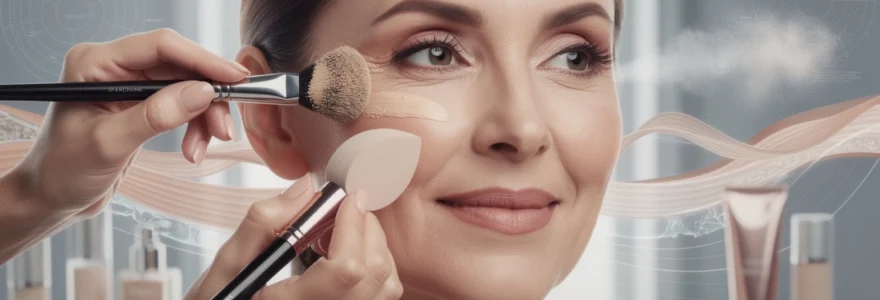
Fine lines and makeup creasing represent one of the most persistent challenges in mature beauty routines. As skin ages, its structure fundamentally changes, creating an environment where traditional makeup application methods often fail. The result is foundation and concealer that settles into expression lines, emphasising wrinkles rather than concealing them. Understanding the scientific mechanisms behind this phenomenon enables the development of targeted strategies that maintain flawless coverage throughout the day.
Professional makeup artists have long recognised that preventing makeup settlement requires a multi-faceted approach combining advanced primer technology, precise application techniques, and strategic product selection. The key lies not simply in using more expensive products, but in understanding how different formulations interact with changing skin physiology. Modern cosmetic science offers sophisticated solutions that address the root causes of makeup creasing, from molecular-level adhesion issues to surface texture irregularities.
Understanding fine line formation and makeup settlement mechanisms
Dermal structure changes in expression lines around eyes and mouth
The formation of expression lines occurs through repeated muscle contractions that gradually weaken the underlying dermal support structure. Around the eyes and mouth, where facial muscles are most active, collagen fibres become increasingly fragmented over time. This creates microscopic valleys and ridges on the skin’s surface that act as collection points for liquid makeup products. When foundation or concealer flows into these depressions, it concentrates in areas where it appears most noticeable.
The periorbital region presents particular challenges due to the absence of sebaceous glands and the skin’s inherent thinness. Without natural oil production to maintain flexibility, the delicate eye area becomes prone to dehydration lines that appear more pronounced when filled with makeup. Understanding this physiological difference is crucial for selecting appropriate products and application techniques that work with, rather than against, the skin’s natural characteristics.
Collagen degradation impact on foundation adhesion properties
Collagen degradation significantly affects how makeup adheres to mature skin surfaces. As collagen density decreases, the skin’s ability to maintain a smooth, taut surface diminishes, creating an uneven terrain that challenges traditional foundation formulations. Products that perform beautifully on younger skin may emphasise texture irregularities on mature complexions, requiring reformulated approaches that account for reduced structural support.
Advanced foundation formulations now incorporate film-forming polymers that create a flexible matrix over irregular skin surfaces. These ingredients help bridge minor imperfections whilst maintaining natural movement, preventing the rigid appearance that can occur when heavy coverage products settle into fine lines. The molecular weight of these polymers determines their ability to span microscopic gaps without creating an artificial finish.
Sebaceous gland activity and oil production in mature skin
Mature skin typically experiences reduced sebaceous gland activity, leading to decreased natural oil production that affects makeup longevity and settlement patterns. Without adequate natural lubrication, makeup products can adhere too strongly to dry areas whilst sliding off zones with residual oil production. This uneven distribution creates the characteristic patchy appearance that many experience with age.
The T-zone often maintains higher oil production levels compared to the perimeter areas of the face, necessitating differentiated approaches within a single makeup application. Products containing dimethicone and other silicone derivatives help normalise these disparities by creating a consistent base layer that regulates product distribution regardless of underlying oil levels.
Hydration levels and transepidermal water loss effects
Transepidermal water loss increases significantly with age, creating a cycle where dehydrated skin attracts moisture from applied makeup products. This process causes foundation and concealer to change consistency throughout the day, often resulting in separation and settling into fine lines. The phenomenon is particularly pronounced in air-conditioned environments or during seasonal transitions when humidity levels fluctuate.
Professional makeup artists recognise that hydration preparation is fundamental to preventing makeup migration, with proper moisturising protocols serving as the foundation for all subsequent application techniques.
Hyaluronic acid-based moisturisers provide optimal preparation by creating a moisture reservoir that prevents makeup products from seeking hydration from the skin itself. This ingredient can hold up to 1,000 times its weight in water, creating a stable environment that maintains consistent
pH levels for several hours. When this moisture balance is optimised, foundation is less likely to be absorbed into the skin’s upper layers or to break apart as the day progresses, which directly reduces makeup settling into fine lines.
In practice, this means that you should think of your hydrating skincare as part of your makeup system rather than a separate step. A lightweight, humectant-rich moisturiser applied 10–15 minutes before foundation allows active ingredients to bind water within the epidermis while forming a smooth, supple surface. When the skin is properly cushioned in this way, colour products remain flexible on top of the skin instead of sinking into micro‑furrows and expression lines.
Advanced primer technology and surface preparation techniques
Once hydration has been addressed, the next critical stage in preventing makeup from settling into fine lines is surface preparation with primer. Modern primers do far more than simply “help makeup last longer”; they are engineered to modify skin texture, control light reflection, and create a controlled slip so foundation can glide rather than drag. When used correctly, the right primer acts like a fine mesh laid over the skin, visually smoothing expression lines and minimising pores before a single drop of foundation is applied.
For mature skin, selecting a primer is less about following trends and more about understanding ingredient technology. The unique combination of silicone elastomers, film-forming polymers, and hydrating agents in a formula determines whether it will blur fine lines or accentuate them. By matching primer type to your skin’s specific needs—texture, oil production, and discolouration—you build a stable base that dramatically reduces makeup creasing around the eyes, mouth and forehead.
Silicone-based primers with dimethicone cross-polymers
Silicone-based primers containing dimethicone and dimethicone cross‑polymers are the backbone of most professional crease-prevention routines. These ingredients form an ultra-thin, breathable film over the skin that fills shallow furrows and softens sharp edges around fine lines. Think of this film as a flexible “silk stocking” laid over uneven terrain; it does not erase the underlying structure, but it visually smooths it so foundation can sit evenly on top.
Dimethicone cross‑polymers in particular create a three-dimensional network that improves slip and reduces friction. When you apply foundation over this network, the pigment particles spread more evenly instead of gathering at the lowest point of each wrinkle. For areas that are prone to heavy expression movement—such as smile lines or crow’s feet—tapping a pea‑sized amount of silicone primer into the skin with your fingertips before makeup can significantly reduce creasing over an 8–10 hour wear period.
Pore-filling formulations using polymethyl methacrylate microspheres
Pore-filling primers that use polymethyl methacrylate (PMMA) microspheres operate on a slightly different principle. These microscopic spheres settle into enlarged pores and shallow depressions, scattering light to create an airbrushed, soft-focus effect. While they are often marketed for oily or combination skin, they can be extremely useful for mature skin with visible texture around the nose and cheeks, where foundation tends to cling and emphasise irregularities.
Because PMMA microspheres are solid rather than fluid, they help to physically support foundation pigments over uneven areas, reducing the likelihood of product pooling. If you struggle with both fine lines and enlarged pores, you can target-apply a pore-filling formula only where needed—typically the T‑zone and inner cheeks—then use a more hydrating or silicone-rich primer on the rest of the face. This customised approach prevents the common issue of foundation looking flat and heavy while still controlling texture and creasing.
Hydrating primer systems with hyaluronic acid and glycerin
Hydrating primers containing hyaluronic acid, glycerin, and other humectants are especially valuable for those whose primary concern is dryness-related creasing. These formulas act like a bridge between skincare and makeup, adding an extra veil of moisture while creating a lightly tacky surface that improves foundation adhesion. When skin is plump and hydrated from below and supported by a humectant-rich primer on the surface, expression lines appear softer and less likely to grab product.
For very dry or dehydrated mature skin, layering a hydrating primer over your moisturiser can make the difference between foundation that cracks within hours and a base that stays supple all day. Apply a thin layer, allow it to become slightly tacky, then press foundation into the skin rather than dragging it across. This technique allows the hydrating primer to act like double-sided tape: it grips the skin on one side and the foundation on the other, minimising movement into fine lines.
Colour-correcting primers for neutralising discolouration in fine lines
Fine lines are not only about texture; they also often contain subtle shadows or discolouration that can make wrinkles look deeper than they are. Colour-correcting primers address this by using soft tints—peach, green, lavender, or yellow—to neutralise specific tones before foundation. When discolouration is corrected at this priming stage, you can use less concealer and foundation later, which is crucial for preventing product buildup in creases.
For example, a peach-toned primer can help counteract blue or purple discolouration around the eyes, meaning you can apply a lighter layer of under-eye concealer that is less likely to cake. Green-tinted formulas are useful around the nose and chin where redness often collects in small folds of the skin. By dealing with colour issues strategically at the primer level, you avoid the heavy layering that almost always leads to makeup settling into fine lines.
Foundation application methods for crease prevention
Even with the most advanced primer, the way you apply your foundation plays a decisive role in whether it will settle into wrinkles. Application technique determines pigment distribution, layer thickness, and how well the product integrates with your skin’s natural movement. Rather than relying on one universal method, professional artists adjust tools and motions according to skin texture, foundation formula, and the areas most prone to creasing.
The overarching principle is simple: thinner, well-blended layers flex with the skin, while thick, unworked layers crack and collect in fine lines. By mastering a few key techniques—stippling, damp sponge “bouncing,” airbrush application, and strategic layering—you can dramatically improve how your foundation behaves over the course of the day, even on expression‑rich, mature skin.
Stippling technique using dense bristle foundation brushes
The stippling technique uses a dense, flat-topped or duo-fibre foundation brush to press pigment into the skin with small, tapping motions. Instead of sweeping the brush across the face, you place the product and lightly bounce the bristles against the surface. This motion helps pigment settle into the primer layer rather than into the natural creases of the skin, resulting in a thinner, more even veil of coverage.
Stippling is particularly effective around the nose, chin, and along smile lines, where traditional buffing can push foundation straight into expression lines. By building coverage with multiple light passes, you maintain a skin-like finish that moves with your facial expressions. If you notice foundation starting to gather in a crease as you work, simply stretch the skin slightly with one hand and continue stippling; this redistributes the pigment without adding thickness exactly where it is most likely to settle.
Beauty blender dampening methods and bounce application
Latex-free makeup sponges—often referred to generically as beauty blenders—are a cornerstone tool for preventing makeup from settling into fine lines. When used damp, they act like a controlled filter, pressing foundation into the skin while simultaneously lifting away any excess that would otherwise sit on the surface and migrate into wrinkles. The key is proper sponge preparation and bounce technique.
To prepare the sponge, fully saturate it under running water, squeezing it several times until it expands and softens, then compress it in a clean towel to remove excess moisture. The sponge should feel cool and damp, not wet. Load a small amount of foundation onto the back of your hand, tap the sponge into the product, then bounce it over the face with light, rapid motions. Pay special attention to the forehead, crow’s feet, and smile lines: the sponge will naturally remove surplus product from these areas, leaving only a thin, flexible layer that is far less likely to crease.
Airbrush foundation systems for even distribution
Airbrush foundation systems atomise liquid foundation into a fine mist, allowing for exceptionally even, lightweight distribution across the skin. Because the product is applied in micro-droplets, it forms an ultra-thin, uniform layer that minimises the risk of accumulation in fine lines and pores. This technology can be especially beneficial for events or long days when you need makeup that resists creasing under heat and movement.
While airbrushing requires an initial equipment investment and some practice, many professional artists rely on it for mature clients who need long-wear, crease-resistant coverage without a heavy feel. You can think of airbrush foundation as a “gradient veil” that sits over the texture rather than sinking into it. For home use, start with low pressure and a sheer formula designed specifically for airbrush application, and build coverage gradually rather than trying to achieve full coverage in a single pass.
Layering protocol with sheer coverage building techniques
One of the most effective “secret techniques” to prevent makeup from settling into lines is disciplined layering. Instead of applying a single, full-coverage layer of foundation, you build opacity in sheer passes, adding slightly more product only where you truly need it. This approach keeps high-movement areas—like the forehead, around the eyes, and around the mouth—light and flexible, while allowing the smoother regions of the face to carry more of the coverage load.
A practical layering protocol might look like this: first, apply a very thin, even layer of foundation over the entire face using a brush or sponge. Next, assess where you can still see discolouration—typically around the nose, chin, and any dark spots—and lightly tap on a second sheer layer only in those areas. Finally, use concealer sparingly to target stubborn imperfections instead of adding more foundation overall. This targeted approach prevents the thick build-up that inevitably migrates into fine lines as you talk, smile, or raise your brows throughout the day.
Professional setting powder strategies and heat activation
Setting powder is often misunderstood in the context of mature skin. Used incorrectly, it can emphasise dryness and texture; used strategically, it is one of the most powerful tools for locking foundation in place and preventing migration into wrinkles. The goal is not to mattify every inch of the face, but to stabilise the areas where makeup is most likely to move, while preserving natural radiance elsewhere.
Professional artists typically choose ultra-fine, translucent loose powders that contain micronised silica or talc blends designed to sit lightly on the skin. Rather than dusting powder broadly with a fluffy brush, they press small amounts into targeted zones with a velour puff or damp sponge. This pressing motion not only sets the foundation but also fuses the powder with the base, creating a soft, flexible film that resists creasing.
Heat activation further enhances this process. After pressing powder into key areas—under the eyes, along smile lines, and on the centre of the forehead—allow it to sit for 30–60 seconds. During this time, the warmth of your skin helps the powder and foundation mesh at a molecular level. You can gently press your fingertips over these zones to encourage that fusion, then lightly buff away any excess with a clean brush. The result is a set base that still looks like skin, with significantly reduced risk of product settling into fine lines over the day.
Long-wear foundation formulations and ingredient analysis
Choosing the right long-wear foundation is just as important as how you apply it. Not all long-wear formulas behave the same way on mature skin; some achieve longevity by using high levels of volatile solvents and mattifying agents that can dehydrate the surface and increase creasing. Understanding which ingredients to look for—and which to avoid—helps you select a base that lasts without tightness or cracking.
Modern long-wear foundations for mature skin often rely on flexible film-forming polymers rather than heavy, occlusive waxes. Ingredients such as trimethylsiloxysilicate and other silicone resins create a breathable, stretchable film that moves with your expressions instead of breaking along each line. When combined with emollients and light-reflecting pigments, these polymers deliver both durability and a soft-focus finish that blurs the appearance of fine lines rather than emphasising them.
At the same time, it is wise to avoid extremely matte, oil-absorbing formulas if your main concern is makeup settling into wrinkles. High concentrations of drying alcohols or clay-based mattifiers can strip surface moisture, causing the foundation film to contract and pull into creases as the day goes on. Instead, look for descriptors such as “natural finish,” “satin,” or “radiant long-wear,” and check that the ingredient list includes humectants like glycerin or hyaluronic acid alongside the long-wear agents. This balance of flexibility and hydration is crucial for a base that remains smooth and crease-resistant on mature skin.
Skin preparation protocols for crease-resistant makeup application
All of these advanced techniques and formulations work best when they are built on a foundation of thoughtful skin preparation. Effective prep does not need to be complicated, but it does need to be consistent. The aim is to refine surface texture, restore moisture balance, and create a stable environment in which your primer and foundation can perform at their highest level.
A simple yet powerful protocol might start with gentle cleansing to remove excess oil and residual products without stripping the skin. Follow with a mild exfoliating step one to three times per week—using lactic acid, polyhydroxy acids, or a very soft physical exfoliant unless you have reactive conditions like rosacea—to smooth away dead cells that can cause foundation to cling and patch. Next, apply a hydrating toner or essence, then layer a serum rich in humectants and barrier-supporting ingredients. Seal this with a moisturiser appropriate to your skin type, and wait 10–15 minutes for everything to absorb before moving on to primer.
Right before makeup, assess your skin: Are there still visibly dry patches? Add a targeted dab of richer cream to those areas. Does your T‑zone look shiny? Use a small amount of mattifying serum or oil-control primer only where needed. By tailoring your preparation to the day’s specific conditions, you avoid blanket solutions that can leave some zones parched and others greasy—both of which contribute to makeup settling in fine lines. When skin is balanced, smooth, and properly hydrated, every subsequent step—from primer selection to foundation application and powder setting—works more efficiently, resulting in a base that looks fresher, smoother, and more youthful for hours on end.