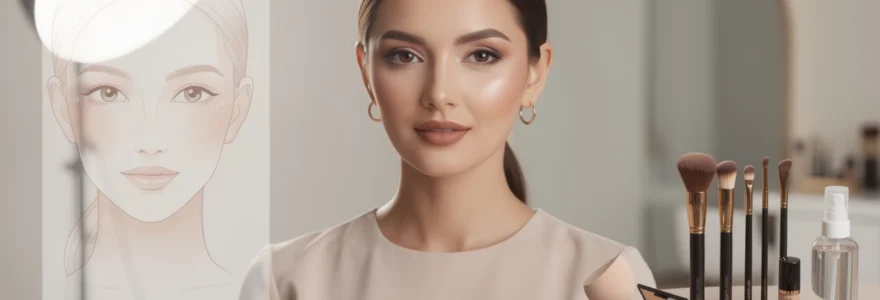
The beauty industry has witnessed a dramatic shift from the heavily structured contouring techniques popularised by social media towards a more refined, natural approach that enhances rather than transforms. Modern contouring philosophy centres on the principle of working with your natural bone structure to create subtle definition that appears effortless yet polished. This evolution represents a mature understanding of how makeup can complement individual features while maintaining authenticity in everyday settings.
Professional makeup artists increasingly advocate for techniques that translate beautifully from artificial lighting to natural daylight, recognising that most individuals require looks that perform consistently across various environments. The art lies in creating dimension and structure that appears to emerge from within, rather than sitting obviously on the surface of the skin. This sophisticated approach requires a deeper understanding of facial architecture, product chemistry, and advanced application techniques.
Understanding facial architecture for strategic contour placement
Identifying your natural bone structure using the Diamond-Square-Heart method
Facial mapping begins with understanding the fundamental geometry of your bone structure, which determines optimal contour placement for maximum effectiveness. The diamond-square-heart method provides a professional framework for analysing facial proportions and identifying key structural points. Diamond-shaped faces benefit from softening angular cheekbones whilst maintaining the natural definition, requiring strategic product placement along the outer perimeter of the cheekbone rather than directly underneath.
Square facial structures present broader jawlines and forehead widths that require careful consideration when applying contour products. The objective involves creating vertical length whilst maintaining the strength of natural angles. Heart-shaped faces, characterised by wider foreheads and narrower chin areas, benefit from techniques that balance proportions through strategic shadowing and highlighting. Each facial geometry demands specific approaches to product placement and blending techniques.
Mapping shadow points with professional makeup artist techniques
Professional shadow mapping involves identifying natural recession points where shadows would naturally occur under optimal lighting conditions. These points typically include the hollow beneath the cheekbone, the temples, the sides of the nose, and the jawline. Understanding the natural shadow patterns of your face allows for more intuitive product placement that enhances rather than contradicts your bone structure.
The key principle involves observing your face in natural, diffused lighting to identify where shadows naturally fall. This observation forms the foundation for strategic contour placement that appears believable under various lighting conditions. Professional makeup artists often use the “shadow test” method, positioning subjects near a window with indirect natural light to map authentic shadow patterns before applying any products.
Analysing light reflection patterns on different skin tones
Light interaction with different skin tones significantly impacts contour visibility and effectiveness. Deeper skin tones reflect light differently than lighter complexions, requiring adjusted techniques and product selection. The melanin content in darker skin creates natural luminosity that can either enhance or compete with applied highlighters, necessitating careful consideration of product intensity and placement.
Cooler undertones tend to create more dramatic shadow effects with less product, whilst warmer undertones may require slightly more intensity to achieve visible results. Understanding these light reflection patterns enables more precise product selection and application techniques that work harmoniously with natural skin characteristics rather than against them.
Determining optimal product placement based on kevin aucoin’s contouring philosophy
The foundational principles established by renowned makeup artist Kevin Aucoin continue to influence contemporary contouring approaches, emphasising the importance of working with natural bone structure rather than attempting to create entirely new facial geometry. Aucoin’s philosophy centres on the concept that effective contouring should enhance existing beauty rather than mask or dramatically alter facial features.
This approach prioritises subtle enhancement through strategic product placement that follows the natural contours of the face. The technique involves identifying the highest points of the cheekbones, the natural hollow beneath them, and the areas where light naturally hits the face. By respecting these natural patterns, the resulting contour appears seamless and believable across various lighting conditions and viewing angles.
Essential product selection and formula chemistry for subtle definition
Cream vs powder formulations: westman atelier and fenty beauty comparisons
Formula selection significantly impacts the final appearance and longevity of subtle con
Formula selection significantly impacts the final appearance and longevity of subtle contouring, particularly when you are aiming for everyday elegance rather than editorial drama. Cream formulations, such as those often seen from brands like Westman Atelier, tend to melt into the skin and mimic natural shadow, making them ideal for dry or mature skin types. Powder formulas, exemplified by ranges from Fenty Beauty, generally offer more control and are excellent for combination to oily skin, as they help to softly mattify areas of the face. When deciding between cream vs powder contour for a natural look, consider not only your skin type but also the level of precision and blendability you require. Many professionals layer a sheer cream contour under a light veil of powder bronzer, creating a multidimensional yet understated finish that reads beautifully in daylight.
From a formulation chemistry standpoint, creams usually rely on emollients, waxes, and volatile silicones that spread easily and fuse with the skin’s surface. This can result in a second-skin effect that is particularly flattering on textured skin, fine lines, or enlarged pores, as there is less risk of product sitting on top of the skin. Powders, on the other hand, are built on talc, mica, or silica bases with finely milled pigments that can be buffed into the complexion for a soft-focus effect. Fenty Beauty’s contour-adjacent bronzers, for instance, illustrate how ultra-fine powders can create smooth gradations of colour when applied with a fluffy brush. For subtle contouring, opt for formulas marketed as “sheer,” “buildable,” or “soft-matte” rather than “full coverage” or “ultra-pigmented,” as the latter can be harder to diffuse discreetly.
Undertone matching techniques using MAC studio fix and NARS laguna standards
Successful, natural-looking contour hinges on undertone accuracy as much as depth of shade. Many artists use reference systems like MAC Studio Fix and the NARS Laguna bronzer family as informal standards to decode undertones. MAC’s alphanumeric codes (such as NC and NW) help you determine whether your skin leans golden-olive (NC) or pink-rosy (NW), which in turn informs whether your contour should be more neutral, cool, or warm. NARS Laguna, now available in multiple intensities, offers a useful benchmark: its original tone is a soft, neutral-warm bronze that suits many light-to-medium complexions seeking “sun-shadow” rather than stark chiselling. By aligning your contour shade with these familiar undertone references, you avoid the common issue of your contour pulling too orange, ashy, or muddy in everyday lighting.
How do you put this into practice at the dressing table? First, identify your foundation undertone using a reliable base product like MAC Studio Fix; if you comfortably wear NC shades, a subtle contour that leans slightly neutral-cool will read as a realistic shadow without clashing with your warmth. If you are an NW wearer, you can usually tolerate a hint more warmth in your sculpting shade, provided it remains at least one step cooler than your bronzer. For those who love the natural sun-kissed effect of NARS Laguna, treat it as your bronzing benchmark and step one to two tones deeper and slightly cooler for contour. Swatch both bronzer and contour side by side on the jawline: the contour should look like the soft shadow your face would naturally cast, while the bronzer resembles where the sun might kiss your skin.
Buildable coverage systems: charlotte tilbury filmstar bronze & glow analysis
When your goal is subtle contour for everyday elegance, buildable coverage becomes more important than intensity. Charlotte Tilbury’s Filmstar Bronze & Glow palette is a textbook example of a buildable contour system designed for soft sculpting rather than dramatic transformation. The sculpting powder has a sheer, finely milled texture that allows you to slowly amplify definition with each pass of the brush, making it almost impossible to create harsh stripes in one swipe. The complementary highlighter is similarly refined, offering a gentle luminosity that enhances high points without emphasising texture or appearing metallic in natural light. This kind of coordinated duo takes the guesswork out of balancing shadow and light, which is crucial when you want your contour to appear seamless to the casual observer.
From a performance perspective, Filmstar Bronze & Glow demonstrates how the correct ratio of pigment to filler creates forgiving, everyday contour. The sculpt shade is neither fully cool nor overtly warm; instead, it sits in a neutral corridor that mimics the natural shadows of many light-to-medium skin tones. Because the formula is less densely pigmented than professional theatre-style contour products, you can layer it over foundation, tinted moisturiser, or even bare skin without risking patchiness. This approach to contour as a gradual “whisper” of structure rather than a bold statement can be replicated regardless of brand: look for palettes marketed with descriptors like “soft focus,” “airbrushed,” or “natural dimension.” These cues often signal that the powder has been formulated for buildable coverage rather than high-impact payoff.
Blendability factors in high-end vs drugstore contour products
Blendability is the deciding factor between contour that looks like natural bone structure and contour that sits obviously on the skin. High-end products often justify their price through the quality of their milling, binder systems, and pigment dispersion, which collectively influence how effortlessly a product will buff out. Drugstore options have improved significantly in recent years, but some may still contain larger particles or more rigid binders, requiring a slightly more patient blending technique. Does that mean you must invest exclusively in luxury contour? Not necessarily; instead, you need to understand how formula behaviour and tool choice interact to create a seamless gradient.
In general, high-end contour powders and creams will feel smoother to the touch, adhere evenly, and diffuse quickly with minimal effort, which is ideal for subtle everyday contouring when you have limited time. Drugstore formulas can absolutely achieve a similar effect if you adjust your method: using a softer, less densely packed brush and applying in light, repeated passes helps prevent blotchiness. Think of it like painting with watercolours versus acrylics: luxury formulas behave more like watercolour, gliding and fusing instantly, while some budget formulations are closer to acrylic, requiring more deliberate strokes and blending. Regardless of price point, always test blendability on the back of your hand or along the jawline before committing to full-face application, especially if your goal is an almost imperceptible contour in daylight.
Precision application techniques using professional tools
Angled brush selection: real techniques 108 vs morphe M527 performance
The choice of brush can transform the same contour product from harsh to harmonious. Angled brushes are particularly useful for subtle contouring because their shape naturally follows facial curves, allowing you to place pigment and blend in a single motion. The Real Techniques 108, with its synthetic bristles and medium density, offers controlled placement and is excellent with cream or liquid formulas. Its structure allows you to “push” product into the skin for a diffused, soft-focus shadow that works especially well on the hollows of the cheeks and along the jawline. The Morphe M527, typically a larger, fluffier brush often crafted with natural or mixed bristles, excels at diffusing powder bronzers and soft sculpt shades over wider areas.
For a natural contour suitable for everyday wear, you might treat the Real Techniques 108 as your sculpting pencil and the Morphe M527 as your blending brush. The 108 can be used to gently sketch your initial shadow line in a soft, upward motion, then you can switch to the M527 to blur any edges and merge the contour into the rest of your complexion. This two-brush technique mirrors professional makeup artist practice, where one tool is reserved for placing pigment and another remains relatively clean to blend. If you prefer minimal tools, choose an angled brush that is not too small or too dense; an overly compact brush can deposit too much product in one area, making it harder to maintain the illusion of naturally receding planes.
Stippling and buffing methods for seamless colour integration
Application technique often matters more than the exact contour product you choose. Stippling and buffing are two complementary methods that help you integrate colour so the eye reads shadow rather than makeup. Stippling—lightly tapping the brush or sponge onto the skin—deposits product gradually and is particularly useful for creams and liquids. Buffing, using small circular motions with a fluffy brush, softens edges and merges the contour into foundation, blush, and bronzer. When creating subtle cheek contour, many professionals stipple the product into the hollow first, then buff out the outer perimeter to avoid dragging pigment too low on the face.
Think of stippling as laying down a delicate veil of pigment, while buffing behaves like a soft-focus filter that blurs any lines of demarcation. If you are working with a more pigmented contour, begin by wiping excess product off your brush onto a tissue, then stipple from the hairline inward, leaving the centre of the face with the least amount of product. Once the shape is mapped, switch to buffing motions to create a gradient that disappears seamlessly into your base. This two-step method significantly reduces the risk of harsh stripes, particularly important when your contour must withstand both indoor and outdoor lighting throughout a busy day.
Beauty sponge dampening ratios for natural finish achievement
When it comes to cream contour and highlight, a beauty sponge can be your most effective tool for maintaining a skin-like finish. The level of dampness—often overlooked—plays a critical role in how sheer or intense your contour appears. A sponge that is thoroughly saturated and then well-squeezed and towel-dried will yield the most diffused result, almost as if you are airbrushing the contours onto your face. A barely damp sponge, by contrast, will maintain more pigment and is useful when you need a touch more definition while still avoiding hard edges. For subtle everyday contouring, most artists favour a medium level of dampness: the sponge feels cool and soft to the touch but does not release water when pressed.
To control your dampening ratio, run the sponge under lukewarm water until fully expanded, then squeeze it out firmly and press it several times in a clean towel. If you notice water streaks when you bounce it on your wrist, it is still too wet and will over-thin your contour and foundation. Use the broad side of the sponge to diffuse contour along larger areas like the cheekbones, and the pointed end for precision around the nose or hairline. This technique is particularly beneficial if you struggle with patchiness or visible texture, as the sponge gently presses product into the skin’s surface, mimicking the natural way light sits on the face.
Setting spray application timing using urban decay all nighter protocol
Setting spray can make the difference between contour that fades by midday and structure that lasts well into the evening, yet timing is often misunderstood. Many artists follow a multi-step “setting protocol,” with products like Urban Decay All Nighter used strategically throughout the process rather than solely at the end. One effective approach is to lightly mist the face after foundation and concealer, allowing the setting spray to create a flexible film that anchors the base. Once this layer is dry, you can apply cream or powder contour and blend as usual, knowing the underlying structure is already stabilised. A final, light mist at the end of your routine helps lock in the complete look without creating a heavy, makeup-like finish.
For those seeking subtle contour specifically, overuse of setting spray can backfire by exaggerating any powderiness or uneven blending. To avoid this, hold the bottle at least an arm’s length away and use a cross or X-shaped motion, allowing a fine cloud to settle evenly over the complexion. If you notice any droplets, gently press them into the skin with a clean sponge—the residual moisture helps re-mesh powders into creams, reducing the appearance of texture. Consider setting spray as the final, invisible veil that merges all layers of contour, highlight, and blush into a unified, skin-like surface, ensuring your carefully sculpted structure remains undetectable yet present throughout the day.
Advanced blending methodologies for invisible transitions
Invisible transitions are the hallmark of truly sophisticated contouring, where dimension is evident but product is not. Advanced blending methods focus on working with multiple textures and tones to create a gradient that the eye reads as natural anatomy rather than pigment. One effective approach is “reverse blending,” where you apply contour first on bare or lightly primed skin and then layer a sheer foundation or tinted moisturiser over the top. This technique acts like a soft-focus lens, diffusing edges while maintaining structure beneath, much like viewing sculpture through a fine layer of gauze. It is particularly effective for those who find traditional contour on top of foundation too visible in direct sunlight.
Another professional strategy involves using adjacent complexion products to soften transitions instead of relying solely on a clean brush. After placing your contour, apply a small amount of foundation or concealer on a detail brush around the outer edges of the shadow and lightly buff; this works similarly to using a blending colour in eyeshadow to merge two tones seamlessly. You can also employ blush as a bridging shade, placing it slightly higher on the cheek and overlapping the upper edge of your contour so the two colours fuse into a natural-looking flush and shadow. By thinking of your face as a series of gradients rather than isolated zones, you create a sculpted yet soft effect that feels intuitive to the viewer.
Colour theory applications in everyday contour palettes
Colour theory is not reserved for artists’ canvases; it plays a fundamental role in how contour behaves on different complexions. The human eye is accustomed to seeing natural shadows that are slightly cooler and more desaturated than the surrounding skin, which explains why grey-brown or taupe-based contour shades often look more realistic than strongly warm browns. When building an everyday contour palette, consider the relationship between your natural skin tone, your bronzer, and your blush. The contour should generally be the coolest and most muted of the three, the bronzer the warmest, and the blush the most saturated or vibrant. This hierarchy ensures that each product has a distinct visual role without competing, producing a harmonious, “barely there” sculpting effect.
For deeper skin tones, true neutrality rather than overt coolness is often more flattering, as overly grey products can create an ashy cast. Here, rich espresso or mahogany shades with balanced red and yellow undertones can function as contour while still respecting natural colour harmony. On very fair complexions, overly warm contour quickly appears artificial, so soft taupes and muted biscuit tones are usually more successful. You might think of your contour palette as a wardrobe of tailored basics: a few carefully chosen, undertone-accurate shades can be mixed and layered to suit seasonal changes in your skin colour, different lighting environments, or varying levels of makeup intensity. By grounding your choices in simple colour theory—cooler, desaturated for shadow; warmer, more saturated for warmth—you create a reliable framework for natural everyday contouring.
Longevity optimisation through strategic layering and setting techniques
Ensuring that subtle contour lasts from morning meetings to evening plans without becoming patchy requires a considered approach to layering. Rather than relying on a single heavy application, professionals build thin, strategically placed layers that interlock, much like a well-constructed architectural framework. Begin with well-prepped skin: a light, non-greasy moisturiser and, if needed, a gripping yet flexible primer in areas where makeup tends to fade. Apply a sheer wash of cream contour after your base but before any setting powder, blending thoroughly; this acts as your “shadow blueprint.” Once set lightly with a translucent or tone-appropriate powder, you can reinforce key areas with a soft powder sculpt shade, focusing on the outer perimeter of the face to avoid overloading the centre.
Throughout the day, oil production, sweat, and environmental factors can gradually break down product, especially around the nose and jawline. To preserve a refined contour, avoid piling on extra powder as a quick fix, as this can create a chalky, uneven surface. Instead, use blotting papers to gently remove excess oil, then, if necessary, refresh specific areas with a sheer veil of pressed powder applied via a small, fluffy brush. A light mist of setting spray afterward helps re-bind powders to creams, restoring a cohesive finish. By treating contour longevity as the result of many small, thoughtful steps—prep, thin layering, selective setting, and targeted touch-ups—you maintain everyday elegance without ever tipping into heavy, overly made-up territory.