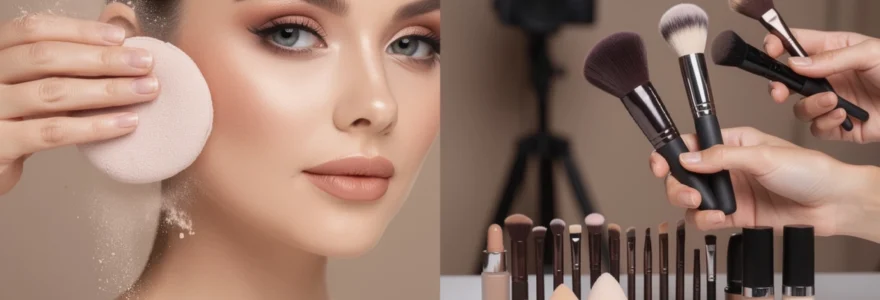
The quest for an airbrushed finish has transformed makeup application from a simple routine into a precise art form. Professional makeup artists and beauty enthusiasts alike debate the merits of different tools, with powder puffs and brushes standing as the primary contenders for achieving that coveted flawless complexion. Each tool brings distinct advantages to the table, from the pressed powder precision of velour puffs to the seamless blending capabilities of synthetic bristle brushes.
Modern makeup application has evolved significantly beyond traditional methods, with innovative tool technologies offering unprecedented control over coverage, texture, and longevity. The choice between powder puffs and brushes isn’t merely about personal preference – it’s about understanding how each tool interacts with different formulations, skin types, and desired finishes. Whether you’re preparing for high-definition photography or seeking everyday perfection, the right tool selection can dramatically impact your final result.
Powder puff application techniques for professional airbrushed coverage
Powder puffs represent the traditional approach to achieving full coverage and matte finishes, offering superior product deposition and oil control capabilities. The dense, compact nature of quality powder puffs allows for precise product application whilst maintaining consistent pressure distribution across facial contours. Professional makeup artists frequently rely on powder puffs when working with clients who require long-wearing, transfer-resistant coverage for special events or photographic work.
The key to mastering powder puff application lies in understanding pressure dynamics and product loading techniques. Unlike brushes, which deposit product through bristle movement, powder puffs work by pressing and rolling powder into the skin’s surface, creating a more substantial barrier against oil breakthrough and environmental factors. This pressing action fills in microscopic skin irregularities, contributing to the smooth, airbrushed appearance that many seek to achieve.
Stippling motion methodology with beautyblender and real techniques miracle complexion sponges
Stippling with beauty sponges requires a fundamentally different approach than traditional powder puff pressing techniques. The stippling motion involves gentle bouncing movements that allow the sponge’s porous surface to gradually build coverage whilst maintaining a natural skin-like texture. This technique works particularly well with liquid and cream formulations, as the sponge’s dampened surface helps blend products seamlessly into the skin without disturbing underlying layers.
Professional stippling technique involves loading the sponge with minimal product and building coverage through multiple passes rather than attempting to achieve full coverage in a single application. The beauty sponge’s unique tear-drop shape allows for precision work around detailed areas such as the inner corners of eyes and nostril creases, whilst the broader surface handles larger facial areas efficiently.
Pressed powder distribution patterns using laura mercier velour puff systems
Velour puff systems excel at creating even powder distribution through their superior product retention capabilities and luxurious texture. The velour surface grips powder particles more effectively than standard cotton or synthetic materials, ensuring consistent product transfer with each application. Professional techniques involve loading the puff with powder, then pressing and rolling in overlapping circular patterns to achieve uniform coverage without streaking or patchiness.
The pressed powder distribution pattern should follow facial contours, beginning with the centre of the face and working outward to ensure natural gradation. Particular attention should be paid to the T-zone area, where oil production tends to be highest, requiring slightly firmer pressure to ensure adequate powder penetration for lasting wear.
Buildable coverage layering through chanel les beiges kabuki techniques
Kabuki brush techniques offer exceptional control over coverage density through their dense bristle configuration and compact head shape. The buildable coverage approach involves applying thin layers of powder, allowing each layer to set before adding additional coverage. This method prevents product overload whilst maintaining the natural skin texture that contributes to an airbrushed appearance.
Professional kabuki application requires circular buffing motions that work powder into skin irregularities without creating a cakey or heavy appearance. The key lies in using light pressure and allowing the brush’s natural bristle density to do the work, rather than forcing product onto the skin through aggressive application techniques.
Seamless blending pressure points for charlotte tilbury airbrush flaw
less setting powder hinges on how you distribute pressure across key areas of the face. For a truly airbrushed finish, focus first on the high-movement zones: under the eyes, around the nose, smile lines, and the centre of the forehead. Gently press and roll the puff rather than dragging it, allowing the finely milled powder to mesh with your foundation instead of sitting on top.
Under the eyes, use a folded puff to create a precise edge that fits the orbital bone and inner corner. Apply slightly more pressure at the deepest part of any shadow and soften as you move outward, mimicking the gradient of natural light on the face. Around the nose and smile lines, a tapping motion rather than a sweeping motion helps prevent product from gathering in creases, which is essential if you are aiming for an HD-ready, airbrushed effect.
With Charlotte Tilbury Airbrush Flawless Setting Powder, less product combined with strategic pressure points usually delivers better results than heavy application. Start at the centre of the face, where pores and texture are most visible, then diffuse outward to avoid a mask-like edge between the face and neck. If you notice any chalkiness, use the clean side of the puff to gently buff and re-press the powder into the skin, restoring a soft-focus, blurred finish without disturbing your base.
Synthetic brush bristle technology for flawless foundation distribution
While powder puffs excel at locking in products, synthetic brushes dominate when it comes to controlled, seamless foundation application. Advances in bristle technology over the last decade have made synthetic brushes superior to many natural-hair options for liquid and cream products, particularly when a smooth, airbrushed complexion is the goal. Modern synthetic fibres are engineered to mimic the cuticle structure of natural hair while remaining non-porous, which reduces product absorption and waste.
The way a brush distributes foundation depends on three primary factors: bristle type, density, and head geometry. Denser brushes push more product into the skin, offering full coverage, while looser, duo-fibre styles create a sheerer, more diffused finish. For many users, the ideal airbrushed foundation routine combines both: a dense brush to lay down coverage and a lighter brush to blur edges and remove streaks. Understanding these design details helps you select the best makeup brush for an airbrushed finish that matches your skin type and coverage goals.
Taklon fibre density analysis in sigma f80 flat kabuki performance
The Sigma F80 Flat Kabuki has become a reference point for high-coverage, airbrushed foundation application thanks to its dense taklon fibre construction. Taklon is a high-grade synthetic material with a smooth surface that does not trap pigment in the same way natural bristles can, making it ideal for distributing liquid and cream foundations evenly. Because the fibres are tightly packed in the F80, the brush can push product into pores and fine lines, creating a smoother visual plane on the skin.
From a performance standpoint, the F80’s density means that a small amount of foundation can cover a large area, which is valuable if you want a full-coverage result without layering multiple coats. When you use a flat kabuki like this, think of it as an airbrush gun in brush form: you achieve the best outcome with short, controlled strokes or gentle buffing motions rather than aggressive sweeping. If you are prone to streaks, rotating the brush in small circular motions helps eliminate visible lines, while pressing the flat surface onto high-texture areas can blur enlarged pores around the nose and cheeks.
One practical consideration with dense taklon brushes is maintenance. Because they hold more product between fibres, they require regular deep cleaning to prevent buildup that can lead to patchy application or breakouts. Using a dedicated brush cleanser and allowing ample drying time will preserve fibre integrity and ensure that the Sigma F80 continues to deliver that polished, airbrushed foundation look over the long term.
Duo-fibre brush architecture in mac 187 stippling brush applications
The MAC 187 Stippling Brush showcases the advantages of duo-fibre architecture for those who prefer a lighter, more diffused foundation finish. This design combines a dense lower layer of shorter fibres with a sparser layer of longer, often lighter-tipped fibres. The shorter fibres provide stability and mild pressure, while the longer fibres lightly distribute product across the skin’s surface, creating the signature “airbrushed veil” effect associated with stippling brushes.
When used correctly, the MAC 187 is particularly effective for sheer foundation, tinted moisturiser, or layering liquid products over existing base makeup. Instead of dragging foundation across the face, you use a bouncing or dabbing motion, letting only the tips of the longer fibres come into contact with the skin. This creates tiny, overlapping dots of product—similar to pointillist painting—that visually merge into a smooth, blurred finish. The result is ideal for those who want their natural skin to show through while still benefiting from mild tone correction.
The duo-fibre design also helps minimise demarcation lines along the jaw and hairline. Because the longer fibres are less densely packed, they naturally create a soft gradient between areas with more product and areas with less. This makes the MAC 187 an excellent tool for blending foundation into the neck or softening the edges of cream blush and bronzer, all without disrupting the underlying base. If you often struggle with heavy or cakey results, swapping to a duo-fibre brush for your final blending pass can be a simple way to achieve a more airbrushed foundation look.
Buffer brush head geometry for real techniques expert face brush coverage
The Real Techniques Expert Face Brush is a compact buffer brush that highlights how head geometry influences coverage and finish. Its slightly domed, oval-shaped head and mid-level bristle density allow it to perform double duty: it can concentrate product in targeted areas and buff it outward for a seamless, second-skin effect. Compared to a flat-top kabuki, the curved profile adapts more intuitively to facial contours such as the sides of the nose, under the cheekbones, and around the jaw.
If you compare buffing foundation with the Expert Face Brush versus a traditional flat foundation brush, you will usually notice fewer streaks and a more diffused edge. The shorter bristles generate more controlled pressure, which helps press product into texture without shifting it around. This makes the brush particularly valuable for medium-coverage application on combination skin types, where certain zones may need more polish and others benefit from a lighter touch.
From a practical standpoint, the brush head’s geometry also makes it ideal for multitasking. You can use it not only for liquid foundation but also for cream bronzer, contour, and even stippling on powder in specific zones. For anyone who wants an airbrushed finish with minimal tools, a versatile buffer brush like the Real Techniques Expert Face Brush often provides the best balance between precision and speed.
Antimicrobial bristle treatments in morphe m527 dense round blender maintenance
The Morphe M527 Dense Round Blender illustrates a growing trend in brush design: integrating antimicrobial treatments into the bristles themselves. While this particular brush is often used for bronzer and finishing powder, the same technology is now common across many foundation and complexion brushes designed for airbrushed finishes. Antimicrobial coatings help inhibit bacteria growth on fibres between washes, which is especially relevant when you are working with cream and liquid products that can linger within the bristle bed.
From a performance perspective, cleaner bristles translate into smoother application. Product buildup and bacterial residue can cause drag, patchiness, or unexpected oxidation on the skin. By choosing brushes treated with antimicrobial technology and combining that with consistent cleaning routines, you maintain a more predictable, even coverage each time you apply your foundation or setting powder. This reliability is critical for professional makeup artists who need repeatable, camera-ready results across many clients.
However, antimicrobial treatment is not a substitute for regular maintenance. Dense brushes like the M527 still require thorough cleansing to remove oils and pigments that can alter the way they interact with your makeup. Think of antimicrobial coatings as a protective bonus that extends the working life of your tools between deep cleans, not as a reason to skip proper hygiene. The cleaner and more structurally intact your bristles remain, the closer you will get to that consistent, airbrushed skin finish every time you work.
Liquid foundation compatibility matrix across tool categories
Not all tools perform equally with every liquid foundation formula, and understanding compatibility is key if you want a truly airbrushed complexion rather than a patchy or streaky result. Modern foundations range from water-based tints to high-pigment, silicone-heavy formulas; each behaves differently on porous sponges, velour puffs, and synthetic brushes. Matching your tool to your product is a bit like pairing the right lens to a camera: the wrong combination can obscure the product’s potential, while the right one reveals its best qualities.
For sheer, watery foundations and skin tints, slightly damp sponges or duo-fibre brushes tend to deliver the smoothest, most skin-like finish. These tools diffuse product thinly while preventing streaks, making them ideal for “no-makeup makeup” looks. Medium-coverage, silicone-based foundations usually perform best with dense synthetic brushes, which can buff product into the skin and maximise pigment payoff without absorbing too much formula. High-coverage, long-wear liquids often pair well with a two-step approach: a dense brush for initial placement followed by a sponge or puff to perfect texture and press product into pores.
If you are dealing with very oily or combination skin, you may find that finishing liquid foundation with a powder puff or velour puff gives the best long-term, airbrushed effect. Pressing a small amount of loose setting powder into freshly applied foundation locks it down, minimises transfer, and smooths visible pores. On drier skin types, using a brush or sponge to apply foundation and then only lightly setting high-movement areas with a puff preserves glow without sacrificing longevity. By treating tool selection as part of your foundation formula choice, you ensure that coverage, texture, and comfort all align with your skin’s needs.
Surface texture analysis: porous vs non-porous application tools
The surface texture of your makeup tools—whether porous or non-porous—directly affects how foundation and powder sit on the skin. Porous tools such as traditional beauty sponges feature microscopic holes that can absorb excess product and water, softening the coverage and creating a diffused, “airbrushed from afar” finish. Non-porous tools, including dense synthetic brushes and many velour puffs, hold most of the product at the surface, pushing it onto the skin rather than soaking it up. Think of porous tools as soft filters and non-porous tools as precision sprayers.
Porous sponges work especially well for those who struggle with heavy-handed application or prefer a natural, skin-like finish. By design, they take up some of the formula, preventing too much product from building on the surface of the skin. However, this absorption can be a drawback with expensive or highly pigmented foundations, as you may waste more product and need frequent cleaning to avoid bacteria accumulation. To mitigate this, some modern sponges now feature coatings or hybrid surfaces that reduce absorption while retaining bounce and blendability.
Non-porous tools like tightly woven velour puffs and high-density brush heads deliver more immediate coverage and better product economy. They place a higher proportion of the formula directly on the face, which is ideal when you want high-impact results or when you are working within a limited application window, such as backstage or on set. The trade-off is that they demand more skill: without controlled pressure and blending, product can sit on top of the skin or emphasise texture. Learning to modulate pressure and use rolling or buffing motions helps harness the advantages of non-porous tools while keeping the finish as smooth and airbrushed as possible.
Professional MUA tool selection criteria for HD photography standards
HD and 4K photography have raised the bar for complexion work, as cameras now capture detail that was previously invisible to the naked eye. Professional makeup artists choose between powder puffs and brushes not only based on personal preference but also on how each tool performs under harsh lighting, close-up lenses, and long shooting schedules. When every pore, fine line, and texture irregularity can be magnified, the margin for error shrinks, and tool selection becomes a strategic decision rather than an afterthought.
For high-definition work, MUAs typically prioritise tools that minimise streaks, texture emphasis, and flashback. Dense synthetic brushes are favoured for building undetectable coverage with modern HD foundations, as they can push product into the skin for a second-skin effect. Velour puffs are then used to set key areas with flash-friendly powders, pressed rather than swept to avoid lifting the base. Sponges often come into play as finishing tools, gently bouncing over the surface to absorb excess product and blend any edges that may catch light on camera.
Other criteria include hygiene, speed, and versatility. On set, brushes and puffs must be easy to sanitise between clients, and they need to perform consistently in different climates and lighting conditions. Many professionals keep multiples of the same tool—separate puffs for different powder shades, duplicate brushes for cream versus powder products—to maintain colour accuracy and prevent cross-contamination. Ultimately, for HD standards, the “best” tool is often a curated combination: a foundation brush for distribution, a sponge for refinement, and a puff for setting, all working together to create a seamless, airbrushed complexion that holds up under scrutiny.
Longevity performance testing: 12-hour wear comparison studies
Longevity is a crucial factor when deciding between a powder puff and a brush for your base, especially if you need your makeup to look airbrushed from morning to night. Comparative 12-hour wear tests—whether conducted in professional environments or through controlled consumer trials—consistently show that application technique and tool choice can extend or shorten wear time by several hours. This is particularly evident on combination and oily skin, where oil breakthrough and product separation tend to occur first around the T-zone and smile lines.
In many side-by-side tests, foundations set with a powder puff, using a press-and-roll technique, demonstrate better resistance to shine and movement than those set with a light dusting from a fluffy brush. The puff presses powder into the foundation, creating a more robust barrier that slows down oil migration and reduces transfer onto masks, clothing, or phone screens. By contrast, brush-applied powder often sits more loosely on top of the skin, providing a softer, more luminous finish but sometimes sacrificing a little in terms of all-day durability.
That said, brushes often win in comfort and flexibility over extended wear, especially on drier or mature skin types. A lighter, brushed-on layer of powder allows natural oils to emerge gradually, preventing the overly tight, flat look that can appear several hours after heavy setting with a puff. For many users, the most effective 12-hour strategy combines both: using a puff to set high-risk areas like the nose, chin, and under-eyes, and a soft brush to lightly veil the rest of the face. By tailoring your tool choice to both your skin type and your schedule, you can maintain an airbrushed finish that looks intentional rather than overdone, even at the end of a long day.