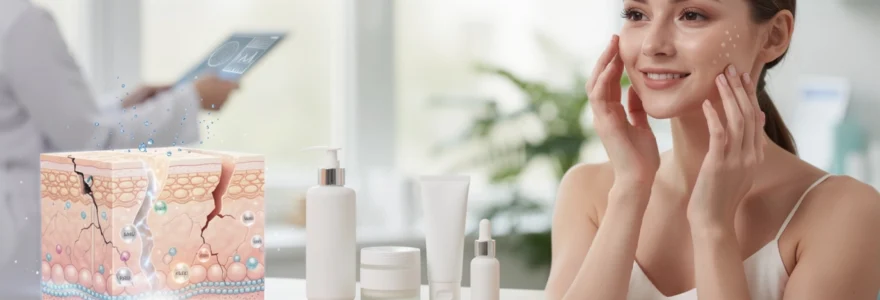
Your skin barrier serves as the body’s frontline defence against environmental aggressors, pollution, and moisture loss. When this protective shield becomes compromised, you may experience persistent dryness, irritation, sensitivity, and accelerated signs of ageing. Understanding how to restore barrier function effectively can transform your skin’s health and appearance within weeks rather than months.
A damaged skin barrier affects millions of people worldwide, with studies indicating that over 70% of individuals believe they have sensitive skin—many of whom are actually dealing with compromised barrier function. Modern skincare routines, environmental stressors, and lifestyle factors contribute to this widespread issue. The encouraging news is that with targeted interventions and proper care, barrier restoration is entirely achievable.
The key to successful repair lies in understanding the underlying mechanisms of barrier dysfunction and implementing evidence-based treatments. Rather than relying on trial and error, a systematic approach combining gentle care with proven ingredients can accelerate healing whilst preventing further damage.
Understanding compromised skin barrier function and transepidermal water loss
The skin barrier, scientifically known as the stratum corneum, functions like a sophisticated brick-and-mortar structure. Corneocytes (dead skin cells) act as bricks, whilst intercellular lipids serve as the binding mortar. When this structure becomes compromised, transepidermal water loss (TEWL) increases dramatically, leading to dehydration and vulnerability to external irritants.
Normal TEWL rates measure approximately 4-8 grams per square metre per hour on healthy facial skin. However, damaged barriers can exhibit TEWL rates exceeding 15-20 grams per square metre per hour—a clear indicator of dysfunction. This excessive water loss triggers a cascade of inflammatory responses, further weakening the barrier’s protective capacity.
Identifying ceramide deficiency and lipid bilayer disruption
Ceramides comprise approximately 50% of the skin’s lipid content and play a crucial role in maintaining barrier integrity. When ceramide levels drop below optimal ranges, the lipid bilayer structure becomes disrupted, creating microscopic gaps that allow moisture to escape and irritants to penetrate. Clinical studies demonstrate that ceramide-deficient skin shows increased sensitivity to topical applications and reduced ability to retain moisture.
You can identify ceramide deficiency through several key indicators: skin that feels persistently tight even after moisturising, products that sting upon application, and visible flakiness despite regular hydration. Advanced diagnostic techniques like tape stripping can measure ceramide levels directly, though visual and tactile assessment often provides sufficient information for treatment planning.
Recognising ph imbalance and acid mantle deterioration
Healthy skin maintains a slightly acidic pH between 4.5 and 5.5, creating an environment that supports beneficial bacteria whilst inhibiting harmful pathogens. When the acid mantle deteriorates, pH levels can rise to 6.0 or higher, compromising antimicrobial defences and enzyme function. This shift often manifests as increased susceptibility to infections, persistent inflammation, and delayed healing responses.
pH imbalance frequently results from over-cleansing with alkaline products, excessive use of acids, or environmental exposure to hard water. The skin’s buffering capacity becomes overwhelmed, leading to chronic inflammation and barrier dysfunction. Restoring optimal pH through targeted interventions forms a cornerstone of effective barrier repair protocols.
Assessing stratum corneum integrity through clinical markers
Professional assessment of stratum corneum integrity involves measuring several key parameters. Corneometer readings evaluate hydration levels, with healthy skin typically showing values above 40-50 arbitrary units. Sebum production analysis reveals whether lipid synthesis remains adequate for barrier maintenance. Additionally, desquamation patterns can indicate whether cell turnover rates support proper barrier renewal.
Visual examination provides immediate insights into barrier status. Healthy stratum corneum appears smooth and uniform under magnification, whilst damaged barriers show irregular cell arrangement, increased visibility of skin markings, and areas of micro-scaling. These observations guide treatment intensity and duration requirements.
Evaluating filaggrin protein deficiency impact on barrier function
Filaggrin is a structural protein that helps organise keratin within corneocytes and is later broken down into components of the natural moisturising factor (NMF). Deficiency in filaggrin, whether genetic or acquired, leads to impaired formation of the corneocyte “bricks” and reduced NMF levels, resulting in increased transepidermal water loss and chronic dryness. Clinically, filaggrin deficiency is strongly associated with atopic dermatitis, but milder reductions can also present as persistently rough, dull, and easily irritated skin even in individuals without overt eczema.
If you suspect filaggrin-related barrier weakness—especially if you have a family history of eczema or “itchy, dry skin since childhood”—you may benefit from more intensive barrier repair strategies. Dermatologists can arrange genetic or immunohistochemical testing in complex cases, but in everyday practice, the focus remains on aggressive moisturisation with ceramide-rich formulas, minimising irritant exposure, and avoiding over-washing. Supporting filaggrin function indirectly through optimal pH maintenance and barrier-friendly skincare helps create conditions where the skin can rebuild a more resilient stratum corneum over time.
Evidence-based topical interventions for barrier restoration
Once you understand why your skin barrier is damaged, the next step is choosing evidence-based products that actively support repair. Rather than chasing every new trend on social media, it is more effective to focus on a handful of well-studied ingredients and formulations. These include ceramides, niacinamide, hyaluronic acid, and occlusives such as petrolatum, all of which target different aspects of barrier function and transepidermal water loss.
Think of your barrier repair routine as rebuilding and sealing a wall: ceramides replace missing mortar, niacinamide improves how the bricks and mortar are made, hyaluronic acid draws in water like a sponge, and occlusives act as a protective tarp while repairs set. When combined thoughtfully, these interventions can noticeably reduce redness, stinging, and dryness within one to two weeks, with continuing improvements over several skin cycles.
Ceramide-rich formulations: CeraVe and la Roche-Posay efficacy studies
Ceramide-dominant moisturisers are the cornerstone of most modern barrier repair protocols. Products from brands like CeraVe and La Roche-Posay have been studied in both healthy volunteers and patients with conditions such as atopic dermatitis and irritant dermatitis. Clinical trials have shown that moisturisers containing ceramides, cholesterol, and fatty acids in physiologic ratios can significantly reduce TEWL within days and improve clinical signs such as scaling, roughness, and erythema over several weeks.
CeraVe’s formulations, for example, utilise multi-vesicular emulsion technology to release ceramides gradually over time, providing sustained barrier support. La Roche-Posay’s Cicaplast and Toleriane ranges integrate ceramides with soothing ingredients such as panthenol and thermal spring water, making them suitable for highly sensitive, reactive skin. For a damaged skin barrier, twice-daily application of a ceramide-rich cream or balm to slightly damp skin is often enough to initiate visible repair, particularly when combined with gentle cleansing and strict SPF use.
Niacinamide 5% protocols for sebaceous regulation and barrier repair
Niacinamide (vitamin B3) is a multitasking ingredient that supports barrier repair while also regulating sebum production and calming inflammation. Studies using concentrations between 2% and 5% have demonstrated improvements in skin smoothness, reduced TEWL, and enhanced synthesis of ceramides and other barrier lipids. A 5% niacinamide serum or moisturiser is often ideal for those with combination or oily skin, as it helps repair the skin barrier without feeling heavy or occlusive.
How should you use niacinamide when your barrier is damaged? During the acute phase of irritation, it is wise to introduce niacinamide slowly—perhaps once daily or every other day—because even beneficial actives can sting compromised skin. Apply a pea-sized amount of a 5% formula after cleansing and before a rich moisturiser. Over two to four weeks, many people notice decreased redness, fewer irritation-related breakouts, and a more stable, less oily T-zone, all while the barrier becomes more resilient.
Hyaluronic acid molecular weight considerations for optimal hydration
Hyaluronic acid (HA) is a powerful humectant capable of binding up to 1000 times its weight in water, but not all HA is created equal. High-molecular-weight HA primarily hydrates the surface, providing an immediate smoothing effect and reducing the appearance of fine lines. Low- and mid-molecular-weight HA can penetrate a little deeper into the stratum corneum, supporting longer-lasting hydration and improving the skin’s ability to retain moisture.
For a compromised skin barrier, a formula that combines multiple molecular weights of HA is often most effective. However, HA should always be paired with an emollient or occlusive moisturiser on top; otherwise, in very dry environments, it may contribute to water being pulled from deeper layers of the skin and lost to the air. To optimise hydration, apply a HA serum to slightly damp skin, then immediately lock it in with a ceramide-rich cream or ointment. This layered approach maximises water content in the stratum corneum and supports quicker restoration of barrier function.
Petrolatum occlusive therapy and aquaphor healing ointment applications
Petrolatum-based products, such as Aquaphor Healing Ointment or plain petroleum jelly, are considered gold-standard occlusives, capable of reducing TEWL by up to 98% when used correctly. They form a semi-permeable film over the skin, which acts like a temporary “artificial barrier” while your own barrier repairs itself. This is particularly useful when the skin is cracked, raw, or stinging, as occlusive therapy can provide rapid relief from burning and tightness.
In practice, you do not need to “slug” your entire face every night to benefit from petrolatum. Instead, many dermatologists recommend targeted application to the most compromised areas—around the nose, corners of the mouth, or along the jawline—after applying a hydrating serum and a ceramide moisturiser. For severely damaged skin, short-term, full-face occlusion at night for three to seven days can be transformative. The key is to monitor for clogged pores if you are acne-prone and adjust frequency accordingly.
Professional dermatological treatment modalities
While most cases of a damaged skin barrier can be managed with over-the-counter skincare, there are situations where professional intervention becomes essential. Persistent burning, widespread eczema-like rashes, or skin that worsens despite gentle care may indicate underlying inflammatory or allergic conditions. Dermatologists can tailor a barrier repair plan that balances prescription therapies with barrier-supportive skincare, ensuring that active treatments do not further impair the stratum corneum.
Professional care often involves adjusting or pausing existing prescriptions, using short courses of anti-inflammatory medications, and performing diagnostic tests to understand your skin’s baseline barrier function. If you have been layering multiple actives—like retinoids, exfoliating acids, and benzoyl peroxide—a dermatologist can help you taper and reintroduce them in a way that respects your skin’s recovery cycles.
Prescription tretinoin tapering during active barrier compromise
Tretinoin and other prescription retinoids are powerful tools for acne and photoageing, but they are also common culprits in barrier disruption when overused or introduced too quickly. When your skin shows clear signs of compromise—stinging with water, intense peeling, or shiny tightness—it is usually necessary to reduce frequency or temporarily stop tretinoin. Continuing at full strength while the barrier is damaged often prolongs irritation and delays healing.
Dermatologists may recommend a structured “tretinoin holiday” lasting one to four weeks, during which you focus on barrier repair exclusively. Once your skin tolerates basic products without burning, tretinoin can be reintroduced at a reduced frequency, such as once or twice weekly, and always sandwiched between layers of moisturiser. This moisturiser-sandwich technique provides the benefits of retinoids while minimising further barrier stress.
Hydrocortisone 1% Short-Term Anti-Inflammatory protocols
In cases of significant inflammation—marked redness, itching, or eczema flare-ups—a short course of low-potency topical steroid such as hydrocortisone 1% can rapidly calm the skin. By reducing inflammatory mediators, hydrocortisone indirectly supports barrier repair, as chronic inflammation itself is a major driver of ongoing damage. However, because long-term or unsupervised use can thin the skin and further disrupt the barrier, it must be used judiciously.
Typical dermatological protocols involve applying a thin layer of hydrocortisone 1% to affected areas once or twice daily for three to seven days, followed by a gradual taper if needed. During this period, it is essential to maintain a simple skincare routine focused on bland moisturisers and gentle cleansers. If symptoms rebound when hydrocortisone is stopped, or if you require repeated courses, professional reassessment is important to rule out underlying dermatoses or contact allergies.
Dermatologist-supervised barrier function testing methods
For complex or chronic cases, dermatologists can use objective tests to quantify barrier impairment and monitor recovery. Instruments such as tewameters measure transepidermal water loss directly, providing numeric values that indicate how leaky the barrier is. Corneometers assess stratum corneum hydration, while sebumeters gauge surface oil levels. Together, these tools offer a more precise picture than visual inspection alone.
Advanced techniques like tape-stripping can evaluate corneocyte cohesion, lipid content, and even inflammatory markers. While these tests are not necessary for everyone, they can be invaluable if your skin fails to respond to standard barrier repair measures or if you are considering more intensive treatments like laser resurfacing or chemical peels. Objective data allow your dermatologist to tailor interventions and verify that your barrier is truly ready for stronger procedures.
Medical-grade moisturiser recommendations: vanicream and cetaphil
Medical-grade or dermatologist-endorsed moisturisers, such as those from Vanicream and Cetaphil, are formulated to minimise potential irritants like fragrance, essential oils, and certain preservatives. Vanicream products, for example, are popular in patients with eczema, contact dermatitis, and multiple sensitivities because they focus on simplicity and barrier support rather than cosmetic elegance. Cetaphil’s restorative lines often incorporate ceramides and niacinamide while maintaining a low risk of irritation.
If you are navigating a damaged skin barrier, choosing one of these “workhorse” moisturisers as your main hydrator can reduce the risk of reaction during the healing phase. Apply liberally at least twice daily, and more often if your skin feels tight or itchy. Once your barrier is robust again and you tolerate these basics without any stinging or redness, you can begin to experiment with more sophisticated formulations if desired.
Targeted ingredient elimination and gentle skincare protocols
One of the fastest ways to repair a damaged skin barrier is not to add more products, but to remove the ones that are causing stress. This means temporarily eliminating or reducing strong actives such as AHAs, BHAs, high-percentage vitamin C, retinoids, and benzoyl peroxide. Fragrance (including many essential oils), drying alcohols, and harsh foaming agents like sodium lauryl sulfate can also perpetuate irritation and should be avoided during recovery.
A gentle barrier-repair protocol typically includes only three to four steps: a mild, pH-balanced cleanser; a hydrating serum or lotion containing humectants like glycerin or hyaluronic acid; a rich, ceramide-based moisturiser; and a broad-spectrum mineral or hybrid sunscreen during the day. By simplifying in this way, you allow your skin to redirect its energy from constantly defending against new irritants to rebuilding the stratum corneum. After three to six weeks of stability, you can carefully reintroduce actives one at a time, watching closely for any return of burning, redness, or flaking.
Lifestyle modifications for accelerated epidermal recovery
Skincare products are only part of the equation. Your daily habits and environment can either support or sabotage barrier repair. Chronic sleep deprivation, high stress levels, smoking, and a diet low in essential fatty acids and antioxidants all impair your skin’s ability to regenerate. Conversely, improving these factors can noticeably accelerate epidermal recovery and make your topical routine far more effective.
Where should you start? Aim for consistent, quality sleep, as many of the skin’s repair processes peak at night. Incorporate omega-3 and omega-6 fatty acids through foods like oily fish, flaxseeds, and walnuts, which help supply the lipids needed for a healthy barrier. Manage stress with techniques such as gentle exercise, breathing exercises, or mindfulness, since elevated cortisol has been linked to increased TEWL and delayed wound healing. Finally, avoid very hot showers and prolonged exposure to low-humidity environments; using a humidifier in dry climates can help maintain optimal moisture levels in both the air and your skin.
Monitoring barrier restoration progress through objective measurements
How do you know if your damaged skin barrier is truly improving? Beyond simply “waiting and hoping,” you can track progress using both subjective signs and more objective indicators. On the subjective side, you should notice less stinging when washing your face, reduced redness and flaking, and an overall feeling of comfort rather than tightness. Makeup may apply more smoothly, and you may feel less urge to constantly reapply moisturiser.
For a more structured approach, some people keep a simple skin diary, noting daily products used, environmental factors, and symptoms such as burning or itching. Over time, patterns emerge that can guide which products to keep, which to drop, and when to reintroduce actives. Although most at-home devices for TEWL or hydration are not as accurate as clinical instruments, they can still provide useful trends if used consistently. Ultimately, a steadily decreasing need for heavy occlusives, improved tolerance to gentle products, and a more even, supple texture are clear signs that your barrier is on the path to full recovery.