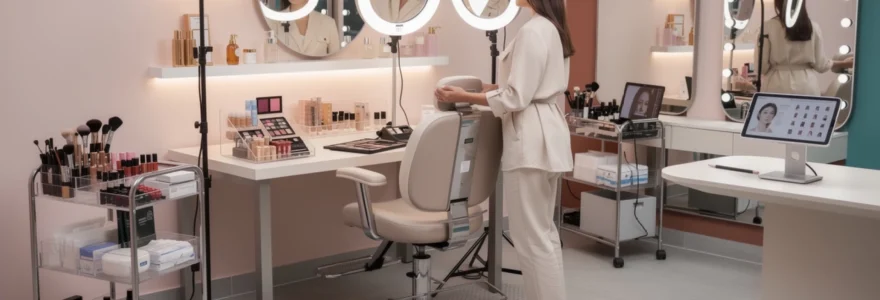
The physical environment where beauty professionals create their artistry directly influences the quality and innovation of their work. A thoughtfully organized workspace serves as more than just a functional area—it becomes a sanctuary for inspiration, a catalyst for efficiency, and a foundation for professional excellence. Whether you’re establishing a home studio, renovating an existing salon, or optimizing a commercial beauty space, the strategic arrangement of furniture, lighting, products, and technology fundamentally transforms how you approach each client and creative project. The modern beauty workspace demands a sophisticated balance between aesthetic appeal and practical functionality, where every element from hydraulic chairs to digital integration serves a specific purpose in elevating your creative output. This comprehensive guide explores proven strategies that beauty professionals worldwide have implemented to create environments that don’t just support their work but actively enhance their creative capabilities and professional satisfaction.
Ergonomic furniture selection for professional beauty workstations
The foundation of any productive beauty workspace begins with furniture that supports both the practitioner’s physical wellbeing and the client’s comfort throughout extended sessions. Ergonomic design principles aren’t merely about comfort—they’re about sustainability, allowing beauty professionals to maintain peak performance throughout their careers without succumbing to the occupational hazards that plague the industry. Research from the Occupational Safety and Health Administration indicates that beauty professionals lose an average of 4.6 working days annually due to musculoskeletal disorders, a statistic that proper furniture selection can dramatically reduce. When evaluating furniture options, consider how each piece contributes to workflow efficiency, spatial optimization, and long-term physical health.
Adjustable hydraulic chairs with lumbar support systems
Professional-grade hydraulic chairs represent one of the most critical investments in a beauty workspace, yet many practitioners underestimate their impact on daily operations. The hydraulic pump mechanism should offer smooth, consistent height adjustment across a minimum range of 15-20 centimetres, allowing you to position clients at optimal working heights regardless of their stature. Premium models incorporate dual-density lumbar support that conforms to individual spinal curvatures whilst maintaining structural integrity over thousands of adjustment cycles. The base diameter matters significantly—chairs with 60-centimetre five-star bases provide superior stability compared to smaller alternatives, particularly crucial during precision work like eyelash extensions or detailed makeup application. Look for chairs upholstered in medical-grade vinyl that resists staining from beauty products whilst remaining breathable enough for extended client sessions.
Multi-tiered trolleys and mobile storage units
Mobile storage solutions transform how you access tools and products during service delivery, eliminating the constant interruptions that fragment your creative flow. Three-tiered trolleys with 360-degree swivel casters allow you to maintain everything within arm’s reach whilst preserving precious floor space. The most versatile configurations feature adjustable shelf heights, accommodating everything from tall aerosol cans to flat palette arrangements. Metal construction with powder-coated finishes outperforms plastic alternatives in durability and professional appearance, withstanding the rigours of daily sanitization protocols. Consider trolleys with integrated towel bars and tool hooks that maximize vertical storage capacity—these seemingly minor additions prevent counter clutter that can stifle creativity and project an unprofessional image to clients.
Height-adjustable tables for makeup application and product display
The traditional fixed-height makeup station has become obsolete in forward-thinking beauty workspaces, replaced by electronically adjustable surfaces that accommodate diverse working preferences and client needs. Contemporary adjustable tables utilize whisper-quiet motors that transition between sitting and standing heights in under 20 seconds, supporting the increasingly popular practice of alternating positions throughout the workday. This flexibility reduces cumulative strain on lower back and leg muscles by up to 43% according to Cornell University ergonomics research. When selecting adjustable tables, prioritize models with memory presets that store your preferred heights—this simple feature eliminates repeated manual adjustments and supports seamless transitions between different service types. Surface materials should resist chemical damage from common beauty products whilst providing stable, non-reflective backgrounds for colour matching and detailed application work.
Anti-fatigue matting for extended standing sessions
Even with optimal furniture, beauty professionals spend considerable time standing during services, making anti-fatigue mat
fatigue matting an essential component of any beauty workspace designed for maximum creativity and long-term comfort. High-density foam or gel-core mats between 1.5 and 2 centimetres thick help distribute pressure across the feet and lower limbs, reducing perceived fatigue by up to 50% during eight-hour shifts according to ergonomic field studies. Opt for beveled edges and non-slip backing to prevent tripping hazards, especially in high-traffic zones around styling chairs and wash basins. For cohesive aesthetics, select mat colours that complement your salon design palette while still providing clear visual separation from the surrounding floor area. Position mats in all primary standing zones—behind styling chairs, at wash stations, and in front of makeup tables—to ensure consistent support wherever you perform detailed work.
Strategic lighting design using ring lights and LED panel systems
Lighting is one of the most overlooked yet powerful tools for organising a beauty workspace that truly supports creative excellence. Poorly planned lighting can distort colour perception, cast distracting shadows, and even strain your eyes, all of which undermine precise makeup application and technical hair work. In contrast, a strategic combination of ring lights, LED panels, and ambient fixtures creates a visual environment where you can assess skin tone, product texture, and hair colour with clinical accuracy. Think of your lighting layout as the “digital calibration” of your physical studio—when it is correctly set, every creative decision becomes more reliable. As you refine your beauty workstation, treat lighting design as a core investment rather than a decorative afterthought.
Colour temperature control: 3200K to 5600K daylight simulation
Colour temperature control is fundamental for beauty professionals who need consistent, predictable results across different client scenarios and environments. Adjustable LED systems that range from 3200K (warm white) to 5600K (daylight) allow you to simulate everything from indoor evening lighting to bright outdoor conditions. This flexibility is crucial when you’re creating bridal makeup for outdoor ceremonies or editorial looks destined for studio photography. Research in visual ergonomics shows that working under stable daylight-balanced lighting reduces colour-matching errors and visual fatigue, both of which directly impact your creative performance. Aim to standardise your default working temperature around 5000–5500K, then fine-tune as needed to match specific client requirements or shoot conditions.
Neewer and godox ring light positioning techniques
Ring lights from brands like Neewer and Godox have become staples in professional beauty workspaces because they provide flattering, shadow-minimising illumination that is ideal for both application and content creation. Yet how you position these lights is just as important as which model you purchase. For makeup application, place the ring light directly in front of the client at eye level and approximately 60–90 centimetres away, ensuring even illumination across the entire face without hot spots on the T-zone. When you’re shooting portfolio images or social content, slightly angle the ring light downwards and experiment with distance adjustments to avoid overexposed highlights on reflective areas such as highlighter or gloss. Treat your ring light as a movable “sun” that you can reposition to sculpt features and showcase your artistry in the most flattering way possible.
Shadow elimination through multi-point illumination
Even the best ring light cannot fully compensate for harsh shadows created by overhead fixtures or poorly placed spotlights. To eliminate distracting shadows in your beauty workspace, adopt a multi-point illumination strategy that combines at least two light sources from different angles. A common professional setup pairs a central ring light with two side-mounted LED panels positioned at 45-degree angles, mirroring a classic photography three-point lighting system. This layout softens jawline and under-eye shadows, improves visibility around the ears and hairline, and reduces the need for you to constantly adjust your own position to see details clearly. Consider your lighting angles the way a painter considers brush strokes: subtle changes can dramatically alter depth, dimension, and the perceived quality of your work.
Dimmable LED strips for ambient workspace enhancement
While task lighting is essential for precision, ambient lighting sets the emotional tone of your beauty studio and influences both client comfort and your own creative mindset. Dimmable LED strips mounted under shelving, along mirrors, or beneath workstation edges create a soft halo effect that makes the environment feel more polished and immersive. Because these strips are low-profile and energy-efficient, they can be integrated into almost any salon layout without adding visual clutter. Use warmer tones (around 3000–3500K) for relaxation zones and reception areas, and slightly cooler tones near workstations to maintain visual clarity. When you can subtly shift the overall ambience with a dimmer or smart controller, you gain another layer of control over how the space supports creativity throughout the day.
Systematic product organisation with acrylic display solutions
With hundreds of products in constant rotation—from foundations and brushes to serums and styling sprays—systematic organisation is essential to prevent your beauty workspace from sliding into chaos. Acrylic display solutions offer a professional, visually clean way to categorise and access your inventory without overwhelming your surfaces. Because clear acrylic is both durable and transparent, it lets you see product labels and shades at a glance, reducing search time and decision fatigue during back-to-back appointments. Tiered acrylic risers elevate hero products and seasonal collections, while divided drawers keep smaller items like lip liners, glitters, and lash clusters neatly contained. Think of acrylic storage like a well-designed product storyboard: when everything has a clear, visible position, your creative ideas flow more freely and your clients perceive a higher level of professionalism.
Digital integration: ipads, smart mirrors, and virtual try-on technology
Digital tools have become integral to organising not only your physical beauty workspace, but also your creative process and client communication. Integrating tablets, smart mirrors, and virtual try-on apps creates a hybrid studio environment where analogue artistry meets digital planning. An iPad on a dedicated stand can house your digital face charts, client history, and product inventories, reducing paper clutter and streamlining consultations. Smart mirrors equipped with lighting presets and skin analysis features help you document transformations and recommend personalised routines with scientific precision. When you align your digital toolkit with your physical layout—placing screens within comfortable reach and line of sight—you create a cohesive workflow that supports both efficiency and experimentation.
Procreate and adobe fresco for digital makeup planning
Applications like Procreate and Adobe Fresco transform your iPad into a dynamic canvas for makeup planning and collaboration. Instead of relying solely on traditional paper face charts, you can photograph your client or a generic face template and sketch potential looks directly on the screen using pressure-sensitive brushes that mimic real-world tools. This approach is especially powerful for editorial, bridal, and creative colour work where you may need to present multiple concepts before committing to application. You can save layered versions of each design, export them to share via email or social platforms, and maintain a digital archive for future reference or portfolio use. In many ways, digital face charts function like mood boards in interior design: they organise your ideas visually, clarify direction, and give clients confidence in your vision.
Himirror and simplehuman sensor mirror integration
Smart mirrors such as HiMirror and Simplehuman sensor mirrors bring professional-grade analysis and consistent lighting control directly to your station. HiMirror devices can assess skin condition, track changes over time, and suggest targeted product categories, which supports more informed recommendations during skincare consultations. Simplehuman mirrors, on the other hand, excel at replicating natural sunlight with colour-correct LED rings that automatically adjust brightness when you approach. Integrating these mirrors into your beauty workspace means you no longer have to guess whether a contour is too strong or a foundation undertone is slightly off. Position smart mirrors at primary makeup stations and calibrate their brightness to match your surrounding lighting so that what you see in the mirror aligns with how the client will appear in real-world conditions.
Modiface and perfect corp virtual application tools
Virtual try-on platforms like Modiface and apps powered by Perfect Corp allow clients to preview hair colours, lip shades, and eye looks digitally before you begin the physical service. This not only elevates the client experience but also organises your consultation process by narrowing down choices and minimising indecision. By mirroring potential looks on a tablet or smart mirror, you can quickly test variations in depth, finish, and colour placement without consuming product or time. Once a client selects their preferred option, you can save the digital reference and use it as a guide throughout application, much like following a recipe in a professional kitchen. Have you ever wished you could “undo” a makeup decision as easily as a digital brushstroke? These tools offer the next best thing during the planning phase.
Colour psychology and palette selection for creative enhancement
The colour palette of your beauty workspace has a profound impact on how you and your clients feel within the environment, which in turn shapes creativity, trust, and perceived professionalism. Soft neutrals and desaturated tones on walls and large surfaces provide a calm, non-distracting backdrop that makes product colours and client features stand out with photographic clarity. Strategic accents—such as muted teal, dusty rose, or deep forest green—can be introduced through furniture, artwork, or textiles to evoke specific emotional responses without overwhelming the eye. Studies in environmental psychology indicate that cool-toned spaces promote focus and precision, while warmer tones encourage relaxation and openness, both of which can be leveraged depending on your service menu. When designing your beauty studio, treat colour like a silent collaborator: it guides mood, supports your brand identity, and subtly directs where attention should fall.
Sanitation zones and professional hygiene protocol stations
In the post-pandemic beauty landscape, clients increasingly evaluate salons and studios based on the visibility and rigour of their hygiene practices. A well-organised sanitation zone functions like a control centre for cleanliness, ensuring that tools, surfaces, and products flow through clear stages of use, disinfection, and storage. Instead of scattering sanitising supplies across multiple counters, dedicate a specific area—ideally near a sink or back bar—equipped with labelled containers, disposable accessories, and clear signage for staff. This not only streamlines daily routines but also reassures clients when they see that hygiene is embedded into the physical design of your workspace. Think of your sanitation station as the backstage of a theatre: when it operates smoothly and systematically, the performance on the main stage feels seamless and safe.
UV steriliser cabinets for brush and tool maintenance
UV steriliser cabinets provide an efficient, space-saving method for maintaining high hygiene standards for brushes, metal tools, and small implements. By exposing items to germicidal ultraviolet light for manufacturer-specified cycles—often between 5 and 15 minutes—you can significantly reduce microbial load between clients. Position your cabinet close to your sanitation zone, with a clear in-and-out system for tools awaiting disinfection versus those ready for use. Many professionals integrate a simple labelling method or colour-coded trays to prevent cross-contamination and ensure that newly sterilised tools do not mix with used items. Consistent use of UV cabinets not only supports compliance with local regulations but also prolongs the life of high-end brushes and tools compared to aggressive chemical soaking.
Barbicide solution stations and disinfection workflows
For combs, clips, and other non-porous implements, Barbicide solution remains a gold standard in professional salons worldwide. A dedicated Barbicide station, equipped with clearly marked jars or tubs, measuring tools, and timers, ensures that concentration ratios and immersion times stay within manufacturer guidelines. To avoid workflow bottlenecks, map out a simple disinfection pathway: used tools move from workstations to a designated “dirty” tray, then into Barbicide for soaking, and finally to a drying and storage area. Training your team to follow this linear process reduces errors and makes hygiene a predictable, low-friction part of the day rather than a constant interruption. When clients see a structured system rather than ad hoc cleaning, their confidence in your safety standards increases dramatically.
Disposable barrier film and single-use product storage
Disposable barrier film and single-use items such as mascara wands, lip applicators, and under-eye pads help maintain strict separation between clients without overcomplicating your setup. Store these consumables in clearly labelled acrylic drawers or containers within your sanitation zone, with the oldest stock placed at the front to support efficient rotation. Barrier film can be quickly applied to high-touch surfaces like chair arms, light switches, and trolley handles, creating a physical layer that is removed and replaced throughout the day. To prevent visual clutter, limit your visible stock to a working quantity and keep bulk supplies in a back-of-house cabinet or storage room. By treating disposables as an organised category within your beauty workspace—rather than a scattered afterthought—you maintain both aesthetic harmony and rigorous hygiene.