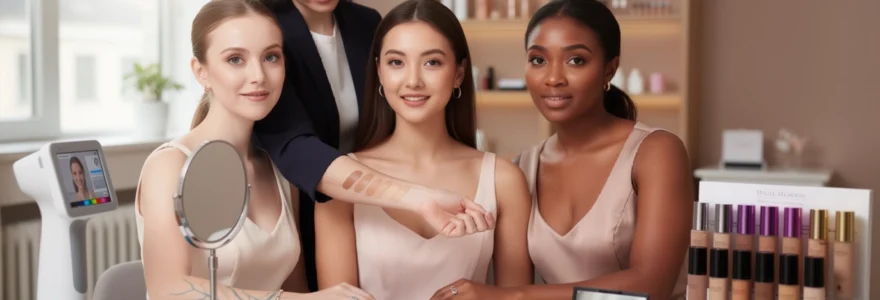
Foundation that truly disappears into your skin remains one of beauty’s most elusive achievements. The difference between a seamless, second-skin finish and an obvious mask of makeup often comes down to one critical factor: undertone matching. Whilst most consumers can readily identify whether they have fair, medium, or deep skin, the underlying pigmentation that determines how foundation appears on the complexion remains a mystery to many. This invisible characteristic influences not only which foundation shades complement your skin, but also which colour correctors, blushers, and even clothing hues will enhance your natural appearance. Understanding your undertone transforms makeup application from guesswork into a science, eliminating the frustration of purchasing expensive foundations that oxidise into unnatural shades or create that telltale demarcation line along the jawline.
The cosmetics industry has made remarkable strides in shade inclusivity over recent years, with many brands now offering upwards of fifty foundation shades. However, this expansion has paradoxically made selection more complex for consumers who lack the knowledge to navigate undertone classifications. Professional makeup artists have long understood that two individuals with seemingly identical skin tones can require completely different foundation shades based solely on their undertones. This nuanced approach to colour matching represents a fundamental shift from the oversimplified light-medium-dark categorisation that dominated the beauty industry for decades.
Understanding skin undertone classification: cool, warm, and neutral pigmentation
Skin undertone refers to the subtle hue that exists beneath the surface of your skin, creating the overall temperature of your complexion. Unlike your surface tone, which can fluctuate with sun exposure, hormonal changes, or skin conditions, your undertone remains constant throughout your lifetime. This permanence makes undertone identification invaluable for building a cohesive makeup collection and wardrobe palette. The three primary undertone categories—cool, warm, and neutral—each possess distinct characteristics that manifest differently across various skin tones.
Melanin distribution and haemoglobin influence on surface tone
The visible colour of your skin results from a complex interplay between melanin pigmentation and haemoglobin in the blood vessels near the skin’s surface. Melanin, produced by specialised cells called melanocytes, exists in two primary forms: eumelanin, which creates brown and black pigments, and pheomelanin, which produces red and yellow tones. The ratio and distribution of these melanin types significantly influence your undertone. Individuals with higher concentrations of pheomelanin typically exhibit warmer undertones, characterised by golden, peachy, or yellow hues beneath the skin’s surface.
Haemoglobin, the oxygen-carrying protein in red blood cells, contributes the pink and red tones visible in lighter complexions where blood vessels sit closer to the skin’s surface. This biological factor explains why individuals with fair skin often display cooler undertones, as the bluish-red colour of deoxygenated blood becomes more apparent through thinner epidermal layers. The concentration and proximity of these blood vessels create the rosy or ruddy appearance associated with cool undertones, whilst deeper skin tones may mask this effect, requiring alternative assessment methods.
The fitzpatrick scale and undertone correlation
The Fitzpatrick Scale, developed by dermatologist Thomas B. Fitzpatrick in 1975, classifies skin into six phototypes based on melanin content and reaction to ultraviolet exposure. Whilst this scale primarily addresses sun sensitivity and skin cancer risk, it provides useful context for understanding undertone distribution across different ethnic backgrounds. Types I and II, characterised by very fair to fair skin that burns easily, frequently correlate with cool undertones, though warm-toned individuals certainly exist within these categories.
Types III and IV encompass light to moderate brown skin that tans more readily than it burns. These phototypes demonstrate the widest variation in undertones, with warm, cool, and neutral possibilities all commonly occurring. Types V and VI, representing brown to very dark brown and black skin, often exhibit warm or neutral undertones, though cool-toned individuals within these categories require specific attention to avoid the common industry assumption that all deeper skin possesses golden undertones. This diversity underscores the importance of individualised undertone assessment rather than relying on generalisations based on surface tone alone.
Distinguishing between surface tone
and underlying undertone
To accurately choose the right undertone for a perfectly matched complexion, it is crucial to separate what you see at first glance from what lies beneath. Your surface tone describes how light or deep your skin appears and may fluctuate dramatically with sun exposure, skincare actives, or temporary irritation. Your underlying undertone, by contrast, is the stable chromatic bias that makes your skin read more pink, olive, golden, or balanced in neutral light.
A helpful analogy is to think of your skin as a piece of fabric that has been dyed: the fabric weight (surface tone) can change slightly as it stretches or shrinks, but the colour of the dye (undertone) remains the same. This distinction explains why your summer foundation may need to be one or two shades deeper but should still share the same undertone family as your winter shade. When undertone is misread as surface tone, consumers often compensate for the wrong undertone by going lighter or darker in depth, resulting in foundations that never quite disappear into the skin.
Seasonal colour analysis theory applied to complexion matching
Seasonal colour analysis, popularised in personal styling, provides another useful framework for understanding undertones. This system categorises individuals into four primary “seasons”—Spring, Summer, Autumn, and Winter—based on a combination of undertone (warm versus cool) and value contrast (light versus deep). Whilst often applied to clothing and hair colour, the same principles can refine your makeup undertone selection, particularly when choosing foundation, bronzer, and blusher.
In broad terms, Spring and Autumn types exhibit warm undertones, with Spring leaning lighter and brighter and Autumn appearing deeper and more muted. Summer and Winter types are typically cool-toned, with Summer characterised by soft, smoky hues and Winter by higher contrast and clearer pigmentation. When we translate this into complexion products, a bright warm Spring skin usually suits golden-beige foundations and apricot blushers, whereas a cool muted Summer skin will look more natural in rosy-beige bases and soft pink cheek colours. Although modern undertone classification avoids boxing people too rigidly, seasonal theory remains a pragmatic tool for visualising how undertone, depth, and clarity interact on the face.
Clinical testing methods for accurate undertone determination
Beyond visual estimation, there are several structured methods you can use at home or with a professional to determine your undertone more reliably. Because lighting, skincare, and even clothing can temporarily skew how your complexion reads, combining a few simple “tests” gives a far clearer picture than relying on a single trick. Think of these methods as diagnostic tools: each one offers a clue, and the pattern that emerges across them reveals your most likely undertone category.
Whenever you perform these undertone tests, aim for consistent conditions to improve accuracy. Remove makeup, wait at least ten to fifteen minutes after washing your face to allow any transient redness to settle, and use bright natural daylight whenever possible. If your skin is currently experiencing a flare-up—such as rosacea or post-inflammatory hyperpigmentation—you may find it helpful to test on less reactive areas like the neck, décolletage, or even behind the ear for a more neutral reading.
The vein test: interpreting blue versus green undertones
The vein test remains one of the most widely recommended methods for undertone detection because it relies on colour theory rather than subjective preference. To perform it, position yourself near a window and examine the veins on the inside of your wrist or at the crook of your elbow. If they appear predominantly blue or violet, your skin is likely reflecting a cooler undertone; if they read more green, this suggests that a warm yellow or golden undertone is overlaying the bluish colour of the blood, shifting it towards green.
Those whose veins appear neither distinctly blue nor green, or who see a mixture of both, often fall into the neutral undertone category. However, it is important not to over-interpret this single test, particularly on deeper skin tones where melanin can obscure colour perception. For very deep complexions, visible veins may be limited; in these cases, the vein test should be used in conjunction with fabric draping or white paper testing for a more accurate undertone reading. Treat the vein test as a starting point rather than a definitive diagnosis.
White paper test and fabric draping techniques
The white paper test offers a simple yet powerful way to reveal undertone by creating a high-contrast reference point next to the skin. Stand in front of a window with clean, indirect daylight and hold a sheet of plain white paper or a bright white T-shirt beside your bare face. If your skin takes on a noticeably pink, rosy, or bluish cast in comparison, you most likely lean towards a cool undertone. If it appears creamy, golden, or slightly peach, this typically indicates a warm undertone.
To refine the result, you can extend this into a basic draping exercise using both stark white and off-white (ivory or cream) fabrics. Cool complexions are usually flattered by crisp, optic white fabrics that make the skin look fresh and luminous, whereas warm undertones tend to look healthier and more even next to ivory and ecru. If both fabric shades appear equally harmonious and your skin shows no strong shift towards pink or yellow, a neutral undertone is probable. This technique borrows from professional image consulting but is easily replicated at home with wardrobe staples.
Jewellery compatibility assessment with gold and silver metals
Jewellery preference may be driven by style, but how different metals appear against your skin can also reveal valuable information about your undertone. Pure yellow gold tends to enhance warm undertones by echoing the skin’s natural golden pigments, making the complexion look vibrant and even. Silver, white gold, and platinum generally bring out cool undertones, harmonising with pink or blue-leaning complexions and creating a refined, luminous effect.
To conduct this assessment objectively, compare similar pieces of jewellery in both metals—ideally simple chains or studs—placed directly against your bare skin at the neck, ears, and wrists. Ask yourself which metal seems to lift and brighten your complexion and which one makes you appear dull, sallow, or washed out. If both gold and silver look equally flattering, you may fall into the neutral undertone category, which can comfortably accommodate a broader spectrum of foundation undertones and colour cosmetics.
Natural sunlight analysis for true pigmentation reading
Artificial lighting can dramatically distort how your undertone appears, making natural daylight analysis one of the most critical steps in accurate undertone determination. Cool white LED lighting often exaggerates sallowness, while warm incandescent bulbs can make almost any complexion appear more golden. To cut through these distortions, examine your bare skin near a large window or outdoors in the shade, where light is bright but diffused.
Observe multiple areas: the centre of your face, the jawline, the neck, the chest, and, on deeper skin tones, the shoulders and forearms. Does your overall colouring lean more towards rosy-beige, olive, or golden caramel? Is there a noticeable contrast between your face and neck, perhaps due to past sun exposure or hyperpigmentation? By mentally averaging these areas, you can identify your true undertone and avoid relying solely on the often more sun-exposed centre of the face, which may appear warmer or redder than your overall complexion.
Foundation shade matching systems and undertone notation
Once you have a clearer understanding of your undertone, the next challenge is decoding how different brands label and categorise their foundation shades. Modern formulations often come in extensive shade ranges, but the naming conventions—letters, numbers, and descriptive terms—can vary widely from one brand to another. Knowing how to interpret these systems turns foundation shopping from a confusing guess into a targeted, almost clinical process.
Most professional and consumer brands use some form of undertone notation to guide you: letters such as W, C, and N, or descriptors like “golden”, “neutral beige”, or “rosy sand”. However, the same label can look surprisingly different between brands because of differences in lab pigment mixes and regional preferences. Understanding a few of the major systems, including MAC, Fenty Beauty, and multi-brand tools like Sephora’s colour matching technology, can significantly reduce the risk of buying the wrong undertone online or in-store.
MAC cosmetics NC and NW classification methodology
MAC Cosmetics pioneered one of the most widely referenced undertone systems in the industry with its NC and NW classifications. Somewhat counterintuitively, MAC defines NC as “neutral cool”, meaning shades designed to neutralise cool, pink-toned skin with yellow-based pigments. In practical terms, NC foundations lean warmer and more golden on the face. Conversely, NW, or “neutral warm”, is formulated to balance warm, golden skin with rose or redder undertones, so NW foundations typically appear cooler and pinker.
This inversion can be confusing if you are used to other brands where “cool” equals pink and “warm” equals yellow. When choosing a MAC foundation, focus less on the letter descriptors and more on swatching the shades: if your skin looks best in golden or olive bases, you will typically gravitate towards the NC family, whilst naturally rosy or ruddy complexions often harmonise better with NW shades. Numerical values (such as 15, 30, or 45) indicate depth, with lower numbers representing lighter skin tones and higher numbers corresponding to deeper complexions.
Fenty beauty’s 50-shade undertone spectrum approach
Fenty Beauty helped redefine industry expectations by launching an inclusive 40-shade foundation range, now expanded to 50, with clearly stated undertones across the spectrum. Each shade number is paired with an undertone code—usually C for cool, N for neutral, and W or Warm for golden-based shades—with particular attention paid to deeper skin tones that had historically been underrepresented. This consistent structure means that once you discover your Fenty shade and undertone, it becomes a reliable reference point for other brands and products.
Another advantage of the Fenty system is its nuanced treatment of olive and red undertones in medium to deep complexions. Many mid-range shades are designated as neutral-olive or warm-golden to capture the complexity of real skin, reducing the risk of the ashy grey cast that cool-toned foundations can create on warm, melanin-rich skin. If you struggle to categorise your undertone, using a Fenty counter or online shade finder as a starting benchmark can give you a precise “anchor” shade from which to calibrate other foundation purchases.
Decoding foundation labels: Y, W, C, and N undertone indicators
Across many brands, a simplified letter code indicates the dominant undertone of a foundation shade. In most systems, Y or W represent yellow or warm undertones; C stands for cool, generally associated with pink or red undertones; and N denotes neutral, designed to sit between these extremes. Some professional brands further refine this by using G for golden or olive (green-leaning) undertones and R for explicitly red-based shades, especially in deeper ranges where red and blue pigment ratios become more pronounced.
When reading these labels, remember that your goal is not to match the label to your perceived skin colour (“I look pink, so I need a cool shade”) but to select a foundation undertone that balances your natural pigmentation. For example, very flushed, cool skin may actually appear more even and natural in a slightly yellow or neutral base that counteracts redness, whereas olive complexions can look brightened by neutral-warm bases that offset greenness. Always test undertone-coded shades along the jawline in natural light; the right undertone should visually disappear into both face and neck without leaving a yellow, orange, or pink edge.
Sephora colour IQ technology and pantone skin tone matching
For those who prefer a data-driven approach, multi-brand retailers have increasingly adopted digital tools to standardise complexion shade matching. Sephora’s Colour IQ system, developed in partnership with Pantone, uses a handheld device or high-resolution imaging to capture your skin’s colour profile at several points on the face. The technology then assigns a unique Colour IQ code that corresponds to a curated list of foundation, tinted moisturiser, and concealer shades across numerous brands that should match your undertone and depth.
Although no system is infallible—lighting, recent sun exposure, and skincare products can still influence readings—these technologies reduce guesswork, especially when shopping for brands you cannot physically swatch. Many consumers find it helpful to note their Colour IQ or equivalent Pantone skin tone reference and use it as a baseline when exploring new formulations or shopping online. Combining this with your own understanding of whether you prefer a slightly brighter, more golden, or more neutral finish enables you to fine-tune recommendations rather than starting from zero with each new product.
Corrective colour theory for undertone neutralisation
Even when you have chosen the right foundation undertone, real skin rarely behaves like a perfectly even canvas. Localised redness, dark circles, sallowness, and hyperpigmentation can disrupt an otherwise harmonious base, which is where corrective colour theory becomes invaluable. By applying targeted colour correctors and primers that sit opposite unwanted tones on the colour wheel, you can neutralise specific issues without needing to over-apply foundation.
Corrective colour theory treats complexion work much like an artist balances paint on a palette: instead of simply adding more of the same colour, you strategically introduce an opposing hue to cancel excess. Used sparingly, these products allow your skin’s natural undertone to show through, preserving a realistic finish while still delivering a perfected look. The key lies in choosing the right corrective shade for the specific undertone concern you are trying to address.
Green primers for redness and pink undertone correction
Green-tinted primers and correctors exploit the fact that green sits opposite red on the colour wheel, making it particularly effective at neutralising excess warmth and surface redness. For cool complexions prone to rosacea, broken capillaries, or persistent flushing, a sheer green primer applied to the centre of the face can bring the overall undertone closer to neutral, allowing a broader range of foundations to appear natural. On warm or neutral skins that experience localised redness around the nose and cheeks, spot application helps prevent these areas from pulling too pink under foundation.
To avoid an obvious green cast, modern formulas are typically semi-transparent and should be applied in a very thin layer, preferably with fingers or a damp sponge for seamless blending. After the green corrector has been gently pressed into the skin, follow with your usual undertone-matched base. You should notice that less foundation is needed to disguise redness, and the end result appears more like even skin than a heavy layer of makeup attempting to mask colour irregularities.
Peach and orange colour correctors for cool-toned dark circles
Under-eye darkness often has a cool, blue-violet undertone, particularly on medium to deep complexions, which can cause standard concealers to look ashy or grey. Peach and orange correctors counteract this issue by adding warmth and brightness, sitting opposite blue on the colour wheel. Light to medium skin tones generally respond best to soft peach or salmon correctors, while tan to deep skin can tolerate more saturated apricot and orange formulations without turning the area visibly warm.
For the most natural result, apply a very thin layer of peach or orange corrector only where the shadow is darkest—usually the inner corner and along the deepest part of the tear trough. Blend the edges thoroughly, then layer a small amount of your usual undertone-appropriate concealer over the top. This two-step approach transforms bruised-looking circles into a more uniform, skin-like finish, with the corrector doing the heavy lifting and the concealer simply restoring your natural undertone.
Lavender brighteners for yellow and sallow undertone adjustment
Lavender or lilac correctors are designed to balance excessive yellowness or sallowness in the complexion, especially in warm or olive skins that can sometimes appear dull in low light. Purple sits opposite yellow on the colour wheel, so a sheer veil of lavender primer can subtly cool and brighten the skin without making it truly cool-toned. This is particularly helpful for smokers, those experiencing post-illness sallowness, or individuals whose undertone is warm but who prefer a fresher, more neutral finish in photographs.
Because purple pigments can quickly become noticeable, restraint is essential. Opt for lightweight, illuminating formulas and apply them sparingly to the areas that appear most sallow—often the outer cheeks and jawline—before blending thoroughly. Once your foundation is applied on top, the lavender base should not be visible as a distinct colour but will translate as a soft, lifted radiance, preventing warm or yellow-based foundations from tipping too far into an orange or jaundiced appearance.
Professional colour matching tools and technologies
As complexion products have become more sophisticated, so too have the tools professionals use to match undertones with precision. Makeup artists, dermatologists, and cosmetic formulators increasingly rely on objective measurements and digital simulations rather than purely visual assessment. For consumers, this technology translates into more accurate in-store consultations, virtual try-on experiences, and even custom-blended foundations tailored to their exact undertone profile.
These innovations do not replace your own understanding of undertones but rather complement it. When you already know whether you lean warm, cool, or neutral, professional tools can fine-tune shade depth, finish, and colour balance to an impressive degree. Think of them as the equivalent of a high-resolution camera compared to the naked eye: both can capture the subject, but one provides more granular information to work with.
Spectrocolorimeter analysis for precise undertone measurement
Spectrocolorimeters are scientific instruments that measure how skin reflects light across different wavelengths, capturing data that corresponds to both surface tone and undertone. In clinical and research settings, these devices provide objective colour coordinates—often in CIE Lab or similar colour spaces—that describe the skin’s lightness, red-green balance, and yellow-blue balance with high accuracy. This allows brands to formulate foundations and concealers that more closely mimic real-world skin colour distributions.
In some high-end retail environments and dermatology clinics, spectrocolorimeter readings are offered as part of bespoke foundation blending or medical camouflage services. The device is typically placed against several areas of the face and neck, and the averaged measurements inform pigment ratios in the final product. While not widely accessible to every consumer, this level of analysis underscores why subtle undertone differences matter and illustrates the direction in which complexion-matching technology is heading.
Artificial intelligence apps: findation and TryItOn virtual matching
For everyday users shopping online, artificial intelligence has become an invaluable ally in narrowing down potential foundation matches. Platforms such as Findation aggregate millions of user shade matches across brands to suggest equivalents based on the products you already know suit your undertone. Meanwhile, many beauty retailers and brands offer “Try It On” virtual matching tools that use augmented reality to simulate how different undertones and depths will look on your live image or selfie.
To get the most from these tools, always ensure your reference shade truly matches your undertone before using it as a baseline; otherwise, the algorithm will reproduce that initial mismatch across other brands. When using virtual try-on, capture images in natural daylight and avoid heavy makeup that could interfere with colour detection. Treat AI recommendations as a curated shortlist to test rather than definitive answers—once you have samples in hand, confirm your ideal undertone match using the jawline and natural light checks outlined earlier.
In-store shade matching services at bobbi brown and charlotte tilbury
Many prestige brands now offer in-store complexion consultations that combine trained human observation with proprietary shade-matching tools. Bobbi Brown, long known for its skin-tone-centric philosophy, trains artists to identify subtle undertones by observing the face, neck, and chest together and often cross-references this with digital tools for consistency. Their philosophy leans towards yellow-based foundations for a natural, skin-like look, but recent ranges also include more neutral and rosy undertone options to cater to a broader audience.
Charlotte Tilbury and similar brands provide structured shade-matching experiences that factor in not only undertone and depth, but also desired finish and coverage level. Consultants may use tablets loaded with brand-specific algorithms or shade charts organised by undertone families to guide you towards the most suitable options. When taking advantage of these services, communicate clearly about your undertone observations and previous shade successes or failures; this collaborative approach often yields a more accurate match than relying solely on either professional judgment or technology alone.
Common undertone mismatching errors and solutions
Even with a solid grasp of undertone theory, missteps can happen—particularly when formulas oxidise, lighting is poor, or skin condition changes after purchase. Recognising the visual signs of undertone mismatches allows you to correct them with strategic product layering rather than discarding an entire foundation. By learning to diagnose the problem—is the base turning orange, grey, or muddy?—you can apply targeted fixes that bring the overall complexion back into harmony.
Think of these common errors as opportunities to refine your eye for undertones. The more familiar you become with how incorrect undertones manifest on your own skin, the easier it becomes to spot potential issues in store before you commit. Below are three frequent undertone-related concerns and pragmatic strategies to resolve them.
Oxidation issues with wrong ph-balanced formulations
Oxidation occurs when foundation pigments react with oxygen, skin oils, or skincare ingredients, causing the product to darken or shift undertone after application. This is particularly noticeable in formulas that are not optimally pH-balanced for your skin or that contain high levels of certain iron oxides. A foundation that initially appears like a good undertone match may oxidise into an unnaturally warm, muddy, or orange hue within a few hours, undermining your carefully selected shade.
To pre-empt oxidation, always test new foundations on bare skin for several hours before purchasing, ideally on the jawline and neck where undertone consistency matters most. If a product consistently oxidises on you, consider switching to oil-free or long-wear formulas with more stable pigment systems, and ensure your skincare underneath is fully absorbed and not overly acidic. Using a translucent setting powder can also help reduce sebum-induced oxidation by creating a barrier between skin oils and the foundation pigments.
Orange jawline syndrome from incorrect yellow-based foundations
“Orange jawline syndrome” describes the conspicuous line where an overly warm, yellow-based foundation stops at the jaw, revealing a cooler or more neutral neck underneath. This mismatch often results from assuming that all medium or deep skin tones require golden undertones, or from overcompensating for redness by choosing shades that are too warm. On lighter complexions, this can translate into a self-tan effect that looks disconnected from the neck and chest; on deeper complexions, it can create an unnatural, brassy cast.
If you find that your current foundation pulls orange, the simplest solution is to adjust one step cooler or more neutral in undertone while maintaining similar depth. Mixing a small amount of a neutral or cool-toned foundation or mixer into your existing base can also help correct excessive warmth. Extending your foundation slightly down the neck and softening the edges with a damp sponge reduces visible demarcation, but the ultimate goal remains to choose an undertone that harmonises naturally with both face and neck, eliminating the line altogether.
Ashy grey cast from cool-toned products on warm skin
An ashy, greyish cast often appears when cool-toned or overly light complexion products are applied to warm or olive skin. This effect is particularly common with high-coverage foundations, concealers, and SPF products that contain high levels of zinc oxide or titanium dioxide. Instead of blending seamlessly, these products sit on top of the skin and neutralise its natural warmth, leaving a dusty or mask-like finish that looks especially stark in flash photography.
To correct or prevent this issue, opt for foundations and concealers explicitly formulated with warm or golden undertones if your skin naturally leans in that direction, and consider using tinted mineral sunscreens designed for deeper skin tones to avoid a white cast. If you already own a cool, ashy base, you can warm it up by mixing in a liquid bronzer, a drop of warm-toned foundation, or a targeted undertone adjuster. Applying a sheer layer of cream bronzer or warm blush on top of ashy areas also helps reintroduce dimension and warmth, restoring a more lifelike, undertone-appropriate complexion.