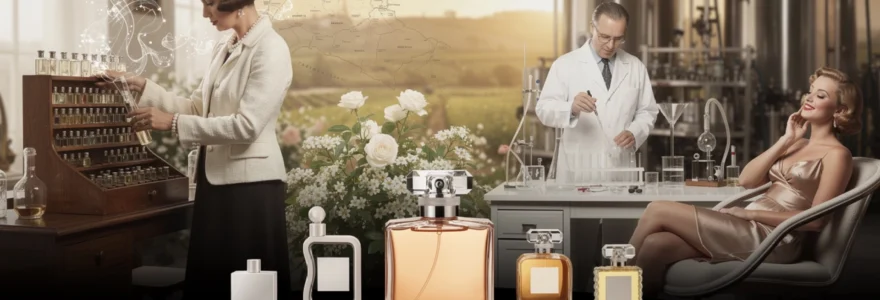
The fragrance industry owes much of its revolutionary transformation to one visionary French couturier whose daring approach to scent creation forever altered how women experience perfume. Gabrielle “Coco” Chanel’s entry into perfumery in 1921 marked a seismic shift from ornamental, single-note floral compositions to complex, abstract fragrances that embodied the sophistication of modern femininity. Her collaboration with perfumer Ernest Beaux produced not just a fragrance, but a cultural phenomenon that challenged conventional expectations of women’s scent preferences. This revolutionary approach established Chanel as the architect of contemporary perfumery, introducing synthetic aldehydes, minimalist packaging aesthetics, and marketing strategies that positioned fragrance as an extension of personal identity rather than mere decoration.
Gabrielle chanel’s revolutionary approach to women’s fragrance composition
Before Chanel’s intervention, women’s perfumery remained trapped in predictable patterns of single-flower compositions that served more as decorative accessories than expressions of personality. The typical fragrance palette consisted of straightforward interpretations of jasmine, rose, or violet, designed to replicate nature rather than transcend it. Chanel recognised this limitation as symptomatic of broader societal constraints placed on women’s self-expression. Her vision extended beyond creating pleasant scents; she sought to develop olfactory compositions that reflected the complexity and sophistication she believed women deserved to embody.
The conceptual breakthrough emerged from Chanel’s fundamental rejection of naturalistic fragrance philosophy. Where contemporary perfumers aimed for botanical accuracy, she demanded abstraction that would smell like a woman, not like a flower. This philosophical shift represented more than aesthetic preference; it embodied her belief that women possessed multifaceted personalities that couldn’t be captured through simple floral mimicry. Her approach treated fragrance composition as architectural construction, layering synthetic and natural elements to create dimensional complexity previously unknown in women’s perfumery.
Aldehydic innovation in no. 5: breaking traditional floral conventions
The aldehydes that gave Chanel No. 5 its distinctive sparkle represented one of perfumery’s most daring technical innovations. These synthetic compounds, previously avoided by perfumers due to their overwhelming intensity, became Chanel’s secret weapon for achieving unprecedented freshness combined with remarkable longevity. Ernest Beaux’s masterful application of aldehydes created what industry professionals now recognise as the first truly abstract fragrance, one that existed beyond natural scent categories.
The technical achievement extended beyond simple aldehyde incorporation. Beaux balanced these powerful synthetic molecules with carefully selected natural essences, creating harmonic tension that prevented the composition from becoming either too sharp or too soft. This balance produced the characteristic aldehydic floral signature that became synonymous with sophisticated femininity. The result challenged olfactory expectations so dramatically that many contemporary wearers described the experience as smelling something entirely unprecedented.
Ernest beaux’s synthetic accord mastery and russian perfumery techniques
Ernest Beaux brought unique technical expertise derived from his experience serving the Russian Imperial Court, where he had developed sophisticated understanding of luxury fragrance creation. His background included extensive knowledge of synthetic aromachemicals, which Russian perfumery had embraced more readily than French houses. This technical foundation proved crucial when Chanel challenged him to create something revolutionary rather than merely pleasant.
Beaux’s methodology involved creating multiple sample variations, numbered sequentially to maintain objectivity during evaluation. His systematic approach allowed Chanel to select based purely on olfactory merit rather than preconceived notions about fragrance naming or marketing appeal. The famous selection of sample number five reflected this scientific rigour, demonstrating how technical precision could serve artistic vision. His Russian training in balancing powerful synthetic materials with delicate natural essences enabled the creation of No. 5’s distinctive character.
Jasmine and rose centifolia sourcing from grasse’s premier distilleries
The natural heart of Chanel No. 5 relied on exceptional quality jasmine and May rose sourced exclusively from Grasse, establishing a standard for raw material excellence that continues today. Chanel’s partnership with local growers ens
ured that the floral heart of No. 5 possessed an unmatched richness and nuance. Over time, this commitment evolved into long-term contracts and, eventually, exclusive cultivation partnerships that protected both supply and quality. By securing fields dedicated solely to Chanel, the house effectively ring-fenced a specific olfactory profile that competitors could not replicate, even if they attempted to copy the formula on paper.
This strategic sourcing from Grasse also shaped how iconic women’s perfumes would be evaluated: not only by their composition, but by the integrity of their ingredients. The dense, honeyed jasmine absolute and the soft, peppery facets of rose centifolia gave No. 5 its luxurious depth, ensuring that the aldehydic sparkle rested on a surprisingly sensual, almost tactile foundation. When we speak today about “high-quality juice” in luxury perfumery, we are in many ways echoing the precedent Chanel set with its insistence on best-in-class raw materials married to avant-garde chemistry.
Ylang-ylang and sandalwood base notes: creating architectural fragrance structure
If jasmine and rose formed the emotional core of Chanel No. 5, its ylang-ylang and sandalwood notes provided the backbone—an architectural framework that allowed the fragrance to feel structured rather than ephemeral. Ylang-ylang, with its creamy, slightly medicinal floral character, acted as a bridge between the bright aldehydic top and the deeper base, smoothing transitions and adding a voluptuous, almost skin-like warmth. Sandalwood, sourced historically from Mysore and now from carefully managed plantations, brought a milky, woody resonance that anchored the entire composition.
From a technical standpoint, this base operated like the foundation of a building: invisible yet essential for stability. Beaux and Chanel used these notes not simply as heavy fixatives, but as sculptural elements that could contour the fragrance’s silhouette on skin. This approach to base construction—treating woods, balsams, and resins as design tools rather than mere supports—would profoundly influence how later iconic women’s perfumes were built, from powdery florals to modern chypres. You can still feel this “architectural” DNA in many contemporary Chanel fragrances, which seem to stand upright on the skin instead of dissolving into flatness.
Chanel no. 5’s market disruption and olfactory legacy since 1921
When Chanel No. 5 launched in 1921, it did more than introduce a new smell; it disrupted an entire market logic. At a time when perfumery was dominated by ornate bottles and literal floral interpretations, Chanel presented an abstract fragrance housed in a minimal, almost pharmaceutical-looking flacon. This stark contrast communicated a clear message: No. 5 was not just another pretty scent, but a manifesto for modern womanhood. Its commercial success proved that women were ready to embrace complexity, both olfactively and culturally.
The olfactory legacy of No. 5 can be traced in countless subsequent launches, from aldehydic florals of the mid-20th century to niche abstractions today. Industry insiders still regard it as a training benchmark; young perfumers study its structure the way architects study Bauhaus buildings. How many other perfumes can claim to have shaped not only consumer taste but also the professional education of those who create them? In that sense, No. 5 functions less as a product and more as a reference point, a north star for the entire category of iconic women’s perfumes.
Minimalist bottle design by charvet frères: pharmaceutical aesthetic revolution
The visual language of Chanel No. 5 was as disruptive as its scent. Instead of the curvilinear, jewel-like bottles popular in the early 20th century, the house turned to Charvet Frères to realise a stark, geometric design reminiscent of apothecary flasks and men’s cologne vials. The result was a rectangular bottle with sharp edges, a flat faceted stopper, and a plain label—closer to a lab object than a boudoir trinket. This “pharmaceutical aesthetic” signalled scientific precision and modern luxury, rather than romantic fantasy.
This minimalism deliberately decoupled luxury from ornament. By stripping away decorative excess, Chanel placed all focus on the liquid itself and the woman who wore it. The bottle became an icon of modern design, later inspiring artists like Andy Warhol and serving as a visual shorthand for sophisticated femininity. In doing so, Chanel demonstrated that packaging could carry as much cultural weight as the fragrance formula, reshaping expectations of what an iconic women’s perfume should look like. Even today, when you see a clean, architectural bottle on a beauty counter, you are seeing the long shadow of No. 5’s design revolution.
First synthetic fragrance marketing strategy targeting modern women
Chanel’s marketing strategy for No. 5 was radical because it openly leaned into its synthetic, “artificial” nature at a time when naturalness was still considered the ultimate luxury. Rather than hiding the role of aldehydes and modern chemistry, Gabrielle Chanel framed them as tools of liberation—technologies that could express the new, independent woman more accurately than simple flower extracts. She famously described wanting a perfume that smelled like a woman, not a rose or a lily-of-the-valley, and this message underpinned much of the early communication around No. 5.
Instead of targeting only aristocratic elites, Chanel positioned No. 5 as an aspirational yet attainable symbol of modern life. Spraying it through the air of chic restaurants on the Riviera, gifting it selectively to her best clients, and later leveraging print campaigns that invited middle-class women into a dream of Parisian chic, she reframed fragrance as a democratic luxury. This focus on the “modern woman” as a psychological and social archetype—rather than as a specific class or age group—set a template for how many heritage houses would subsequently market their own iconic women’s perfumes.
Monroe’s 1952 endorsement impact on fragrance consumer psychology
In 1952, when Marilyn Monroe answered that she wore “just a few drops of Chanel No. 5” to bed, she offered more than a charming quip; she cemented the perfume’s association with sensuality, intimacy, and star power. The remark, repeated endlessly in magazines and later in advertising, transformed No. 5 from a refined Parisian classic into a global cultural myth. For many consumers, owning a bottle became a way to participate in a fantasy of glamorous vulnerability—both powerful and exposed.
From a consumer psychology standpoint, Monroe’s endorsement exemplifies how celebrity narratives can fuse with brand identity to create enduring emotional bonds. No. 5 was no longer simply a luxury object; it became a narrative device through which women could imagine themselves as both desirable and self-possessed. How many fragrances today still try to replicate that formula—pairing an iconic bottle with an equally iconic face? The Monroe moment demonstrated that when a scent, a story, and a personality align, an ordinary purchase can feel like an initiation into a legend.
Contemporary reformulations under jacques polge’s perfumery direction
Maintaining the integrity of a century-old formula in a rapidly changing regulatory and sourcing environment is a formidable challenge. Under Jacques Polge, Chanel’s master perfumer from 1978 to 2015, No. 5 underwent subtle reformulations to comply with IFRA guidelines, adapt to the reduced availability of certain raw materials, and suit evolving consumer tastes. Crucially, these adjustments were handled with a conservator’s touch; Polge treated the original composition like a historical monument that could be restored but never fundamentally altered.
Using modern fractionation techniques, high-tech isolates, and refined musks, Polge preserved the aldehydic-floral architecture while softening some of the animalic and overly sharp aspects that might feel challenging to contemporary wearers. Variants such as No. 5 Eau de Parfum, Eau Première, and later L’Eau allowed different generations to connect with the legend at varying intensities. This strategy of respectful innovation—evolving around a core identity rather than away from it—has become a model for how heritage houses can keep their iconic women’s perfumes relevant without erasing their past.
Technical evolution of chanel’s signature fragrance families
While No. 5 laid the conceptual groundwork, Chanel’s later creations expanded the brand’s influence across multiple olfactory families, from chypres to airy florals and gourmand-leaning woods. Each new pillar fragrance translated the house’s codes—abstraction, structural rigor, and high-quality materials—into forms that reflected their respective eras. The evolution from No. 5 to Coco, Coco Mademoiselle, Chance, Gabrielle, and Les Exclusifs charts not just a brand story, but a century-long dialogue with changing ideas of femininity.
Technically, this evolution mirrors changes in perfumery itself: the rise of new aroma chemicals, advances in extraction, and heightened regulatory scrutiny. Yet throughout, Chanel has maintained a recognizable style, often described by perfumers as “polished,” “textural,” and “architectural.” When we look closely at key compositions such as Coco Mademoiselle or the Chance series, we see how the house continuously reinterprets its core principles for new generations of women seeking iconic perfumes that feel both timeless and current.
Coco mademoiselle’s patchouli and orange blossom molecular structure
Launched in 2001 under Jacques Polge, Coco Mademoiselle became a defining scent for millennial women and remains one of the best-selling perfumes worldwide. At its heart lies a sophisticated interplay between citrus, transparent florals, and a highly worked patchouli accord. Rather than using patchouli in its raw, earthy form, Polge relied on fractionated patchouli—essentially a “filtered” version with certain heavy, camphoraceous molecules removed—to create a cleaner, more radiant impression.
This refined patchouli is wrapped in bright bergamot and sweet orange, with orange blossom and rose providing a luminous floral core. The result is a structure that feels like a modern reinterpretation of a classic chypre: you get the depth and contrast, but without the mossy darkness that can feel dated to contemporary noses. Think of it as patchouli put through a prism—still recognizable, but refracted into sparkling facets. For anyone exploring iconic women’s perfumes today, Coco Mademoiselle offers a masterclass in how molecular fine-tuning can transform a once-bohemian note into a polished symbol of urban sophistication.
Chance series: citrus terpene analysis and fresh spicy accords
The Chance franchise, introduced in 2003, marked Chanel’s move into a more playful, youthful territory without sacrificing its technical rigor. At the core of these compositions are citrus terpenes—molecules like limonene, beta-pinene, and gamma-terpinene—which provide effervescence and lift. In Chance Eau de Toilette, these terpenes animate a floral-chypre structure, while in Chance Eau Fraîche and Chance Eau Tendre, they push the compositions toward sparkling, almost fizzy transparency.
Fresh spicy accents—such as pink pepper, often built around the molecule rose oxide and other peppery aromachemicals—add a subtle bite that keeps the sweetness in check. This is where the analogy of fragrance as music becomes clear: the citrus terpenes are the high notes, the florals the melody, and the spicy, woody base the rhythm section. Have you ever noticed how Chance feels simultaneously lighthearted and structured? That balance comes from meticulous dosing of these molecular building blocks, giving the wearer an iconic women’s perfume that feels casual enough for daytime yet composed enough for evening.
Gabrielle parfum’s white flower overdose technique by olivier polge
With Gabrielle, launched in 2017, Olivier Polge set out to bottle an abstract vision of radiance built around an overdose of white flowers: jasmine, tuberose, orange blossom, and ylang-ylang. Rather than presenting each flower separately, he fused them into a single, luminous accord, using modern headspace analysis and captive molecules to capture specific facets—green, creamy, solar—while avoiding the indolic heaviness that can make white florals feel overly retro. The result is a diffuse, almost halo-like floral aura that seems to glow around the wearer.
This “white flower overdose” technique exemplifies how Chanel has updated its historic love of florals for a new era. Instead of linear soliflores, we experience a multi-dimensional cloud of petal effects, carefully calibrated for transparency and diffusion. In technical terms, it’s akin to layering multiple sheer fabrics to create volume without weight. For women seeking an iconic perfume that feels unabashedly feminine yet resolutely contemporary, Gabrielle stands as a direct descendant of No. 5’s abstract floral vision—proof that the house continues to innovate within its own codes.
Les exclusifs collection: raw material purity and artisanal extraction methods
The Les Exclusifs de Chanel collection, launched in 2007 and continuously expanded since, represents the brand’s haute couture approach to perfumery. These fragrances—such as Sycomore, Coromandel, Beige, and Le Lion—often spotlight specific raw materials, treated with extraordinary care in both sourcing and extraction. Chanel’s long-standing partnerships in Grasse for jasmine and rose are mirrored by similar commitments to high-grade vetiver, sandalwood, iris, and resins used in this line.
Techniques like supercritical CO2 extraction, fractional distillation, and the use of proprietary “captive” molecules allow the perfumers to sculpt incredibly precise facets of natural ingredients. For example, Sycomore showcases a dry, smoky vetiver that feels both raw and refined, while Coromandel drapes patchouli and benzoin in a cashmere-like softness. For fragrance enthusiasts, Les Exclusifs offers a laboratory of Chanel’s olfactory thinking—a space where the brand can push artistry and material purity without the commercial constraints of mass-market launches. In many ways, this collection has helped redefine what connoisseurs expect from truly iconic women’s perfumes in the 21st century.
Chanel’s vertical integration model in luxury perfumery manufacturing
Behind Chanel’s creative achievements lies a rigorous industrial strategy: vertical integration. Unlike many brands that outsource raw material sourcing, formula development, and even manufacturing, Chanel controls much of its fragrance value chain. From owning fields of jasmine and rose in Grasse to maintaining an in-house perfumer-creator and dedicated production facilities, the house reduces dependence on third parties and secures exceptional consistency across decades.
This model has far-reaching implications for how iconic women’s perfumes are made and perceived. It allows Chanel to invest in long-term agricultural projects, ensuring both quality and sustainability—a growing concern for consumers who want luxury without ethical compromise. It also means that reformulations, flankers, and entirely new launches can be managed with a high degree of confidentiality and control. When you spray a Chanel perfume, you are experiencing not just artistry in a bottle, but an entire ecosystem designed to protect that artistry from field to flacon.
Competitive analysis: chanel versus dior, guerlain, and lancôme heritage houses
Placed alongside other great heritage houses—Dior, Guerlain, Lancôme—Chanel occupies a unique position in the history of iconic women’s perfumes. Guerlain is famed for its signature “Guerlinade” base and romantic, often gourmand-leaning creations like Shalimar and Mitsouko; Dior for its bold, fashion-driven pillars such as Miss Dior and J’adore; Lancôme for its luminous, approachable icons like Trésor and La Vie Est Belle. Chanel, by contrast, has consistently framed fragrance as an extension of a broader lifestyle manifesto rooted in simplicity, structure, and modernity.
What truly differentiates Chanel is the coherence between fashion, accessories, and fragrance: the same principles that govern the little black dress, the tweed suit, and the 2.55 bag also shape the olfactory universe. While Dior or Lancôme may follow market trends more visibly, Chanel often sets them, introducing abstractions that initially seem disruptive but later become reference points. For consumers navigating today’s crowded perfume landscape, this means that choosing a Chanel scent is not only a matter of taste but also of aligning with a particular vision of femininity—one that embraces complexity, autonomy, and timeless elegance. In this way, Chanel has not merely participated in the history of iconic women’s perfumes; it has written many of its most enduring chapters.