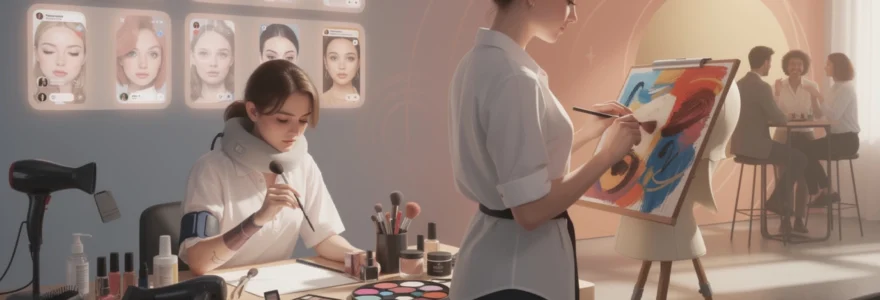
The beauty industry has entered an era of unprecedented exhaustion. From salon professionals performing back-to-back appointments to makeup artists scrolling through endless reference images at midnight, the relentless pace of contemporary beauty culture has created a perfect storm of creative depletion. Research indicates that over 67% of beauty professionals report experiencing symptoms of burnout within their first five years of practice, with many citing the pressure to constantly innovate whilst maintaining technical precision as a primary factor. This phenomenon extends beyond physical fatigue—it encompasses emotional drainage, creative stagnation, and a profound disconnection from the artistic passion that initially drew professionals to the field. The combination of algorithmic content demands, homogenised aesthetic trends, and client expectation management has transformed what was once a fulfilling creative practice into a source of chronic stress for many practitioners.
The transformation isn’t merely anecdotal. Industry data from 2023 revealed that beauty professional turnover rates reached 43%, with creative exhaustion cited as the second-most common reason for leaving the profession. As appointment books fill with requests for identical “Instagram-worthy” looks and social media algorithms demand constant content production, the space for authentic artistic exploration continues to shrink. This pressure affects not only established professionals but also emerging artists who enter the field with innovative visions only to find themselves trapped in repetitive execution of trending techniques.
Recognising the psychological and physical symptoms of beauty burnout
Understanding burnout requires recognising its multifaceted manifestations. Unlike simple tiredness that resolves with rest, genuine burnout creates persistent physical, emotional, and cognitive symptoms that compound over time. For beauty professionals, these symptoms often emerge gradually, making early identification challenging. You might notice decreased enthusiasm for techniques that once excited you, or find yourself mechanically executing services without the creative engagement that previously defined your work. Physical manifestations frequently include chronic headaches, disrupted sleep patterns, and unexplained muscle tension—particularly in the neck, shoulders, and hands from repetitive movements.
Psychological symptoms prove equally debilitating. Many professionals describe a pervasive sense of cynicism about their work, experiencing emotional detachment from clients and colleagues. The creative spark that once generated innovative colour combinations or unique styling approaches dims, replaced by reliance on formulaic techniques and safe choices. Decision fatigue becomes overwhelming; selecting between eyeshadow palettes or determining the optimal brow shape for a client’s face structure—tasks that once felt intuitive—now demand exhausting mental effort. Research from occupational health studies indicates that beauty professionals experiencing burnout show measurably decreased cognitive flexibility, directly impacting their ability to customise services and problem-solve technical challenges.
Compassion fatigue in salon professionals and makeup artists
Compassion fatigue represents a specific form of burnout affecting those in client-facing roles. Beauty professionals frequently serve as informal therapists, listening to clients’ personal struggles whilst maintaining focus on technical execution. This emotional labour, whilst often rewarding, accumulates over time. You may find yourself feeling emotionally numb during consultations, struggling to muster genuine enthusiasm for a client’s wedding preparations, or experiencing irritability when faced with routine requests. Studies examining emotional labour in service industries reveal that professionals who regularly manage others’ emotions whilst suppressing their own experience significantly higher rates of burnout and associated health issues.
The phenomenon intensifies when professionals feel unable to establish appropriate boundaries. Many beauty practitioners report difficulty saying no to last-minute appointments, extended service times, or emotionally demanding client interactions, fearing negative reviews or client loss. This boundary erosion creates a cycle where your energy reserves deplete faster than they can replenish, leading to progressive emotional exhaustion. The impact extends beyond the workplace, affecting personal relationships and overall life satisfaction.
Repetitive strain injury and chronic pain from beauty techniques
Physical burnout manifests distinctly in beauty professions through repetitive strain injuries and chronic pain conditions. Hairstylists commonly develop carpal tunnel syndrome, tendonitis, and lower back pain from prolonged standing and repetitive hand movements. Makeup artists experience neck strain from bending over clients and thumb joint issues from precise brush manipulation. Nail technicians face particularly high risks, with studies showing that 89% report hand, wrist, or shoulder pain directly related to their work. These physical symptoms don’t merely cause discomfort—they fundamentally limit your ability to perform at the level your artistic vision demands.
Over time, many professionals begin to normalise this discomfort as “just part of the job”, pushing through pain rather than addressing its root causes. Yet untreated repetitive strain injury can permanently restrict range of motion and fine motor control, directly undermining your capacity for detailed beauty work. Recognising physical symptoms as legitimate warning signs—rather than personal weakness—is a crucial step in addressing beauty burnout holistically. Early intervention through ergonomic adjustments, scheduled breaks, targeted strengthening exercises, and professional medical support can significantly reduce long-term damage. Protecting your body is not separate from protecting your creativity; it is the physical foundation that allows your artistic skill to flourish over the long term.
Creative block and loss of artistic vision in beauty work
Creative burnout in the beauty industry often appears as a subtle but persistent loss of artistic vision. Looks that once felt exciting start to feel repetitive, and you may notice yourself defaulting to the same safe combinations of tones, placements, or techniques regardless of the client in front of you. Instead of feeling energised by creative challenges—such as adapting a runway trend for a real-world event—you might experience anxiety, indecision, or complete mental blankness. This creative block can be especially distressing for beauty professionals who strongly identify as artists, as it can feel like losing a core part of your identity.
Neurologically, chronic stress and overwork reduce activity in the brain regions responsible for divergent thinking and imaginative problem-solving. In practical terms, this means fewer “what if we tried…” moments and more rigid, risk-averse choices. You may find it harder to visualise finished looks during consultations or struggle to translate your ideas onto a client’s face or hair. Left unaddressed, this can spiral into self-doubt and a shrinking creative range, where every booking feels like a test you’re failing rather than an opportunity to create. Recognising creative block as a symptom of burnout—not proof that you’re “not talented enough”—allows you to respond with compassion and strategy rather than self-criticism.
Social media exhaustion and algorithm-driven content pressure
For many beauty professionals, burnout doesn’t end when the salon door closes; it continues on-screen. Social media, once a place to share work and connect with peers, has evolved into a relentless performance space governed by opaque algorithms. You might feel compelled to film every service, chase viral sounds, and constantly produce “scroll-stopping” content just to maintain visibility. The result is a dual workload: the labour of doing the beauty work and the labour of packaging it into bite-sized, algorithm-friendly content.
This always-on pressure fuels a state of digital exhaustion. Doom-scrolling competitor feeds late at night, obsessively checking engagement metrics, and tweaking captions for maximum reach all drain cognitive resources that could otherwise feed your creativity. Over time, you may begin to create looks “for the grid” rather than for the client or for your own artistic satisfaction, which further disconnects you from your original passion. The irony is that the very platforms that helped many artists build careers can, if unmanaged, become major drivers of beauty burnout. Learning to set boundaries with social media is therefore not indulgent—it is a core part of sustaining a long-term creative practice.
Deconstructing the root causes of creative exhaustion in the beauty industry
Understanding why beauty burnout is so pervasive requires looking beyond individual resilience and examining systemic pressures. The modern beauty landscape is shaped by powerful cultural, technological, and economic forces that collectively narrow what is considered “beautiful” and how quickly professionals are expected to adapt. From the rise of hyper-curated Instagram feeds to the speed at which micro-trends explode and vanish on TikTok, beauty workers operate in an environment that rewards sameness and speed over experimentation and depth. This context makes creative exhaustion not a personal failing, but a predictable response to chronic external demands.
By deconstructing these root causes, you can begin to identify which pressures are truly non-negotiable and which are inherited assumptions you can challenge. Do all clients really need to leave looking like the same filter? Does every new product launch require a complete overhaul of your kit? Asking these questions allows you to reclaim pockets of autonomy within an industry that often feels rigid and unforgiving. When you see the system clearly, you can start to work with it strategically rather than being silently drained by it.
The instagram aesthetic trap and homogenised beauty standards
The “Instagram face” and its countless variations have created what many critics call a globalised aesthetic monoculture. Perfectly arched brows, overlined lips, sculpted cheekbones, and soft-glam eyes dominate feeds across cities and cultures. While technically impressive, this homogenisation can suffocate artistic exploration. You may find yourself reproducing nearly identical looks day after day, not because it reflects your creative vision, but because it photographs well and performs reliably online. Over time, this disconnect between your inner aesthetic impulses and outer output erodes your sense of artistic ownership.
This aesthetic trap also reinforces narrow beauty standards that marginalise non-conforming features, textures, and ages. Professionals who want to celebrate textured skin, natural freckles, hooded eyes, natural grey hair, or culturally specific beauty practices often feel pressure to “tone it down” for the feed. The creative exhaustion that follows is similar to speaking in someone else’s voice all day; it takes far more energy than expressing yourself authentically. Reclaiming inspiration often starts with consciously diversifying the faces, bodies, and styles you consume online, reminding your visual brain that beauty is far broader than what the algorithm typically rewards.
Client expectation management and the pinterest reference problem
Another major driver of beauty burnout is the “Pinterest reference problem”: clients arriving with heavily edited inspiration photos and expecting identical results. These images often feature different face shapes, hair densities, lighting setups, and even AI filters, making them technically impossible to replicate exactly. Yet professionals are frequently placed in the position of managing unrealistic expectations while still delivering a satisfying outcome. The emotional load of repeatedly negotiating this gap between fantasy and reality can be immense.
Over time, you may start to dread consultations, anticipating conflict or disappointment before the appointment even begins. You might also feel pressured to override your professional judgement to please clients, agreeing to techniques that are not ideal for their features, lifestyle, or budget. This not only risks client dissatisfaction later, but also undermines your sense of artistic integrity. Developing structured consultation processes—such as showing unfiltered before-and-after photos, explaining limitations in plain language, and offering multiple “realistic” options—can transform these conversations from draining battles into collaborative design sessions. When clients understand the creative why behind your recommendations, both parties are more likely to leave feeling empowered rather than exhausted.
Fast beauty trends versus sustainable creative practice
The beauty industry increasingly operates on a “fast fashion” model, where micro-trends flare up and fade away at dizzying speed. One month it’s latte makeup, the next it’s strawberry girl, vanilla chrome, or some newly coined aesthetic. Keeping up with each wave can feel like running on a treadmill that never slows down. You’re expected to master new techniques, buy trending products, and update your content strategy every few weeks simply to appear current. This constant adaptation pulls focus away from deeper skill-building and long-term creative development.
Sustainable creative practice, by contrast, is more like cultivating a garden than chasing fireworks. It involves developing a strong technical foundation, a clear personal style, and a set of guiding principles that can outlast viral hashtags. When your sense of creative identity is stable, trends become tools rather than tyrants—you can selectively incorporate what fits your vision and ignore what doesn’t. Recognising fast trends for what they are—short-lived surges of attention—allows you to reduce the pressure to participate in all of them. This shift alone can dramatically reduce creative exhaustion and restore a sense of control over your artistic direction.
Imposter syndrome and comparison culture in professional beauty communities
Comparison culture thrives in visual industries, and beauty is no exception. Constant exposure to polished portfolios, viral transformations, and perfectly lit videos can make even experienced professionals question their worth. Imposter syndrome often shows up as thoughts like “I’m not a real artist”, “Everyone else is more booked than me”, or “I’ll be exposed as a fraud if I raise my prices.” These beliefs are rarely grounded in reality, but they exert real emotional weight, especially when combined with algorithmic metrics like likes and views that seem to assign numerical value to your talent.
This psychological strain can quietly drain your creative energy. Instead of experimenting freely, you may play small, only posting “safe” work that you believe will perform well. You might overwork simple looks in pursuit of perfection or delay launching new services until they feel beyond criticism. Ironically, the more you compare yourself, the more disconnected you become from the unique perspective that could set you apart. Countering this requires intentionally curating your professional circles—both online and offline—to include peers who share process as well as polish, and who speak openly about mistakes, revisions, and learning curves. When you see that even your role models experience doubt, it becomes easier to treat your own imposter thoughts as passing weather rather than fixed truth.
Neuroplasticity techniques for reigniting creative passion
Recovering from beauty burnout is not just about resting; it’s about rewiring. Neuroplasticity—the brain’s ability to form new connections and pathways throughout life—means that creativity is not a fixed trait you either have or lose. It is a dynamic capacity that responds to your environment, habits, and attention. When your days are dominated by repetitive tasks, identical looks, and constant digital noise, your brain quite literally gets “stuck” in those patterns. To reignite creative passion, you need to intentionally introduce new stimuli and ways of working that signal to your nervous system that exploration is safe again.
Think of your creative mind like a muscle that has been overused in one narrow motion. Strengthening it requires both rest and fresh types of movement. Strategic exposure to new art forms, deliberate quiet, and carefully managed digital input can help you carve new neural pathways that support curiosity, play, and innovation. The goal is not to force inspiration, but to create the conditions where it can naturally re-emerge.
Cross-disciplinary inspiration from fine art and fashion archives
One powerful way to stimulate neuroplasticity is to step outside the echo chamber of beauty content and immerse yourself in other visual disciplines. Fine art, photography, costume design, and historical fashion archives offer colour stories, textures, shapes, and narratives that differ radically from the TikTok feed. Visiting a gallery, browsing museum collections online, or studying vintage runway shows can spark connections your brain has never made before. A 1970s editorial might inspire a new approach to blush placement; a Renaissance painting could influence your highlight and shadow mapping.
Instead of asking, “What’s trending this week?” you can ask, “What visual worlds am I drawn to, and how can I translate them into hair or makeup?” This shift in questioning engages deeper cognitive processes linked to imagination and synthesis. To make this practical, you might schedule a weekly “reference hour” dedicated to non-beauty images, saving anything that catches your eye into a private mood board. Over time, these cross-disciplinary influences will filter into your work, helping you develop a more distinctive style that feels rooted in rich visual tradition rather than fleeting trends.
Sensory deprivation and mindfulness practices for mental reset
While new inspiration is important, so is intentional emptiness. Constant stimulation—from bright ring lights to loud music and endless notifications—keeps your nervous system in a low-level fight-or-flight state. In this mode, your brain prioritises survival over experimentation, which is why creativity often feels out of reach when you are overstimulated. Brief periods of sensory deprivation and mindfulness can act like a system reboot, calming overactive stress circuits and reactivating the brain regions associated with insight and imaginative thinking.
This doesn’t require extreme silence tanks or long retreats. Small practices integrated into your daily routine can make a measurable difference. You might spend five minutes between clients sitting quietly with your eyes closed, focusing on your breath and noticing physical sensations without judgement. Or you could create a short end-of-day ritual—lights dimmed, phone in another room, a warm compress over your eyes—to signal to your body that it is safe to shift out of performance mode. Over time, these micro-moments teach your nervous system a new pattern: work, then reset, rather than work, then scroll. Like clearing clutter from a studio before starting a new painting, mental space gives fresh ideas somewhere to land.
Dopamine detox from beauty content and platform boundaries
Many beauty professionals unintentionally train their brains to crave rapid-fire dopamine hits from social media—new likes, new comments, new videos to consume. While this is understandable, it also makes sustained focus and deep creative work more difficult. A “dopamine detox” from beauty content doesn’t mean quitting platforms forever; it means intentionally reducing overstimulating input so your reward system can recalibrate. Think of it like resetting your palate after too many overly sweet desserts so you can taste subtle flavours again.
Practically, this could involve unfollowing or muting accounts that trigger comparison, setting app limits, or designating one or two days per week as “no scroll” days where you only open platforms to post scheduled content. You might also experiment with time-blocking: consuming beauty content only during a dedicated 20–30-minute window, and avoiding it entirely outside those boundaries. Many professionals find that within a few weeks of these adjustments, their urge to check their phone constantly decreases, and their attention span improves. Freed from the constant tug of the feed, your mind has more capacity to wander productively—a key ingredient in rekindling genuine inspiration.
Building a sustainable creative recovery framework
Recovery from beauty burnout is not a single breakthrough moment; it is a structured process. Without a framework, even the best intentions—taking a weekend off, buying new products for inspiration—can quickly dissolve under the weight of daily demands. A sustainable recovery plan addresses time, skills, and support systems, ensuring that you not only escape the immediate burnout cycle but also develop habits that protect your creativity long-term. Think of it as building scaffolding around your artistic practice so it can grow taller without collapsing under pressure.
This framework should be personalised, but several evidence-backed strategies consistently help beauty professionals rebuild. Adapting productivity tools to suit hands-on creative work, investing in targeted education, scheduling regular portfolio renewals, and cultivating strong peer networks all play a role. Taken together, these elements transform recovery from a vague hope into a concrete, manageable path forward.
The pomodoro technique adapted for beauty professionals
The classic Pomodoro technique—25 minutes of focused work followed by a 5-minute break—was designed for desk workers, but its principles can be adapted effectively for beauty environments. The core idea is to alternate periods of deep focus with intentional rest, reducing cognitive fatigue and preserving concentration across a full day. For a makeup artist or stylist, this might look like structuring your schedule so that back-to-back appointments are punctuated with short recovery windows. Even three to five minutes between clients can be used strategically to stretch, hydrate, rest your eyes, or reset your station mindfully rather than rushing.
You can also apply a Pomodoro-style approach to non-client tasks that often contribute to burnout, such as content creation or admin. For example, you might dedicate one 30-minute block to replying to messages, another to editing photos, and another to planning content, rather than task-switching constantly. This reduces the mental friction of juggling multiple responsibilities at once. Over time, you’ll likely notice that you end each day with more energy and fewer mistakes—not because you worked less, but because you worked with your brain’s natural rhythms rather than against them.
Skill diversification through advanced education and masterclasses
Burnout often thrives in environments where you feel stuck—repeating the same services, at the same price point, for the same type of client. Strategic skill diversification can interrupt this stagnation and reignite a sense of progress. Advanced education, whether through in-person masterclasses, accredited courses, or specialised online training, exposes you to new techniques, product knowledge, and creative philosophies. Learning from experts outside your usual circle can challenge your assumptions and expand your aesthetic vocabulary.
This doesn’t mean you must constantly chase new certifications. Instead, think in terms of intentional upgrades: which one or two skills, if developed deeply this year, would open the most creative and financial opportunities? Perhaps it’s editorial hair styling, corrective colour, SFX makeup, or working with mature and textured skin. As you integrate new competencies, you widen the scope of projects you can say yes to and reduce the monotony of your schedule. Importantly, education also reinforces a growth mindset—you are not “past your peak”; you are an artist in continuous evolution.
Establishing creative sabbaticals and portfolio refresh cycles
Many beauty professionals wait until they are on the brink of collapse to take significant time off, but planned creative sabbaticals can be far more effective and far less disruptive. A sabbatical doesn’t have to mean months away from work; it can be as small as one day per quarter dedicated solely to experimentation, test shoots, or mood boarding without client expectations. During this time, you can play with unconventional colour combinations, try editorial shapes, or revisit past looks with a fresh eye. The purpose is to reconnect with the part of your practice that exists beyond commercial demands.
Aligning these mini-sabbaticals with portfolio refresh cycles can keep your public-facing work aligned with your evolving vision. Set a recurring date—perhaps every 6 or 12 months—to review your website, social media, and printed materials. Ask yourself: does this still represent who I am as an artist? Which images no longer excite me? What kinds of clients do these visuals attract? Curating your portfolio intentionally not only strengthens your brand but also reinforces your creative identity to yourself. When your visible body of work reflects what you actually want to create, it becomes easier to stay inspired and say no to draining, misaligned projects.
Mentorship networks and peer collaboration models
Isolation amplifies burnout. Working alone in a studio, freelancing across locations, or even being the most senior artist in a team can leave you without peers who truly understand your challenges. Building or joining mentorship networks can provide both emotional support and practical guidance. A mentor who has navigated similar creative slumps or industry shifts can offer perspective that shortens your learning curve: what feels like a career-ending crisis to you may be a familiar, survivable phase to them. Likewise, mentoring emerging artists can reconnect you with the curiosity and excitement that first drew you into beauty work.
Peer collaboration—through styled shoots, education swaps, or joint projects—also functions as powerful burnout prevention. Instead of viewing other professionals solely as competitors, you can see them as co-creators. Sharing techniques, trading feedback, and co-designing concepts can reintroduce play and experimentation into your practice. Even informal models, such as monthly meet-ups or online group chats focused on honest discussions (not just highlight reels), can make a measurable difference. When you feel part of a supportive ecosystem rather than a lone performer on a crowded stage, the weight of beauty burnout becomes easier to carry—and easier to heal.
Leveraging emerging beauty movements for fresh perspective
While some aspects of contemporary beauty culture contribute to burnout, emerging movements within the industry also offer powerful antidotes. Shifts towards skin acceptance, slow beauty, gender-inclusive aesthetics, and culturally rooted practices invite professionals to rethink what beauty can look like and who it is for. Engaging with these movements can feel like opening a window in a stuffy room; suddenly there is more space to breathe, experiment, and align your work with your values.
For example, the rise of minimal, “skin-first” looks can inspire you to explore texture, light, and subtle colour rather than heavy transformation on every client. Inclusive beauty conversations may prompt you to deepen your skills with a wider range of skin tones, hair types, ages, and gender expressions—expanding both your creative horizons and your client base. Slow beauty philosophies encourage longer appointment times, richer consultations, and more intentional product choices, which can transform rushed, transactional services into collaborative experiences. By selectively aligning with these movements, you can position yourself not just as a trend follower, but as a thoughtful participant in the evolving future of beauty.
Implementing long-term prevention strategies against future burnout
Once you’ve begun to recover from beauty burnout, the next challenge is preventing a relapse. Long-term sustainability requires embedding protective habits into the very structure of your career, rather than treating self-care as an occasional fix. This might involve setting firm boundaries on working hours, capping the number of daily appointments, or defining clear criteria for which projects you accept. It can also mean regularly reviewing your pricing to ensure your rates reflect the true time, expertise, and emotional labour you invest, reducing the pressure to overbook just to stay afloat.
On a psychological level, cultivating ongoing reflective practices—such as journaling about challenging appointments, tracking energy levels across different services, or conducting quarterly check-ins with yourself—helps you catch early warning signs before they escalate. Are you dreading a certain type of booking? Feeling increasingly resentful towards social media? Experiencing more physical pain than usual? These signals are invitations to adjust, not accusations of failure. Ultimately, protecting your inspiration is not a one-time task but an ongoing commitment. When you treat your creative energy as a non-renewable resource that deserves careful stewardship, you give yourself permission to build a beauty career that is not only aesthetically impactful, but also emotionally and physically sustainable for years to come.