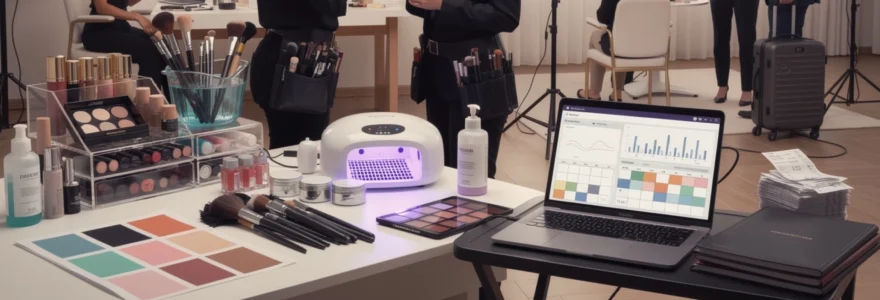
The world of freelance makeup artistry demands precision, creativity, and exceptional organisational skills. Behind every flawless look lies meticulous preparation, advanced technical expertise, and the ability to adapt seamlessly across diverse environments. From dawn preparations to evening wrap-ups, professional makeup artists navigate a complex landscape of client expectations, technical challenges, and business operations. The journey requires mastery of colour theory, skin analysis techniques, and product knowledge whilst maintaining the highest standards of hygiene and professionalism. Success in this competitive field depends on continuous learning, strategic networking, and the development of robust systems for managing both creative work and business administration.
Pre-dawn preparation rituals and kit organisation
The day of a professional makeup artist begins long before clients arrive, often starting at 4:30 AM for early morning shoots or events. This pre-dawn period is crucial for ensuring every tool, product, and surface meets professional standards. The ritual begins with a comprehensive review of the day’s schedule, client notes, and specific requirements for each booking. Understanding whether the day involves a bridal party, editorial shoot, or commercial campaign determines the exact preparation protocol required.
Temperature and humidity checks follow immediately after schedule review. Environmental conditions significantly impact product performance, particularly foundations and setting sprays. Artists must adjust their kit accordingly, selecting products that perform optimally in the day’s expected conditions. This might mean switching from cream-based products to powder formulations in humid conditions, or ensuring adequate setting products are available for outdoor shoots.
Professional makeup kit sanitisation using barbicide and UV sterilisers
Sanitisation represents the cornerstone of professional makeup practice. Every metal tool undergoes immersion in Barbicide solution for a minimum of 10 minutes, following EPA-approved guidelines for hospital-grade disinfection. This includes tweezers, scissors, metal spatulas, and eyelash curlers. The blue solution’s concentration must be maintained at precise levels – typically one ounce of concentrate per 16 ounces of water – to ensure effective pathogen elimination.
UV sterilising chambers complement chemical disinfection for brushes and sponges that cannot withstand liquid immersion. Professional-grade UV-C light at 254 nanometers wavelength provides germicidal action, with exposure times varying from 15 to 30 minutes depending on item density. Synthetic brushes tolerate UV exposure better than natural bristles, which may require alternative sanitisation methods to preserve their structure and performance characteristics.
Brush maintenance protocols with cinema secrets and master’s brush cleaner
Daily brush maintenance extends far beyond basic cleaning, encompassing conditioning and shape preservation techniques that ensure consistent performance. Cinema Secrets Professional Brush Cleaner offers rapid sanitisation between clients, with its alcohol-based formula evaporating quickly whilst dissolving makeup residue effectively. The technique involves gentle agitation in the cleaner, followed by wiping on clean tissue until no colour transfers.
Deep conditioning treatments using Master’s Brush Cleaner occur weekly or after particularly demanding assignments. Natural bristle brushes benefit from this soap-based formula that removes product buildup whilst maintaining bristle integrity. The process requires lukewarm water, gentle circular motions in the palm, and careful reshaping whilst damp. Proper drying technique involves laying brushes flat on a towel with bristles extending beyond the edge, preventing water damage to ferrules.
Product inventory management for Multi-Client bookings
Effective inventory management becomes critical when serving multiple clients in a single day. Professional artists maintain detailed logs of product usage, tracking consumption rates to anticipate restocking needs. Foundation shades require particular attention, as running out of a specific match mid-application can derail an entire session. Smart inventory systems include backup products for high-usage items and alternative options for unexpected shade requirements.
Expiration date monitoring forms an essential component of inventory management. Mascara and liquid eyeliners require replacement every three months, whilst powder products may last 18-24 months when stored properly. Professional artists maintain spreadsheets or use specialised apps to track purchase dates and replacement schedules, ensuring client safety whilst maintaining product performance standards.
Travel case configuration for On-Location assignments
Location work demands strategic packing that balances comprehensiveness with portability. Professional rolling cases with custom
compartments allow artists to separate complexion, eye, lip, and special-effects products, reducing setup time on location. Lightweight chairs, collapsible lighting, and compact tables may be added depending on the nature of the assignment. A well-configured travel case functions like a mobile studio, enabling consistent quality whether you are working in a hotel room, backstage, or on an outdoor set hundreds of kilometres from home.
Weight distribution is carefully considered to protect the artist’s body over years of freelance makeup work. Heavier items such as palettes and liquids sit at the base of the case, with frequently accessed tools positioned at the top or in outer pockets. Cable ties, small pouches, and labelled bags prevent products from shifting during transit. Over time, most freelance makeup artists develop several pre-packed configurations—bridal, editorial, commercial—so they can switch cases quickly based on the day’s bookings.
Client consultation and skin analysis techniques
Once on site, the focus shifts from preparation to personal interaction. A structured client consultation sets the tone for the session and ensures that the final look aligns with expectations and technical requirements. Professional freelance makeup artists begin with open-ended questions about the client’s preferences, comfort levels, and past experiences with makeup. This is followed by a systematic skin analysis, covering skin type, sensitivities, and any current treatments or medications that may affect product choice.
In a freelance context, time is often limited, but rushing this stage can lead to mis-matched foundations, irritation, or an unsuitable finish under professional lighting. Efficient artists learn to conduct a thorough assessment in just a few minutes, seamlessly integrating conversation with observation. They read subtle cues—such as how confident a client appears wearing bold colour—to decide whether to push creative boundaries or keep the look more classic.
Fitzpatrick scale assessment for foundation matching
The Fitzpatrick scale provides a scientific framework for understanding how skin responds to UV exposure, but it is also a valuable reference for foundation matching. Freelance makeup artists quickly determine whether a client falls into types I–VI by asking how easily they burn or tan. This information helps predict how the skin may appear under natural light and how much warmth is needed in the base to avoid an ashy or sallow effect.
For example, clients who rate as Fitzpatrick type IV–VI often require foundations with richer, golden or red undertones to preserve dimension in photography. Those in types I–II may need careful balancing to avoid over-warming the skin, particularly under cool studio lights. By combining Fitzpatrick assessment with visual observation, artists can narrow down their selection and spend less time testing multiple shades on the jawline.
Undertone identification using MAC and bobbi brown colour theory
Accurate undertone identification remains one of the defining skills of a professional makeup artist. Brands like MAC and Bobbi Brown have developed clear undertone systems—NC/NW for MAC, and warm/cool/neutrals for Bobbi Brown—that many freelancers use as a shared language. Artists observe the colour of veins, natural lip tone, and how the skin reacts to pure white versus cream fabric to determine whether the client leans warm, cool, or neutral.
Once the undertone is established, products are pulled accordingly: MAC NC shades for yellow-golden complexions, Bobbi Brown warm ranges for olive or golden skin, and cooler ranges for pink or rosy undertones. Think of undertone like the key of a song; if you choose the wrong key, every note feels slightly off. Matching undertone correctly ensures that blush, bronzer, and lipstick all sit harmoniously on the face, especially under high-resolution cameras.
Skin condition evaluation for product selection
Beyond tone, the condition of the skin dictates which formulas and techniques will yield a long-wearing, comfortable result. Freelance makeup artists visually assess texture, pore size, dehydration lines, and active breakouts while asking about skincare routines and known sensitivities. Oily, acne-prone skin might call for oil-free, non-comedogenic foundations and silicone-based primers, while dehydrated or mature skin benefits from hydrating primers and light-reflecting bases.
Choosing the wrong product for the skin condition can be like painting on damp paper—nothing adheres properly, and the finish deteriorates quickly. Artists therefore keep multiple formulations of similar shades: matte, satin, and luminous options ready to customise for each client. Spot treatments, colour correctors, and targeted powders allow them to balance problem areas without overloading the entire face with product.
Photography lighting considerations for editorial shoots
When working on editorial or commercial campaigns, freelance makeup artists must think like both a painter and a lighting technician. The same makeup look can appear dramatically different under soft daylight, harsh direct sun, tungsten, or LED panels. During the consultation, artists ask about the lighting setup: Will the shoot be predominantly natural light, studio flash, or continuous video lighting? Will gels or coloured backgrounds be used that might reflect onto the skin?
High-definition cameras and 4K video demand meticulous blending and strategic placement of highlight and contour. Under strong flash, shimmer particles can either create a refined glow or appear as harsh hotspots. To manage this, artists often test the makeup through the lens—taking a quick phone photo under similar lighting—to see how the base translates. Adjustments in powder intensity, bronzer warmth, and under-eye brightness are then made before the client steps in front of the camera.
Advanced application methods for commercial bookings
Commercial bookings—such as advertising campaigns, TVCs, and corporate shoots—demand efficiency, consistency, and technical finesse. Freelance makeup artists often work within strict timeframes while maintaining continuity across multiple scenes and lighting setups. Advanced techniques include airbrush foundation for a seamless, long-wearing base, strategic colour correction to minimise post-production retouching, and precise product layering to withstand long shooting days under hot lights.
Airbrushing, for example, allows ultra-thin layers of pigment to build coverage without texture, ideal for close-up product shots and 4K video. Artists pre-mix foundation shades in the cup to match both undertone and depth, then apply in circular motions to avoid patchiness. Cream products are frequently used under powders to create dimension that reads well on camera, while waterproof formulas ensure durability in outdoor or high-humidity environments. In many ways, commercial application is like building a set: each layer has a structural purpose, not just an aesthetic one.
Continuity is paramount on commercial jobs, as scenes are rarely shot in chronological order. Professional makeup artists keep detailed face charts and continuity photos from multiple angles, noting specific products, brush types, and application techniques. This documentation ensures the look can be replicated exactly days or weeks later, safeguarding the brand’s visual identity. When directors request sudden tweaks—perhaps a glossier lip or a softer brow—the artist must adapt quickly without compromising continuity across existing footage.
Professional networking at industry events and shoots
Beyond technical skills, a freelance makeup artist’s success often hinges on the strength of their professional network. Industry events, fashion weeks, beauty expos, and on-set days are all prime opportunities to build relationships with photographers, stylists, hair artists, and producers. Rather than aggressive self-promotion, effective networking feels more like building a collaborative circle: showing reliability on set, respecting call times, and contributing positively to the production environment.
On shoots, many freelance makeup artists arrive a few minutes early to introduce themselves to key team members and understand the creative direction. They exchange business cards or connect on professional platforms after the job, sharing selected portfolio images (with permission) that highlight their contribution. Over time, consistent performance leads to repeat bookings and referrals. Think of each job as an audition not just for the current client, but for every professional watching how you work.
Industry events and masterclasses also serve as networking hubs. Attending brand launches, trade shows, or panel discussions allows artists to stay abreast of product innovations while meeting decision-makers face-to-face. A simple, well-prepared introduction—who you are, what kind of makeup work you specialise in, and where your portfolio can be viewed—often opens doors to future collaborations. For freelancers, your network effectively becomes your sales team; the stronger it is, the more stable your booking calendar becomes.
Financial management and invoice processing systems
Behind the scenes of every polished makeup look lies a structured financial system keeping the freelance business sustainable. Professional makeup artists manage quoting, invoicing, expenses, and tax obligations with the same diligence they apply to hygiene and product organisation. Without clear processes, even a fully booked calendar can translate into inconsistent cash flow and financial stress.
Most established freelancers develop standard rate cards for different services—bridal, editorial, commercial day rates—and adjust for travel, overtime, and usage rights. Written agreements or booking confirmations outline the scope of work, rates, and payment terms before the job begins, preventing misunderstandings later. By treating makeup artistry as both a creative pursuit and a business, artists protect their income and reputation while building long-term stability.
Quickbooks integration for freelance beauty professionals
Digital accounting platforms such as QuickBooks have become essential tools for freelance makeup artists who want to streamline their financial management. By integrating bank accounts and payment gateways, artists can automatically track income and categorize expenses like product purchases, travel, and education. Invoices can be generated directly from the system, branded with the artist’s logo, and sent to clients within minutes of completing a job.
Using cloud-based software also simplifies tax time. Income reports, expense summaries, and GST/VAT data can be exported for accountants without manual spreadsheet work. For busy freelancers juggling back-to-back bookings, automation is akin to having a part-time financial assistant. The more you systemise these processes, the more mental space you retain for creative thinking and client care.
Client retainer agreements and payment terms
As freelance makeup artists grow their client base, retainer agreements can provide much-needed income stability. Regular clients—such as production companies, agencies, or corporate brands—may secure a set number of days or hours per month in exchange for priority booking and agreed rates. These retainers are formalised through contracts that outline deliverables, cancellation policies, and payment schedules.
Clear payment terms are non-negotiable in a sustainable freelance business. Many artists require a non-refundable booking fee for bridal or special event work, with the balance due before or on the day of service. Commercial clients might operate on 14–30 day payment terms, which should be stated on the invoice. Late payment clauses, while rarely enforced aggressively, signal professionalism and encourage timely settlement. By setting expectations upfront, you reduce awkward conversations later and protect your cash flow when workloads are high.
Equipment depreciation tracking for tax purposes
Makeup kits, lights, camera equipment, chairs, and travel cases represent significant investments that gradually wear out over time. From a financial perspective, these assets can often be depreciated, reducing taxable income for freelance makeup artists. Tracking the purchase date, cost, and expected lifespan of each major item enables accurate depreciation calculations in collaboration with an accountant.
Think of depreciation tracking like monitoring the shelf life of your products—but for your equipment. When you know approximately when a key light or airbrush compressor will need replacing, you can budget ahead rather than facing sudden large expenses. Detailed records also prove invaluable if you ever need to make an insurance claim for lost or damaged kit during travel or on set.
Continuous education through masterclasses and trade shows
In a fast-evolving beauty landscape, continuous education separates thriving freelance makeup artists from those who struggle to keep up. New product formulations, application tools, and trends emerge every season, driven by social media, celebrity culture, and advances in cosmetic science. Attending masterclasses, trade shows, and brand trainings allows artists to refine technique, discover time-saving methods, and experiment with emerging textures and finishes.
Many professionals schedule at least one major educational event annually—such as an international makeup trade show or a specialised SFX course—alongside smaller online workshops throughout the year. These learning experiences are not just about copying trends; they provide insight into why certain techniques work on camera, how to adapt runway concepts for real clients, and how to manage increasingly diverse skin tones and textures. Education, in this context, becomes an ongoing investment in both artistic evolution and commercial relevance.
Trade shows also double as research and networking labs. Artists can test new foundations, compare brush fibres, and evaluate kit-friendly packaging options side by side. Conversations with product developers and educators often reveal advanced usage tips that never appear on consumer marketing materials. Just as a musician continues to practice scales regardless of experience level, successful makeup artists commit to regular skill refreshers. This ensures that when a client requests the latest trend or a director needs a specific technical effect, you are ready with both the knowledge and confidence to deliver.