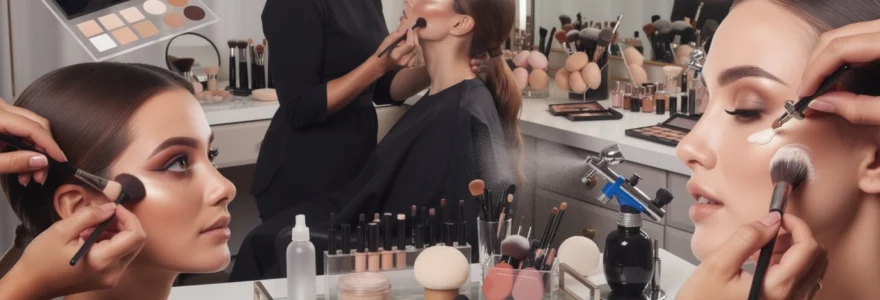
Professional makeup artists possess an arsenal of techniques that transform ordinary faces into camera-ready masterpieces. These industry veterans understand the intricate science behind colour theory, facial anatomy, and product chemistry in ways that elevate their artistry beyond basic application. Their expertise extends far beyond what typical tutorials might teach, encompassing sophisticated methods refined through years of working with diverse clients under demanding conditions.
The difference between amateur and professional makeup application lies in understanding these foundational principles that govern how products interact with skin, light, and photography. Professional artists have mastered the delicate balance between enhancing natural features and creating dramatic transformations, knowing precisely when to apply each technique for optimal results.
From backstage at fashion week to red carpet premieres, these beauty professionals rely on time-tested methods that ensure flawless results under any circumstance. Their secrets encompass everything from advanced colour matching protocols to strategic product layering sequences that maintain longevity and photogenic appeal throughout extended wear periods.
Colour theory application techniques used by celebrity makeup artists
Understanding colour theory forms the cornerstone of professional makeup artistry, distinguishing industry experts from casual enthusiasts. Celebrity makeup artists approach colour selection through scientific principles that consider undertones, skin temperature, and lighting conditions with mathematical precision.
Complementary colour matching for skin undertone enhancement
Professional artists identify undertones through multiple assessment methods rather than relying on surface-level observations. The most effective technique involves examining the veins on the inner wrist under natural daylight, where blue-green veins indicate cool undertones, whilst purple or blue veins suggest warm undertones. However, seasoned professionals understand that many clients possess neutral undertones, requiring a more nuanced approach to colour selection.
Artists utilise the concept of complementary colours to neutralise skin imperfections strategically. Orange-based correctors counteract blue-toned dark circles, whilst green correctors neutralise red blemishes or rosacea. This scientific approach ensures that foundation appears seamless rather than simply covering imperfections with additional product layers.
Pat McGrath’s strategic colour wheel implementation methods
Industry legends have developed systematic approaches to colour wheel application that transcend basic complementary pairings. Advanced practitioners employ triadic colour schemes for eyeshadow palettes, selecting three colours equally spaced on the colour wheel to create harmonious yet dynamic looks. This technique ensures visual interest whilst maintaining sophisticated balance.
The strategic placement of analogous colours creates seamless gradients that appear professionally blended even under high-definition photography. Artists apply this principle by selecting colours that sit adjacent on the colour wheel, creating natural transitions that enhance eye shape without appearing stark or artificial.
Advanced chromatic adaptation principles in editorial makeup
Editorial makeup artists understand how lighting conditions affect colour perception, adjusting their palette selections accordingly. Professional applications require consideration of metamerism—the phenomenon where colours appear different under various light sources. This knowledge proves essential when creating looks that must translate from studio lighting to outdoor photography.
Chromatic adaptation techniques involve selecting foundation shades that complement the intended lighting environment. Warm-toned foundations enhance golden hour photography, whilst cooler foundations provide optimal results under fluorescent studio lighting. This strategic approach ensures consistent colour accuracy across different shooting conditions.
Temperature-based foundation mixing protocols
Professional makeup artists rarely rely on single foundation shades, instead creating custom mixtures that perfectly match each client’s unique colouring. Temperature-based mixing involves combining warm and cool-toned foundations to achieve precise undertone matching. This technique requires understanding how different foundation formulations interact when blended.
The mixing protocol begins with identifying the dominant undertone, then adding small amounts of complementary temperatures to achieve neutrality. Artists maintain detailed records of successful combinations, creating personalised formulas for repeat clients. This systematic approach ensures consistent results whilst accommodating seasonal skin tone variations.
Professional contouring and highlighting methodology
Professional contouring transcends the basic light-and-shadow concepts popularised by social media tutorials. Industry professionals approach facial sculpting through anatomical
structure, mapping every highlight and contour to the underlying bones and muscle rather than copying a generic template. Instead of drawing harsh lines, they build subtle gradients that mimic the way natural light would fall on the face, resulting in dimension that looks believable both in person and on camera.
Mario dedivanovic’s three-dimensional facial mapping system
Mario Dedivanovic’s approach to contouring, often referenced in professional training, revolves around a three-dimensional mapping of the face. Rather than following social media diagrams, he analyses the individual’s bone structure, areas of natural shadow, and where light naturally hits. This allows him to design a sculpting plan that respects each client’s unique architecture.
In practice, this system starts with identifying four key zones: the hollow of the cheek, the perimeter of the forehead, the jawline, and the sides of the nose. Instead of drawing single harsh stripes, Dedivanovic prefers soft, diffused shapes that are gradually built up in thin layers. By thinking in 3D—imagining how the face will turn under different lighting—he avoids “flat” contour lines and creates a lifted, seamless effect.
Cream-to-powder layering sequence for photogenic results
One of the most reliable professional contouring secrets is the cream-to-powder layering sequence. Artists apply cream contour and highlight products first to create a flexible, skin-like base that can be easily blended. Only once the cream work is perfected do they lock everything in with finely milled powders that add structure and longevity without caking.
This layering technique mirrors traditional painting: broad strokes and shading with cream, followed by precise refinement with powder. You might, for instance, use a cream bronzer to warm and sculpt the face, then set only the areas prone to movement with a translucent powder before adding a powder contour just under the cheekbones. The result is a sculpted yet soft finish that reads beautifully in high-definition photography and lasts through long events.
Strategic light reflection point placement techniques
Highlighting in professional makeup artistry is less about adding glitter and more about directing attention. Experts place reflective products only where they want the eye to travel: typically the tops of the cheekbones, bridge (not tip) of the nose, brow bone, and cupid’s bow. They choose textures with micro-fine shimmer or pure sheen rather than chunky sparkle to avoid emphasising texture or pores.
Think of highlight as stage lighting for your face—too much and the illusion is broken, but targeted beams can instantly make you look more awake and lifted. Many celebrity artists will also add a whisper of cream highlight above the arch of the brow and at the centre of the chin, then diffuse with fingers to merge it seamlessly into the base. This creates a controlled glow that looks like healthy skin rather than makeup sitting on top.
Bone structure analysis for customised sculpting approaches
Before a single contour product touches the face, professionals perform a quick bone structure analysis. They observe the width of the forehead, prominence of the cheekbones, angle of the jaw, and length of the chin. This determines whether they should visually widen, shorten, soften, or sharpen specific areas. For example, a very angular jaw may require softer, more diffused shading, while a rounder face benefits from vertical, lifting contours.
A simple way to adopt this pro technique at home is to smile, relax, then tilt your head under a strong but soft light source. Notice where natural shadows and highlights already appear—your sculpting should echo, not fight, these areas. By respecting your own architecture instead of copying a trend, you’ll achieve customised sculpting that enhances rather than masks your features.
Advanced eyeshadow blending techniques from fashion week pros
Backstage at fashion week, eye looks must be created at speed but still withstand intense lighting, close-up photography, and long wear. Professional makeup artists rely on advanced eyeshadow blending techniques that prioritise gradient, placement, and texture control. Their goal is always the same: seamless transitions with no visible edges, regardless of how bold the colours may be.
Erin parsons’ gradient transition methods using synthetic brushes
Erin Parsons is known for her flawless eyeshadow gradients, often achieved with carefully chosen synthetic brushes. Unlike natural hair, synthetic bristles offer consistent tension and work exceptionally well with modern cream and liquid shadows that dominate editorial makeup. Parsons typically starts with a medium-sized, slightly tapered blending brush to lay down a soft wash of colour in the crease.
She then switches to smaller, more precise synthetic brushes to deepen the outer corner and refine the gradient. The secret lies in using progressively cleaner brushes as she moves upward toward the brow bone, almost like using “erasers” to soften any harsh edges. By controlling which brush touches which colour, she ensures that transitions between deep and light shades remain flawless, even under unforgiving HD lenses.
Windshield wiper motion application for seamless colour diffusion
The classic windshield wiper motion remains a backstage staple for a reason. When applied correctly, this simple back-and-forth movement helps distribute pigment evenly through the crease without patchiness. Professional artists keep the bristles mostly on the tip of the brush in contact with the skin, using light pressure so the colour floats on top rather than grinding into the lid.
To refine the blend, they combine this motion with small circular buffing actions at the outer corner, where depth typically needs the smoothest gradient. You can think of it like polishing glass: repeated, gentle strokes create clarity and smoothness. If lines appear harsh, pros reach for a clean, slightly larger brush dipped lightly in a skin-tone shadow to soften the edges without removing intensity from the main colour.
Layering opacity control through strategic product selection
Fashion week pros treat eyeshadow like layers of tinted film, choosing product types based on the level of opacity and control they need. Creams and pencils form the base, providing grip and saturation; pressed powders add blendable colour; loose pigments or metallic creams become the final, high-impact layer. This sequencing allows them to build intensity gradually rather than relying on a single, heavy application.
If you struggle with muddy eyeshadow, consider your product order. Start with a sheer cream base close to your skin tone to even out discolouration, then add mid-tone matte shades to sculpt the socket. Reserve your darkest shades for the lash line and outer V, where professionals often use a smaller brush and stippling motions instead of sweeping strokes. By treating opacity as something to be controlled in layers, you gain the same precision seen on runway models.
Cut crease precision techniques using concealer as base
A sharp cut crease may look intimidating, but artists simplify the process with a concealer-as-base method. After sketching the initial crease shape with a matte shadow, they load a flat, firm brush with a small amount of creamy concealer and “carve out” the mobile lid. The trick is to have the client look straight ahead and slightly down, so the artist can map the new crease line just above the natural fold, ensuring it shows when the eyes are open.
Instead of dragging the concealer in one long line, pros tap and press to maintain control and avoid lifting the underlying shadow. Once the cut shape is defined, they immediately set it with a light-toned eyeshadow or shimmer, locking in the crisp edge. Much like tracing and filling in a stencil, this technique relies on patience and precision rather than artistic flair, making it surprisingly attainable when broken into steps.
Skin preparation protocols for long-wearing professional results
Every professional makeup artist will tell you that flawless, long-wearing makeup begins with meticulous skin preparation. Under hot lights or during long events, base products can only perform as well as the canvas beneath them. That’s why pros approach skin prep like a mini facial, tailoring each step to the client’s skin type, condition, and the demands of the day.
The protocol usually follows a consistent order: cleanse, balance, treat, hydrate, then prime where necessary. For dry or dehydrated skin, they may incorporate hydrating sheet masks or water gel moisturisers loaded with humectants like hyaluronic acid and glycerin. For oily or combination skin, lightweight, mattifying lotions are focused on the T-zone, while the perimeter of the face still receives adequate moisture to prevent foundation from clinging to dry patches.
Texture management is another key part of professional prep. Gentle exfoliating toners or enzyme-based pads are used sparingly to smooth flaky areas, while calming gels and barrier creams are reserved for reactive or sensitised skin. Have you ever noticed your makeup breaking apart around your nose or chin? That often comes down to skipping this texture-refining step. By taking a few extra minutes to balance the skin’s surface, professionals drastically improve how base products apply and wear.
High-definition camera-ready makeup application standards
With 4K and even 8K cameras now standard in film, TV, and content creation, high-definition makeup application has become non-negotiable for professional artists. HD lenses capture every pore, line, and makeup edge, so techniques that looked acceptable in lower resolution can now appear heavy or obvious. To adapt, pros prioritise thin, flexible layers and diffusion over heavy coverage.
Instead of applying full-coverage foundation across the entire face, they practise “zonal” application—concentrating coverage only where it’s genuinely needed, such as around the nose, chin, and under the eyes. Sheer or skin-tint formulas are often used on the outer perimeter of the face to keep things looking natural. Concealer is applied strategically for targeted correction, following the same “strategic camouflage” approach many top artists advocate.
Texture control is equally critical. HD makeup avoids thick, overly luminous highlighters that can appear greasy on camera, as well as overly matte products that can translate as chalky. Instead, artists reach for semi-matte or satin finishes that mimic healthy skin under bright light. They also routinely check their work under different light sources and, increasingly, on camera monitors or phone screens to ensure the makeup reads well in real-world digital conditions.
Professional tool selection and maintenance strategies
Behind every flawless look is a carefully curated set of tools. Professional makeup artists choose brushes, sponges, and devices based on hair type, density, and intended use rather than simply following trends. For complexion work, dense synthetic brushes and high-quality sponges help press product into the skin for an undetectable finish. Fluffier, natural or synthetic-blend brushes are reserved for powders and diffused colour.
Maintenance is just as important as selection. Clean tools not only prevent breakouts and irritation but also ensure predictable product performance. Most professionals deep-clean brushes at least once a week using gentle soap or specialised cleansers, then spot-clean between clients with quick-drying solutions. Sponges are washed after every use, squeezed until the water runs clear, and replaced regularly to avoid harbouring bacteria.
Think of your tools like a chef thinks of knives: sharpened, sanitised instruments produce better, more precise work. A frayed blending brush or saturated sponge can sabotage even the best foundation or eyeshadow. By investing in a few high-quality tools and caring for them consistently, you dramatically elevate the overall standard of your makeup application.
Setting and longevity enhancement methods for all-day wear
To keep makeup intact from early call times to late-night events, professionals rely on strategic setting and longevity techniques rather than simply piling on powder. The first principle is to set only where necessary. Artists press a small amount of translucent powder into areas prone to shine or movement—typically the T-zone, smile lines, and under the eyes—using a puff or dense brush in a rolling motion to avoid disturbing the underlying base.
Layering is another pro secret for long-lasting makeup. Cream blush or bronzer is lightly set with a matching powder version, creating a “colour sandwich” that resists fading. Similarly, eyeliner pencils are often locked in with coordinating powder shadows, and lipstick is built in thin layers with blotting in between. Have you ever wondered why red carpet lips rarely feather? This multi-layered approach, combined with careful use of lip liner and a touch of translucent powder through a tissue, is the key.
Finally, setting sprays are used not as a last-minute fix, but integrated throughout the routine. Many artists mist the face after foundation, again after powder, and once more at the end to meld all layers together. The result is makeup that looks like real skin, moves comfortably, and withstands heat, humidity, and long hours—exactly what you’d expect from the insider beauty secrets professional makeup artists swear by.