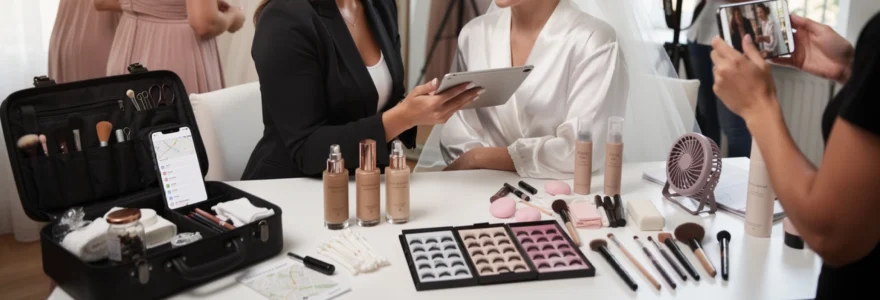
The bridal beauty industry represents one of the most emotionally charged, detail-oriented, and high-stakes segments of professional makeup artistry. When you book your first bridal client, you’re not simply scheduling another appointment—you’re accepting responsibility for someone’s most photographed day, their most scrutinized appearance, and quite possibly their most emotionally vulnerable moment. The weight of this responsibility transforms even the most confident makeup artist into a meticulous planner, researcher, and problem-solver. Those first bridal experiences shape your entire approach to wedding work, teaching lessons that textbooks and training courses simply cannot replicate. Understanding what separates a competent bridal artist from an exceptional one often comes down to learning from those initial challenging experiences, refining processes, and developing systems that protect both you and your client from preventable stress.
Pre-wedding consultation protocols for First-Time bridal bookings
The consultation phase establishes the foundation for everything that follows, yet many makeup artists underestimate its complexity when working with their first bridal client. This initial meeting serves multiple purposes beyond simply discussing eyeshadow preferences—it’s where you assess skin type, identify potential challenges, manage expectations, and begin building the trust that will carry you through the wedding day itself.
Establishing clear timelines and trial session expectations
First-time bridal clients often arrive at consultations with vague notions of when things should happen. They may not realize that booking should occur six to twelve months before the wedding date, or that trial sessions require their own dedicated time slots separate from the wedding day. Setting these expectations early prevents last-minute panic and ensures adequate preparation time. During your consultation, present a clear timeline that outlines when deposits are due, when the trial should be scheduled (ideally three to six months before the wedding), and when final confirmations need to happen. Many brides appreciate receiving this information in writing, as wedding planning involves managing dozens of vendors simultaneously. The trial session itself should be scheduled for approximately 90 minutes, allowing sufficient time to experiment with different looks, test product longevity, and photograph results in various lighting conditions.
Creating detailed bridal questionnaires beyond pinterest boards
While Pinterest boards provide valuable visual references, they represent only a fraction of the information you need to deliver exceptional results. Develop a comprehensive questionnaire that explores skin concerns, makeup sensitivities, daily makeup routines, specific features the bride wants enhanced or minimized, and her comfort level with various application techniques. Ask about the wedding’s formality level, time of day, season, indoor versus outdoor ceremony, and expected weather conditions. These contextual details significantly impact product selection and application approach. For instance, a summer outdoor wedding in humid conditions requires entirely different products than a winter indoor ceremony. Include questions about photography plans—will there be professional photographers, videographers, drone footage? Each capture method interacts differently with makeup application, particularly concerning flash photography and high-definition video.
Setting deposit structures and cancellation policy boundaries
Financial boundaries protect your business and demonstrate professionalism. First-time bridal bookings should require a non-refundable deposit of 30-50% to secure the date, with the remaining balance due two to four weeks before the wedding. This structure ensures commitment from both parties while providing you with financial security against last-minute cancellations. Your cancellation policy should clearly state that deposits are non-refundable regardless of circumstances, as you’re reserving your time exclusively for this client and potentially turning away other opportunities. Many artists also include provisions for rescheduling fees, travel cost adjustments if venue locations change, and additional charges for timeline modifications. Present these terms professionally during the consultation, provide them in writing, and require signed agreement before booking the trial session. This approach might feel uncomfortable initially, but establishing clear boundaries prevents misunderstandings and protects your business reputation.
Managing bridal party coordination and group booking logistics
Your first bridal client rarely comes alone—she typically brings bridesmaids, mothers, and sometimes flower girls who also need services. Managing group bookings introduces complexity that solo appointments don’t involve. During consultation, determine exactly how many people require services, what level of application each person wants (full makeup versus touch-ups), and whether anyone has special considerations like mature skin, acne
or rosacea. From there, you can reverse‑engineer a realistic schedule. Factor in your own pace – for many artists, 45–60 minutes per face for bridesmaids and 75–90 minutes for the bride is standard. Build in a 15-minute buffer every 2–3 faces to catch up if someone runs late or needs extra attention. If the party is large, decide early whether you’ll bring an assistant and add their rate and responsibilities to your proposal so there are no surprises. Clarifying these logistics at the consultation prevents the last‑minute chaos that often derails even the best-planned wedding timelines.
Product selection and kit preparation for long-wear bridal applications
One of the biggest lessons from a first bridal client is that your usual “night out” kit isn’t enough for a 12–16 hour wedding day. Bridal makeup needs to survive tears, hugs, kisses, sweat, and studio lighting, all while looking seamless in person and on camera. That means curating a bridal-focused kit: transfer-resistant base products, waterproof formulas, and reliable setting systems, plus a wide shade range to accommodate different skin tones in the bridal party. Think of it as building a small, mobile lab where every product has been stress-tested for longevity, comfort, and photography.
Investing in transfer-resistant foundations: estée lauder double wear vs. NARS natural radiant
When it comes to long-wear bridal foundations, two formulas consistently appear at the top of artist kits: Estée Lauder Double Wear and NARS Natural Radiant Longwear. Both are popular for a reason, but they perform differently under wedding-day pressure. Double Wear is like the bulletproof vest of foundation – ultra long-wearing, transfer-resistant, and highly buildable with a natural-matte finish. It’s ideal for hot climates, oily or combination skin, and outdoor summer ceremonies where shine and breakdown are major concerns. However, it can look flat or heavy if over-applied, especially on dry or mature skin, so sheer layers and a hydrating base are essential.
NARS Natural Radiant, on the other hand, offers full coverage with a more skin-like, luminous finish. It photographs beautifully, especially for brides who want that “bride glow” without looking greasy. While it’s long-wearing, it isn’t quite as indestructible as Double Wear in extreme humidity or on very oily skin, so you’ll need strategic powdering and a strong setting spray. A smart approach is to carry both: Double Wear for brides who prioritize longevity and oil control, and NARS for normal to dry skin types or indoor weddings where comfortable, radiant skin is the priority. Always test each formula on your bride during the trial, wear it on your own skin for a full day, and photograph it under natural light and flash to see how it truly performs.
Waterproof setting sprays: urban decay all nighter vs. ben nye final seal
If foundation is your anchor, setting spray is your insurance policy. Urban Decay All Nighter and Ben Nye Final Seal are both industry staples, but with distinct personalities. All Nighter is a flexible, comfortable long-wear spray that locks makeup in place without feeling tight or sticky. It works well across most skin types and is a safe “universal” choice, particularly for brides with normal to combination skin who want their makeup to last from ceremony to reception without feeling mask-like. It’s also less likely to irritate sensitive skin than more intense formulas.
Ben Nye Final Seal, by contrast, is an ultra-matte, almost theatrical setting spray known for its serious staying power and minty scent. It excels in situations where sweating is inevitable – hot outdoor ceremonies, destination weddings in tropical climates, or high-energy receptions where the bride will dance non-stop. The trade-off is that it can feel tight or drying on the skin and may be too intense for dry or reactive complexions. A balanced bridal strategy is to use Final Seal targeted on high-disruption areas (around the nose, forehead, upper lip) layered over a more comfortable spray like All Nighter applied all over. As with your foundations, always test both during the trial, especially if your client has a history of sensitivity.
Building a comprehensive bridal lash collection for different eye shapes
Lashes can make or break a bridal look, especially in close-up photos. Your first bridal client quickly teaches you that one lash style does not suit everyone; eye shape, lid space, and personal comfort all come into play. A comprehensive bridal lash collection should include: subtle half-lashes for natural looks or hooded eyes, medium-density wispy lashes for soft glam, and fuller but lightweight styles for brides who want drama without heaviness. Prioritize clear bands for brides who rarely wear lashes, as they tend to feel more comfortable and are more forgiving if the bride tears up.
Think of your lash selection like a wardrobe: you want basics, statement pieces, and in-betweens. Stock multiple lengths (8–14mm) and shapes (cat-eye, round, doll-like) so you can tailor the effect to the bride’s eye shape and liner style. For monolids or deep-set eyes, shorter, denser lashes often photograph better than long, spiky ones that can cast shadows. Always trial the lashes with your bride – many first-time lash wearers underestimate how different they will feel. Show her a “tiered” approach during the trial (natural, soft glam, full glam) so she can choose what feels appropriate for her comfort level and the overall wedding aesthetic.
On-location logistics and emergency kit management
Your first on-location bridal job is often where you realize makeup artistry is only half the job; the rest is logistics and problem-solving. Wedding days rarely run exactly to schedule, venues can be tricky to access, and bridal suites are often crowded and poorly lit. Developing systems for travel time, packing, and emergency preparedness is one of the key lessons that separates a stressed new artist from a calm, in-demand professional. Think of yourself as both artist and micro event-coordinator for your portion of the day.
Calculating accurate travel time buffers for wedding venues
Arriving late to a wedding booking is every artist’s worst nightmare, and it can permanently damage your reputation. To prevent this, you need a realistic travel-time strategy that goes beyond simply entering the address into your GPS. Always plan to arrive 30–45 minutes before your first scheduled appointment, factoring in traffic patterns, parking limitations, venue check-in, and the time it takes to unload and set up your kit. For rural venues or popular weekend destinations, double-check typical travel times for the specific day and time – a Saturday morning in the city can look very different from a weekday afternoon.
A practical system is to treat your arrival time like a flight departure: non-negotiable and always early. If your GPS says 45 minutes, plan for 70–75. For destination or unfamiliar locations, call the venue in advance to ask about parking, loading docks, elevators, and where vendors typically set up. If you’re coordinating multiple locations (for example, the bride at a hotel and the bridal party at a separate Airbnb), map out each leg with generous buffers in between. These small adjustments protect you when last-minute changes happen and give you mental space to focus on artistry instead of watching the clock in a panic.
Assembling a professional emergency kit beyond standard touch-up products
An emergency kit is your silent assistant on wedding days. Beyond your core makeup kit and touch-up products, you’ll need a curated selection of non-makeup essentials that can save the day when things go wrong (and they almost always do). Think stain removers, double-sided tape, tiny sewing kit, safety pins, blotting sheets, cotton buds, small scissors, and extra disposable wands. Add pain relievers, blister plasters, tissues, mints, deodorant wipes, and a phone charging cable. These aren’t strictly “makeup” items, but they position you as a trusted problem-solver who can calmly handle emergencies your bride didn’t anticipate.
From a business perspective, this emergency kit is a branding opportunity. You can mention it in your bridal brochure as part of your service – “full emergency kit on site for any last-minute mishaps” – which reassures anxious brides and differentiates you from artists who only bring a basic kit. Pack everything in a clearly labeled, easy-to-access bag so you can grab what you need in seconds. Over time, update the kit based on real experiences: if you once had to improvise a hair fix with lip balm and bobby pins, you’ll know to throw in clear hair elastics and a small styling product next time.
Navigating limited space and natural lighting challenges in bridal suites
Many first-time bridal artists assume they’ll have a large, well-lit space to work in, only to arrive to a dark hotel room packed with people, suitcases, and garment bags. Learning to manage tight spaces and poor lighting is essential. Whenever possible, request in advance that your set-up area be near a window with natural light, and let the bride know you’ll need a table or flat surface and a chair with a straight back. Pack a compact, daylight-balanced ring light or panel light for rooms where natural light isn’t available or is uneven. This simple tool can be the difference between a flawless complexion and one that looks patchy in photos.
In cramped spaces, efficiency is everything. Use a streamlined set-up: a folding table, brush belt, and a kit organized in clear pouches so you’re not rummaging through products while people weave around you. Be prepared to adapt to distractions, interruptions, and last-minute schedule shifts. Maintaining a calm, professional presence in these chaotic environments helps regulate the bride’s stress levels – and she will remember that. Over time, you’ll develop a mental checklist for every new venue: Where is the best light? Where can I plug in my light and chair? Where can I safely position products away from food, drinks, or curious flower girls?
Communication breakdown prevention with brides under emotional stress
Wedding days amplify emotions. Even the most laid-back clients can become overwhelmed by the pressure of timelines, family expectations, and the reality of such a big life transition. As a bridal makeup artist, you’re in intimate physical proximity to the bride at a highly emotional moment, which means you often become an unofficial therapist. Preventing communication breakdowns starts long before the wedding day itself: during the consultation and trial, you’re not just discussing eyeliner; you’re learning how your bride communicates under stress, what her non-negotiables are, and how she wants you to support her if things get intense.
One effective strategy is to establish a simple communication framework early on. Ask your bride questions like, “If you feel something isn’t right on the day – lashes, lip color, skin finish – how would you like to tell me?” This gives her permission to speak up and shows that you won’t take adjustments personally. During the trial, encourage honest feedback and frame tweaks as a normal part of the process. Remind her that you’d rather make three small changes at the chair than have her feel unhappy when she looks back at her photos. This pre-emptive reassurance dramatically reduces the chances of a meltdown later, when time and emotions are running high.
Your role isn’t just to apply makeup – it’s to create an environment where your bride feels safe, heard, and taken care of.
On the wedding day, read the room. Is your bride unusually quiet? Is she talking faster than usual? Is a family member increasing her anxiety? Adapt your energy to what she needs. Some brides want calm, almost spa-like silence; others want light conversation and reassurance. Use clear, gentle language: “I’m going to add a touch more coverage here,” or “We’ll do lashes next – if anything feels uncomfortable, tell me straight away.” If tension arises – for example, a relative questioning the makeup while you’re working – keep your focus on the bride and gently redirect: “Let’s see how you feel about it in the mirror first.” These small communication choices protect your professional boundaries while centering the client’s preferences and emotional well-being.
Photography-ready application techniques for digital and film capture
Bridal makeup is unique because it must perform in three dimensions at once: in real life, in digital images, and sometimes on film. What looks soft and subtle to the naked eye can disappear under strong lighting and high-resolution cameras, while heavy contouring that works for editorial shoots can look harsh in natural daylight. Your first bridal client with a professional photographer (and possibly a videographer) quickly teaches you that “Instagram glam” alone isn’t a reliable guide. You need to understand how different products and techniques interact with flash, lenses, and post-production editing to create truly photography-ready bridal makeup.
Understanding flash photography impact on foundation oxidation
Flash photography can expose foundation issues that aren’t visible under ambient lighting, including oxidation (darkening or color-shifting) and uneven texture. Some long-wear formulas, especially those with higher pigment loads, can oxidize slightly over the course of the day, shifting warmer or deeper on the skin. For brides, this can be problematic when photos capture them at different points throughout the event – ceremony, golden hour portraits, late-night dancing. To minimize surprises, always swatch and wear-test your chosen bridal foundations on yourself and, ideally, on models or friends with different undertones. Take flash photos after application and again several hours later to see how the shade evolves.
Foundation matching for weddings is a bit like predicting the weather: you’re not just matching the current moment, but planning for where the skin tone might be a few hours later (especially if your bride tans easily or has recently self-tanned). When in doubt, err on the slightly lighter, neutral side and use bronzer strategically to add warmth and dimension. This approach is more forgiving in flash photography and easier to adjust compared to a base that oxidizes too dark. Also, pay attention to how powder products sit on top of the foundation – heavy, talc-based powders can catch flash and emphasize texture, whereas finely milled, translucent powders tend to photograph more softly.
Contouring adjustments for professional wedding photographers vs. iphone cameras
Contouring for real life and contouring for the camera are related but not identical skills. iPhone cameras and social media filters often flatten features, which tempts many artists to over-contour to compensate. However, professional wedding photographers use high-quality lenses, controlled lighting, and editing, which all pick up more detail. Overly sharp or heavily cool-toned contour can translate as harsh lines or muddy patches in high-resolution images, especially in daylight or when the bride turns her head. The goal for bridal contour is to create subtle, believable dimension that enhances bone structure without announcing itself.
A good rule of thumb is to contour one step softer than you think you need for social media. Use creams or finely milled powders in neutral-warm tones, applied in sheer layers and blended thoroughly, focusing on areas where natural shadows already exist – under the cheekbones, around the temples, and lightly along the jawline. Then, do a quick test: take a photo in natural light on your phone and zoom in, and another under indoor lighting with and without flash. Ask yourself, “Does this still look like skin, or like makeup sitting on top of skin?” Remember that the photographer will also be shaping the face with lighting; your contour should be a supporting actor, not the main character.
Avoiding SPF flashback in close-up bridal portraits
SPF flashback – that unwanted white cast in photos – is a common fear among bridal artists, especially with HD cameras and night-time receptions that rely heavily on flash. The main culprits are certain physical sunscreens (zinc oxide, titanium dioxide) and high-SPF products with reflective particles. While not all SPF causes flashback, playing it safe on the wedding day is wise, particularly for evening ceremonies or indoor receptions. One approach is to have your bride apply a non-whitening, flash-friendly SPF as part of her skincare earlier in the day, allowing it to fully absorb before makeup. You can then use a foundation and concealer without SPF or with very low SPF, which dramatically reduces the risk of flashback.
As you build your bridal kit, test your preferred base products with and without flash on different skin tones. Some powders marketed as “HD” or “translucent” can still create a white cast if over-applied, especially under the eyes. Apply powders sparingly, pressing them into the skin rather than dusting thick layers over the face. When in doubt, do a quick flash test after the base is finished – it takes seconds, and it can save you from a disappointed email weeks later when the gallery arrives. Communicate this with your bride as well; explaining why you avoid certain SPF products close to the event helps her understand that you’re thinking long-term about her photos, not just the immediate finish in the mirror.
Post-wedding client retention and referral generation strategies
The bridal service doesn’t end when you pack up your kit and leave the venue. Your first wedding client is also a powerful marketing asset – a satisfied bride can become a repeat client for future events and a vocal advocate for your services. In many markets, referrals are one of the strongest drivers of new bookings, with word-of-mouth and social proof often outweighing paid advertising. Turning a one-time bridal booking into a long-term relationship starts with how you follow up after the wedding and how you position yourself as an ongoing beauty resource, not just a one-day service provider.
Within a week or two of the wedding, send a brief, personalized follow-up message. Congratulate the couple again, thank the bride for trusting you on such an important day, and ask if everything wore as expected. This is also a good moment to gently request a review on your preferred platform or a short testimonial you can feature in your portfolio. If you know the photographer’s name, ask the bride if she’s comfortable connecting you so you can access a few professional images (with proper credit) for your website and social media. Beautiful, real-wedding photos are invaluable for attracting future bridal clients who want to see proven, photography-ready work.
To encourage client retention, think beyond weddings. Offer returning-client rates for special occasions such as anniversaries, maternity shoots, professional headshots, or holiday parties. You might create a simple “bridal alum” email list where you share occasional beauty tips, product recommendations, or early access to seasonal booking slots. Keep it light and value-driven – the goal is to stay present in her mind without overwhelming her inbox. Over time, you’ll likely find that brides refer sisters, friends, and colleagues, especially if they felt truly cared for and supported throughout the process. In a field as personal and emotionally charged as bridal makeup, that sense of care is often the deciding factor between a one-time booking and a steady stream of referrals.